St Katharine's & Wapping in Tower Hamlets in Greater London, England, United Kingdom — Northwestern Europe (the British Isles)
Gateway to the Sea
Discover the Fortress story
Photographed by Ian Lefkowitz, September 11, 2026
1. Gateway to the Sea Marker

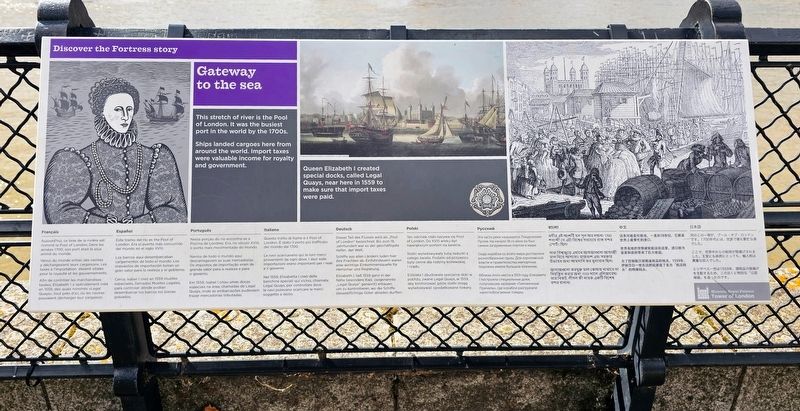
Gateway to the Sea
This stretch of river is the Pool of London. It was the busiest port in the world by the 1700s. Ships landed cargoes here from around the world. Import taxes were valuable income for royalty and government.
Queen Elizabeth I created special docks, called Legal Quays, near here in 1559 to make sure that import taxes were paid.
Aujourd’hui, ce bras de la rivière est nommé la Pool of London. Dans les années 1700, son port était le plus animé du monde.
Venus du monde entier, des navires y déchargeaient leur cargaison. Les taxes à l’importation étaient vitales pour la royauté et les gouvernements.
Afin de contrôler les marchandises taxées, Élisabeth I a spécialement créé en 1559, des quais nommés «Legal Quays», tout près d’ici, où les navires pouvaient décharger leur cargaison.
Este tramo del río es the Pool of London. Era el puerto más concurrido del mundo en el siglo XVII.
Los barcos aquí desembarcaban cargamentos de todo el mundo. Los impuestos de importación tenían un gran valor para la realeza y el gobierno.
Cerca, Isabel I creó en 1559 unos muelles
this page online
Nesta porção do rio encontra-se a Piscina de Londres. Era, no século XVIII, o porto mais movimentado do mundo.
Navios de todo o mundo aqui descarregavam as suas mercadorias. Os impostos de importação eram de grande valor para a realeza e para o governo.
Em 1559, Isabel I criou umas docas especiais de iras, chamadas Legal Quays, onde as embarcações pudessem trazer mercadorias tributadas.
Questo tratto di fiume è il Pool of London. È stato il porto più trafficato del mondo dal 1700.
Le navi scaricavano qui le loro merci provenienti da ogni dove. I dazi sulle importazioni erano introiti per i reali e il governo.
Nel 1559, Elisabetta I creò delle banchine speciali qui vicino, chiamate Legal Quays, per controllare dove le navi potevano scaricare le merci soggette a dazio.
Dieser Teil des Flusses wird “Pool of London” bezeichnet. Bis zum 18. Jahrhundert war es der geschäftigste Hafen der Welt.
Schiffe aus allen Ländern luden hier ihre Frachten ab. Einfuhrsteuern waren eine wichtige Einkommensquelle
Photographed by Ian Lefkowitz, September 11, 2026
2. Gateway to the Sea Marker
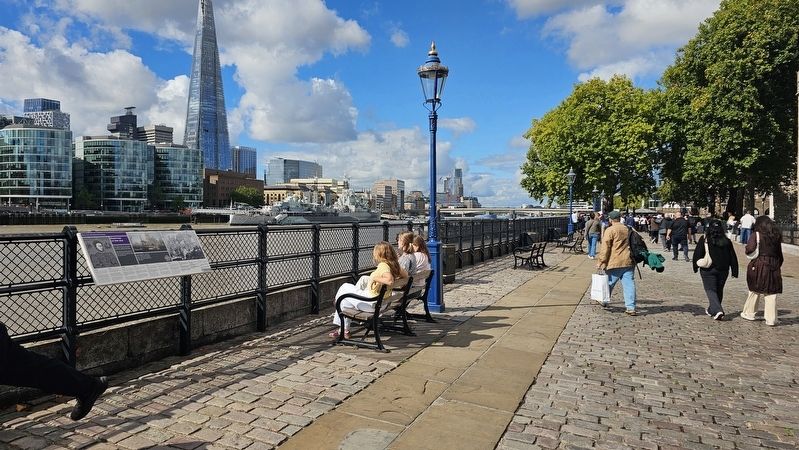
The marker is located on the Tower Wharf, overlooking the River Thames and South London.
Elizabeth I. ließ 1559 ganz in der Nähe besondere Kais, die sogenannten “Legal Quays” genannt, erbauen, um zu kontrollieren, wo die Schiffe steuerpflichtige Güter abladen durften.
Ten odcinek rzeki nazywa się Pool of London. Do XVIII wieku był największym portem na świecie.
Statki wyładowywały tutaj ładunki z całego świata. Podatki od przywozu były cenne dla rodziny królewskiej i rządu.
Elżbieta I zbudowała specjalne w pobliżu, zwane Legal Quays, w 1559, aby kontrolować, gdzie statki mogą wyładowywać opodatkowane towary.
Эта часть реки называется Лондонским Пулом. На начало 18-го века он был самым загруженным
Photographed by Ian Lefkowitz, September 11, 2026
3. The Pool of London
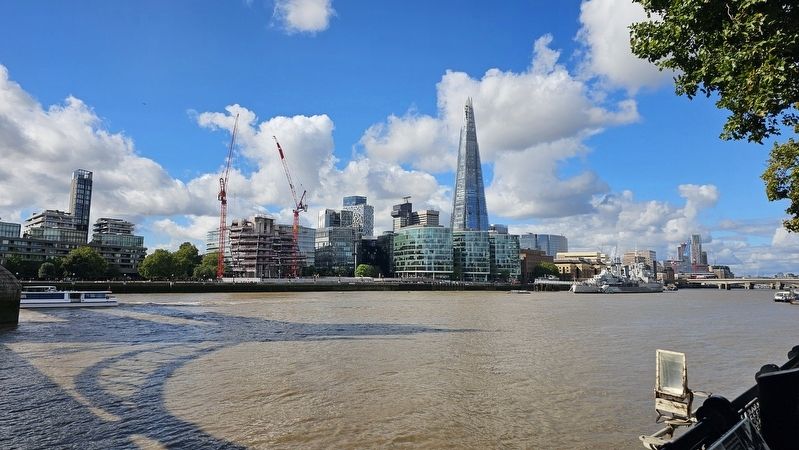
This section of the River Thames has as its moniker 'The Pool of London.'
Сюда корабли со всего мира доставляли разнообразные грузы. Для королевской власти и правительства импортные пошлины имели большое значение.
Вблизи этого места в 1559 году Елизавета I построила специальные доки, получившие название «Таможенные Причалы», где корабли разгружали налогооблагаемые товары.
নদীর এই অংশটি হল পুল অব লন্ডন। 1700 শতাব্দী তে এটা বিশ্বের সবচেয়ে ব্যস্ত বন্দর (পোর্ট) ছিল।
সারা বিশ্বজুড়ে এখানে জাহাজেলো জাহাজী মাল নিয়ে আসতো। রাজবংশ এবং সরকার উভয়ের জন্য আমদানি কর মূল্যবান ছিল।
জাহাজেলো করযুক্ত মাল কোথায় নামাবে তা নিয়ন্ত্রিত করার জন্য 1559 সালে এলিজাবেথ তার নিকট, লীগল কী নামক একটি বিশেষ বন্দর বানান।
这条河就是伦敦池,一直到18世纪,它都是世界上最繁忙的港口。
世界各地的货物被轮船运到这里,进口税为皇室和政府带来了巨大收益。
为了控制船只卸载课税品的地点,1559年,伊丽莎白一世在这附近建造了名为“执法码头”的特殊码头。
河のこの一帯が、プール・オブ・ロンドンです。1700年代には、世界でもっとも繁忙な港でした。
ここで、世界中からの船荷が陸揚げされました。王室にも政府にとっても、輸入税は貴重な収入でした。
エリザベス一世は1559年、課税品の陸揚げを支配するため、この近くに特別な“公認埠頭”を造ったのです。
Erected by Historic Royal Palaces.
Topics. This historical marker is listed in this topic list: Waterways & Vessels. A significant historical year for this entry is 1559.
Location. 51° 30.431′ N, 0° 4.595′ W. Marker is in Tower Hamlets, England, in Greater London. It is in St Katharine's & Wapping. It can be reached from the intersection of Tower Bridge Approach and Tower Hill, on the left when traveling north. Touch for map. Marker is in this post office area: Tower Hamlets, England EC3N 4DT, United Kingdom. Touch for directions.

Regionally, this marker is in London and in the Greater South East. Globally, it is on the Atlantic Ocean, in the North Atlantic Region, in Europe, in Atlantic Europe, on one of the British Isles, in the Western World, and in the Anglosphere. Historically, it finds itself in what was once the Roman Empire.
Other nearby markers. At least 8 other markers are within walking distance of this marker: Layers of Defence (a few steps from this marker); The Middle Drawbridge (a few steps from this marker); Royal Beasts (within shouting distance of this marker); Traitors' Gate (within shouting distance of this marker); Pushing Back the River (within shouting distance of this marker); a different marker also named Traitors' Gate (within shouting distance of this marker); Iron 24 pounder Guns (within shouting distance of this marker); Iron 36 pounder Guns (within shouting distance of this marker). Touch for a list and map of all markers in Tower Hamlets.
Also see . . . Legal Quays (Wikipedia).
The Legal Quays of England were created by the Act of Frauds or Customs Act 1558 (1 Eliz. 1. c. 11), an act of the Parliament of the United Kingdom enacted in 1559 during the reign of Elizabeth I of England. It established new rules for customs in England in order to boost the Crown's finances. One of its most important provisions was the establishment of a rule that it was illegal to land or load goods anywhere other than authorised Legal Quays in London and other ports, under the supervision of customs officers.(Submitted on October 3, 2026, by Ian Lefkowitz of New York, New York.)
Credits. This page was last revised on October 3, 2026. It was originally submitted on October 3, 2026, by Ian Lefkowitz of New York, New York. This page has been viewed 6 times since then. Photos: 1, 2, 3. submitted on October 3, 2026, by Ian Lefkowitz of New York, New York. • Andrew Ruppenstein was the editor who published this page.
