St Katharine's & Wapping in Tower Hamlets in Greater London, England, United Kingdom — Northwestern Europe (the British Isles)
The Tower Under Attack
Discover the Fortress story
Photographed by Ian Lefkowitz, September 11, 2026
1. The Tower Under Attack Marker

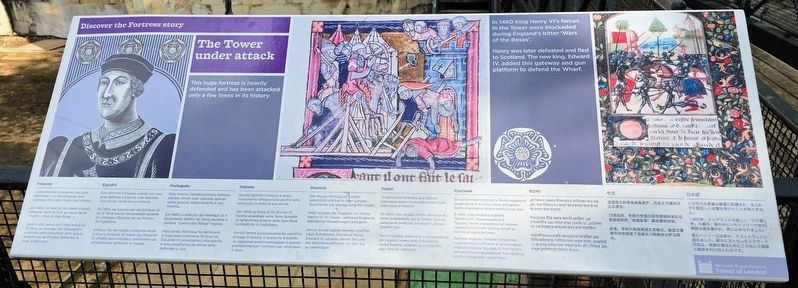
This huge fortress is heavily defended and has been attacked only a few times in its history.
In 1460 King Henry VI’s forces in the Tower were blockaded during England’s bitter ‘Wars of the Roses’.
Henry was later defeated and fled to Scotland. The new king, Edward IV, added this gateway and gun platform to defend the Wharf.
Cette énorme forteresse, très bien défendue, n’a été attaquée que quelques fois dans toute son histoire.
En 1460, l’armée du roi Henri VI était bloquée dans la Tour au cours de la cruelle « Guerre des Roses ».
Henri a été vaincu et il s’est enfui en Écosse. Le nouveau roi Edward IV, a ajouté cette passerelle ainsi que la plateforme de tir pour défendre le quai d’attaque.
Esta enorme fortaleza cuenta con una gran defensa y solo ha sido atacada unas pocas veces en su historia.
En 1460, las fuerzas del rey Enrique VI en la Torre fueron bloqueadas durante las amargas «Guerras de las Rosas» de Inglaterra.
Enrique fue derrotado posteriormente y huyó a Escocia. El nuevo rey, Eduardo IV, añadió esta entrada y plataforma de artillería para defender el muelle.
Esta
this page online
Em 1460, o exército de Henrique VI é bloqueado dentro da Torre, durante a penosa «Guerra das Rosas» inglesa.
Mais tarde, Henrique foi derrotado e fugiu para a Escócia. O novo rei, Eduardo IV, acrescentou este portão e esta plataforma para defender o cais.
Questa grande fortezza è stata fortemente difesa e solo poche volte attaccata in tutta la sua storia.
Nel 1460, le forze di Re Enrico VI furono assediate nella Torre durante la sanguinosa Guerra delle due Rose combattuta in Inghilterra.
Enrico venne successivamente sconfitto e fuggì in Scozia. Il nuovo re, Edoardo IV, aggiunse questo passaggio e questa piattaforma per i cannoni per difendere il molo.
Die riesige Festung ist schwer geschützt und ist in ihrer gesamten Geschichte nur wenige Angriffe erlitten.
1460 wurden die Truppen von König Henry VI. im Tower während des ersten Rosenkriegen belagert.
Henry wurde später besiegt und floh nach Schottland. Der neue König, Edward IV, erließ dieses Tor und die Kanonenplattform, um den Kai zu verteidigen.
Ta ogromna
Photographed by Ian Lefkowitz, September 11, 2026
2. The Tower Under Attack Marker
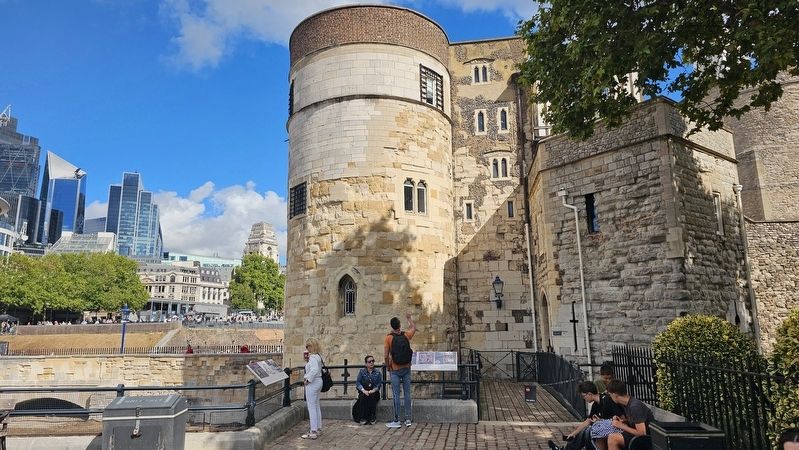
The marker is one of two, directly opposite Byward Tower.
W 1460 roku książę króla Henryka VI, które znajdowały się w Tower, zostały uwięzione podczas rozpoczęcia «Wojen Dwóch Róż».
Henryk został pokonany i przeprowadził do Szkocji. Nowy Król, Edward IV, dodał bramę i platformę z działami, aby chronić nabrzeża.
Эта огромная крепость была надёжно защищена и за всю свою историю была атакована всего несколько раз.
В 1460 году войска короля Генриха VI, находившиеся в Тауэре, были окружены во время кровопролитных войн Алой и Белой розы в Англии.
Вскоре король Генрих потерпел поражение и сбежал в Шотландию. Новый король Эдуард IV построил эти ворота и орудийную платформу, чтобы защищать пристань.
এই বিশাল কেল্লার তীক্ষণভাবে প্রতিরক্ষা করা হয় এবং তার ইতিহাসে কেবল কয়েকবার তার উপর আক্রমণ করা হয়েছে।
ইংল্যান্ডের তীব্র ‘ওয়ার অব দি রোসিস’-এর চলাকালীন 1460 সালে রাজা হেনরি VI -এর সেনা বল কে টাওয়ারে অবরোধ করে রাখা হয়েছিল।
পরবর্তীকালে হেনরি কে হারানো হয়েছিল এবং তিনি স্কটল্যান্ডে পালিয়ে যান। নতুন রাজা, এডওয়ার্ড IV জাহাজ-ঘাটার রক্ষা করার জন্য এই গেটওয়ে এবং বন্দুক প্ল্যাটফর্মের নির্মাণ করেন।
这座庞大的堡垒戒备森严,历史上只遭到过几次袭击。
15世纪时,亨利六世国王驻伦敦塔的军队在英国惨烈的“玫瑰战争”期间遭到封锁。
后来,亨利六世战败逃亡苏格兰。新国王爱德华四世新建了这座大门和炮台以护卫码头。
この巨大な要塞は厳重に防護され、史上わずか数回しか攻撃を受けたことがありません。
1460年、イングランドの苦しい「バラ戦争」の最中、塔の中にいたヘンリー六世の軍隊は庫を塞がれ、閉じ込められました。
後にヘンリー王は敗れ、スコットランドに逃れました。新たに王となったエドワード四世は、埠頭を護るためにこの出入り通路と砲床を付け加えたのです。
Erected by Historic Royal Palaces.
Topics. This historical marker is listed in these topic lists: Forts and Castles • Wars, Non-US. A significant historical year for this entry is 1460.
Location. 51° 30.46′ N, 0° 4.678′ W. Marker is in Tower Hamlets, England, in Greater London. It is in St Katharine's & Wapping. It can be reached from the intersection of Lower Thames Street and Three Quays Walk, on the left when traveling west. Touch for map. Marker is in this post office area: Tower Hamlets, England EC3R 6AH, United Kingdom. Touch for directions.

Regionally, this marker is in London and in the Greater South East. Globally, it is on the Atlantic Ocean, in the North Atlantic Region, in Europe, in Atlantic Europe, on one of the British Isles, in the Western World, and in the Anglosphere. Historically, it finds itself in what was once the Roman Empire.
Other nearby markers. At least 8 other markers are within walking distance of this marker: The Western Entrance (here, next to this marker); The Tower's Community (within shouting distance of this marker); Guarding the Tower (within shouting distance of this marker); The Wharfinger’s Cottage (within shouting distance of this marker); Wharfinger Cottage (within shouting distance of this marker); St Thomas's Tower (within shouting distance of this marker); a different marker also named St Thomas’s Tower (within shouting distance of this marker); Traitors' Gate (within shouting distance of this marker). Touch for a list and map of all markers in Tower Hamlets.
Other markers no longer nearby. The Byward Postern (was a few steps from this marker but has been replaced with another marker now near it); The Queen’s Stairs (was a few steps from this marker but has been permanently removed); Saluting Battery (was a few steps from this marker but has been permanently removed); The Tower of London foreshore (was a few steps from this marker but has been permanently removed); Western entrance (was within shouting distance of this marker but has been replaced with another marker now near it); The Bell Tower (was within shouting distance of this marker but has been replaced with another marker now near it); The Tower Wharf (was within shouting distance of this marker but has been permanently removed).
Also see . . . Blockade of the Tower of London, July 1460 (The Wars of the Roses).
The plan worked. On 19 July, aware that the Queen’s army was defeated and now without food, the Tower surrendered. Lord Scales attempted to escape by boat but was seen, identified, and stabbed to death. His body was unceremoniously thrown into the Thames.(Submitted on October 3, 2026, by Ian Lefkowitz of New York, New York.)
Credits. This page was last revised on October 4, 2026. It was originally submitted on October 3, 2026, by Ian Lefkowitz of New York, New York. This page has been viewed 7 times since then. Photos: 1, 2. submitted on October 3, 2026, by Ian Lefkowitz of New York, New York. • Andrew Ruppenstein was the editor who published this page.
