Delos in Mykonos, The Aegean, Greece — Ελλάδα (Southeastern Europe, Balkan Peninsula)
The Theatre Quarter
H Συνoικία τoυ Θεάτρoυ
Photographed by James Hulse, September 23, 2026
1. The Theatre Quarter Marker

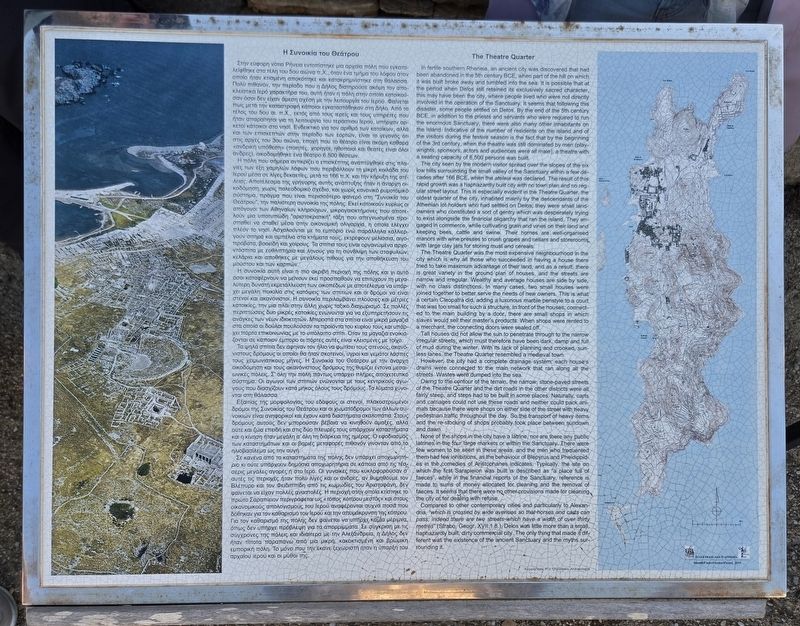
Στην εύφορη νότια Ρήνεια εντοπίστηκε μια αρχαία πόλη που εγκαταλείφθηκε στα τέλη του 5ου αιώνα π.Χ., όταν ένα τμήμα του λόφου στον οποίο ήταν κτισμένη αποκόπηκε και κατακρημνίστηκε στη θάλασσα. Πολύ πιθανόν, την περίοδο που η Δήλος διατηρούσε ακόμη τον αποκλειστικά ιερό χαρακτήρα της, αυτή ήταν η πόλη στην οποία κατοικούσαν όσοι δεν είχαν άμεση σχέση με τη λειτουργία του Ιερού. Φαίνεται πως μετά την καταστροφή κάποιοι εγκαταστάθηκαν στη Δήλο. Από το τέλος του 5ου αι. π.Χ., εκτός από τους ιερείς και τους υπηρέτες που ήταν απαραίτητοι για τη λειτουργία του τεράστιου Ιερού, υπήρχαν αρκετοί κάτοικοι στο νησί. Ενδεικτικό για τον αριθμό των κατοίκων, αλλά και των επισκεπτών στην περίοδο των εορτών, είναι το γεγονός ότι στις αρχές του 3ου αιώνα, εποχή που το θέατρο είναι ακόμη ξύλινο («ανδρική υπόθεση» — ποιητές, χορηγοί, ηθοποιοί και θεατές είναι όλοι άνδρες), οικοδομήθηκε ένα θέατρο 6.500 θέσεων.
Η πόλη που σήμερα αντικρίζει ο επισκέπτης αναπτύχθηκε στις πλαγιές των έξι χαμηλών λόφων που περιβάλλουν τη μικρή κοιλάδα του Ιερού μέσα σε λίγες δεκαετίες, μετά το 166 π.Χ. και την κήρυξη της ατέλειας. Αποτέλεσμα της γρήγορης αυτής ανάπτυξης ήταν η άναρχη οικοδόμηση, χωρίς πολεοδομικό σχέδιο
this page online
Η συνοικία αυτή είναι η πιο ακριβή περιοχή της πόλης και γι’ αυτό όσοι καταφέρνουν να μείνουν εκεί προσπαθούν να επιτύχουν τη μεγαλύτερη δυνατή εκμετάλλευση των οικοπέδων, με αποτέλεσμα να υπάρχει μεγάλη ποικιλία στις κατόψεις των σπιτιών και οι δρόμοι να είναι στενοί και ακανόνιστοι. Η συνοικία περιλαμβάνει πλούσιες και μέτριες κατοικίες, την μία πλάι στην άλλη χωρίς ταξικό διαχωρισμό. Σε πολλές περιπτώσεις δύο μικρές κατοικίες ενώνονται για να εξυπηρετήσουν τις ανάγκες των νέων ιδιοκτητών.
Photographed by James Hulse, September 23, 2026
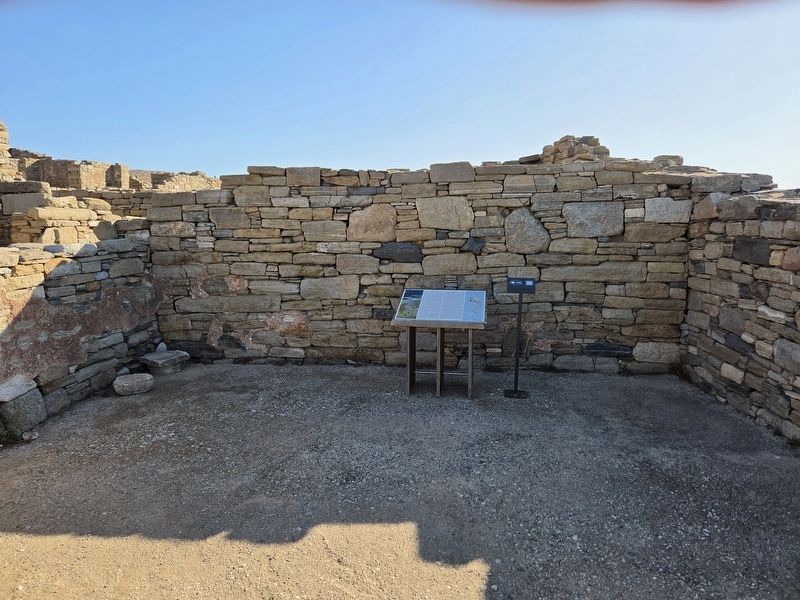
2. The Theatre Quarter Marker
Τα ψηλά σπίτια δεν άφηναν τον ήλιο να φωτίσει τους στενούς, ακανόνιστους δρόμους, οι οποίοι θα ήταν σκοτεινοί, υγροί και γεμάτοι λάσπες τους χειμωνιάτικους μήνες. Η Συνοικία του Θεάτρου, με την άναρχη οικοδόμηση και τους ακανόνιστους δρόμους της, θυμίζει έντονα μεσαιωνικές πόλεις. Σ’ όλη την πόλη πάντως υπάρχει πλήρες αποχετευτικό σύστημα. Οι αγωγοί των σπιτιών ενώνονται με τους κεντρικούς αγωγούς που διασχίζουν κατά μήκος όλους τους δρόμους. Τα λύματα χύνονται στη θάλασσα.
Εξαιτίας της μορφολογίας του εδάφους οι στενοί, πλακοστρωμένοι δρόμοι της Συνοικίας του Θεάτρου και οι χωματόδρομοι των άλλων συνοικιών είναι ανηφορικοί και έχουν κατά διαστήματα σκαλοπάτια. Στους δρόμους αυτούς δεν μπορούσαν βέβαια να κινηθούν άμαξες, αλλά ούτε και ζώα, επειδή και στις δύο πλευρές τους υπάρχουν καταστήματα και η κίνηση ήταν μεγάλη σ’ όλη τη διάρκεια της ημέρας. Ο εφοδιασμός των καταστημάτων και οι βαριές μεταφορές πιθανόν γίνονταν από το ηλιοβασίλεμα
Photographed by James Hulse, September 23, 2026
3. The Theatre Quarter Marker
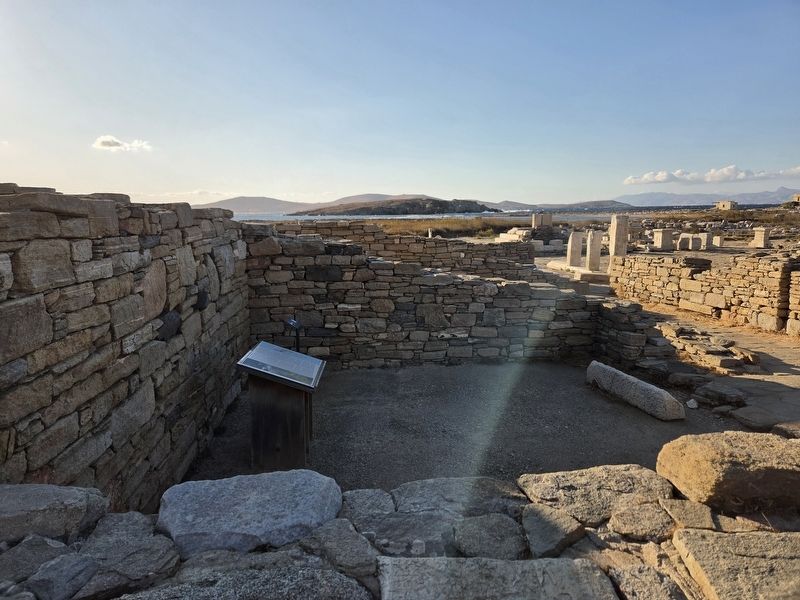
The marker looking towards the sea.
Σε κανένα από τα καταστήματα της πόλης δεν υπάρχει αποχωρητήριο και ούτε υπάρχουν δημόσια αποχωρητήρια σε κάποια από τις τέσσερις μεγάλες αγορές ή στο Ιερό. Οι γυναίκες που κυκλοφορούσαν σ’ αυτές τις περιοχές ήταν πολύ λίγες και οι άνδρες, αν θυμηθούμε τον Βλέπυρο και τον Φειδιππίδη από τις κωμωδίες του Αριστοφάνη, δεν φαίνεται να είχαν πολλές αναστολές. Η περιοχή στην οποία κτίστηκε το πρώτο Σαραπιείο περιγράφεται ως «τόπος κόπρου μεστός» και στους οικονομικούς απολογισμούς του Ιερού αναφέρονται συχνά ποσά που δόθηκαν για τον καθαρισμό του Ιερού και την απομάκρυνση της κόπρου. Για τον καθαρισμό της πόλης δεν φαίνεται να υπήρχε καμία μέριμνα, όπως δεν υπήρχε πρόβλεψη για τα απορρίμματα. Σε σύγκριση με τις σύγχρονες της πόλεις και ιδιαίτερα με την Αλεξάνδρεια, η Δήλος δεν ήταν τίποτα παραπάνω από μια μικρή, κακοκτισμένη και βρώμικη εμπορική πόλη. Το μόνο που την έκανε ξεχωριστή ήταν η ύπαρξη του αρχαίου Ιερού και οι μύθοι της.
Κείμενα: P. J. Chatzidakis, Αρχαιολόγος
In fertile southern Rheneia, an ancient city was discovered that had been abandoned in the 5th century BCE, when part of the hill on which it was built broke away and tumbled into the sea. It is possible that at the period when Delos still retained its exclusively sacred character, this may have been the city where people lived who were not directly involved in the operation of the Sanctuary. It seems that following this disaster, some people settled on Delos. By the end of the 5th century BCE, in addition to the priests and servants who were required to run the enormous Sanctuary, there were also many other inhabitants on the island. Indicative of the number of residents on the island and of the visitors during the festive season is the fact that by the beginning of the 3rd century, when the theatre was still dominated by men (playwrights, sponsors, actors and audiences were all male), a theatre with a seating capacity of 6,500 persons was built.
The city seen by the modern visitor spread over the slopes of the six low hills surrounding the small valley of the Sanctuary within a few decades after 166
Photographed by James Hulse, September 23, 2026
4. The Theatre Quarter Marker
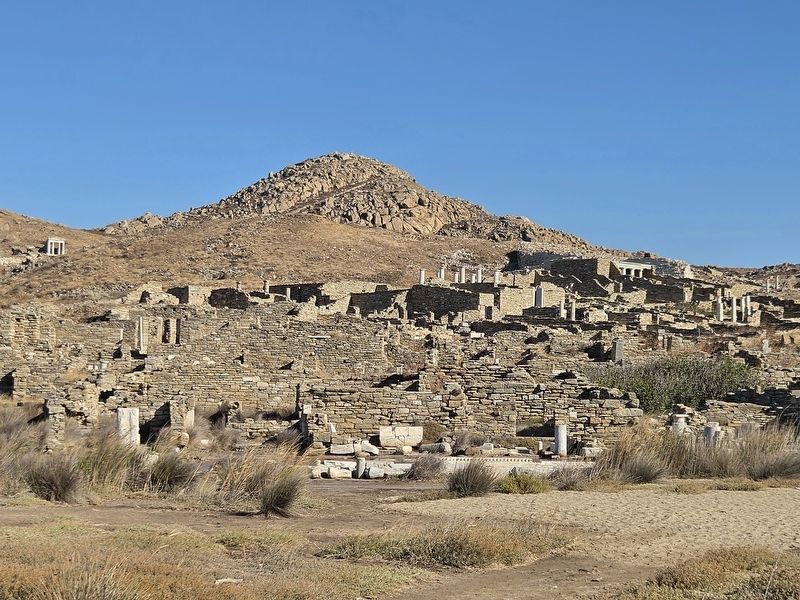
The view of the site as approaching the Theatre Quarter.
The Theatre Quarter was the most expensive neighbourhood in the city, which is why all those who succeeded in having a house there tried to take maximum advantage of their land, and as a result, there is great variety in the ground plan of houses, and the streets are narrow and irregular. Wealthy and average houses are side by side, with no class distinctions. In many cases, two small houses were joined together to better serve the needs of new owners. This is what a certain Cleopatra did, adding a luxurious marble peristyle to a court that was too small for such a structure. In front of the houses, connected to the main building by a door, there are small shops in which slaves would sell their master’s products. When shops were rented to a merchant, the connecting doors were sealed off.
Tall houses did not allow the sun to penetrate through to the narrow irregular streets, which must therefore have been dark, damp and full of mud during the winter. With its lack of planning and crooked, sunless lanes, the Theatre Quarter resembled a medieval town. However, the city had a complete drainage system: each house’s drains were connected to the main network that ran along all the streets. Wastes were dumped into the sea.
Owing to the contour of the terrain, the narrow, stone-paved streets of the Theatre Quarter and the dirt roads in the other districts were all fairly steep, and steps had to be built in some places. Naturally, carts and carriages could not use these roads and neither could pack animals because there were shops on either side of the street with heavy pedestrian traffic throughout the day. So the transport of heavy items and the re-stocking of shops probably took place between sundown and dawn.
None of the shops in the city have a latrine, nor are there any public latrines in the four large markets or within the Sanctuary. There were few women to be seen in these areas, and the men who frequented them had few inhibitions, as the behaviour of Blepyrus and Pheidippides in the comedies of Aristophanes indicates. Typically, the site on which the first Sarapieion was built is described as “a place full of faeces”, while in the financial reports of the Sanctuary, reference is made to sums of money allocated for cleaning and the removal of faeces. It seems that there were no other provisions made for cleaning the city or for dealing with refuse.
Compared to other contemporary cities and particularly to Alexandria, “which is crossed by wide avenues so that horses and carts can pass; indeed there are two streets which have a width of over thirty metres” (Strabo, Geogr. XVII. 1.8), Delos was little more than a small, haphazardly built, dirty commercial city. The only thing that made it different was the existence of the ancient Sanctuary and the myths surrounding it.
Text: P. J. Chatzidakis, Archaeologist
Erected 2011 by Hellenic Ministry of Culture.
Topics. This historical marker is listed in this topic list: Anthropology & Archaeology.
Location. 37° 23.924′ N, 25° 15.998′ E. Marker is in Delos, The Aegean, in Mykonos. It is on Odos Hvris Onomasia. Touch for map. Marker is in this post office area: Delos, The Aegean 846 00, Greece. Touch for directions.

Regionally, it is in Europe, the European Union, the Schengen Area, a coastal Mediterranean country, and the Western World. Historically, it finds itself in what was once the Byzantine Empire, the Ottoman Empire, and specifically the Roman Empire.
Other nearby markers. At least 8 other markers are within walking distance of this marker: The House with the Dionysus (about 90 meters away, measured in a direct line); Portico of Philip V (about 120 meters away); The House of Cleopatra (about 120 meters away); Delos (about 150 meters away); The House with the Trident – Delian Houses (about 150 meters away); The Oikos and the Colossus of the Naxians (about 180 meters away); Temple of the Delians, or Great Temple (about 180 meters away); Temple of the Athenians (about 210 meters away). Touch for a list and map of all markers in Delos.
More about this marker. The marker is at the Archaeological Site of Delos, which you can reach by boat from Mykonos. Admission to the site and the round-trip boat fare are charged separately.
Credits. This page was last revised on October 4, 2026. It was originally submitted on October 4, 2026, by James Hulse of Medina, Texas. This page has been viewed 9 times since then. Photos: 1, 2, 3, 4. submitted on October 4, 2026, by James Hulse of Medina, Texas.
