Delos in Mykonos, The Aegean, Greece — Ελλάδα (Southeastern Europe, Balkan Peninsula)
Delos Theatre
Το Θέατρο της Δήλου
Photographed by James Hulse, September 23, 2026
1. Delos Theatre Marker

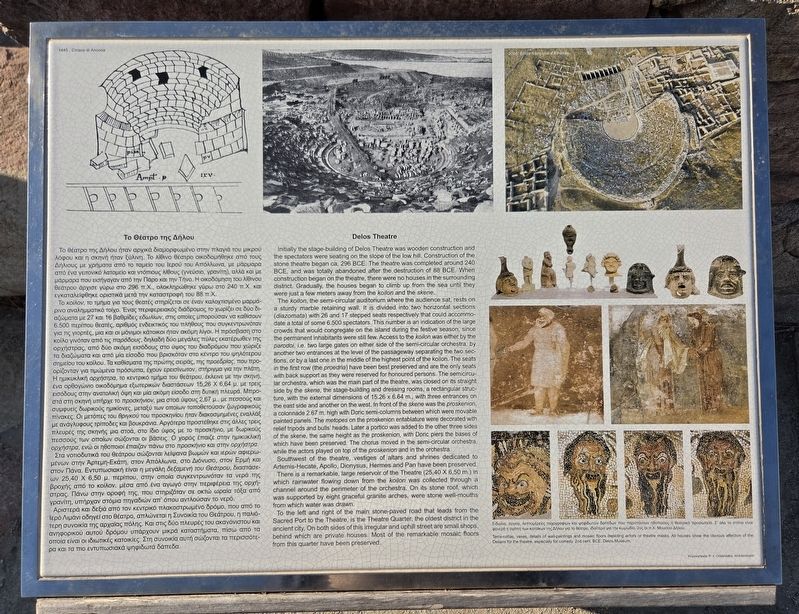
Το Θέατρο της Δήλου ήταν αρχικά διαμορφωμένο στην πλαγιά του μικρού λόφου και η σκηνή ήταν ξύλινη. Το λίθινο θέατρο οικοδομήθηκε από τους Δήλιους με χρήματα από το ταμείο του Ιερού του Απόλλωνα, με μάρμαρα από ένα γειτονικό λατομείο και ντόπιους λίθους (γνεύσιο, γρανίτη), αλλά και με μάρμαρα που εισήγαγαν από την Πάρο και την Τήνο. Η οικοδόμηση του λίθινου θεάτρου άρχισε γύρω στο 296 π.Χ., ολοκληρώθηκε γύρω στο 240 π.Χ. και εγκαταλείφθηκε οριστικά μετά την καταστροφή του 88 π.Χ.
Το κοίλον, το τμήμα για τους θεατές, στηρίζεται σε έναν καλοχτισμένο μαρμάρινο αναλημματικό τοίχο. Ένας περιφερειακός διάδρομος το χωρίζει σε δύο διαζώματα με 27 και 16 βαθμίδες εδωλίων, στις οποίες μπορούσαν να καθίσουν 6.500 περίπου θεατές, αριθμός ενδεικτικός του πλήθους που συγκεντρωνόταν για τις γιορτές, μια και οι μόνιμοι κάτοικοι ήταν ακόμη λίγοι. Η πρόσβαση στο κοίλο γινόταν από τις παρόδους, δηλαδή δύο μεγάλες πύλες εκατέρωθεν της ορχήστρας, από δύο ακόμη εισόδους στο ύψος του διαδρόμου που χώριζε τα διαζώματα και από μία είσοδο που βρισκόταν στο κέντρο του ψηλότερου σημείου του κοίλου. Τα καθίσματα της πρώτης σειράς, της προεδρίας, που προορίζονταν για τιμώμενα πρόσωπα, έχουν ερεισίνωτον, στήριγμα
this page online
Η ημικυκλική ορχήστρα, το κεντρικό τμήμα του θεάτρου, έκλεινε με τη σκηνή, ένα ορθογώνιο οικοδόμημα εξωτερικών διαστάσεων 15,26 × 6,64 μ. με τρεις εισόδους στην ανατολική όψη και μία ακόμη είσοδο στη δυτική πλευρά. Μπροστά στη σκηνή υπήρχε το προσκήνιον, μια στοά ύψους 2,67 μ., με πεσσούς και συμφυείς δωρικούς ημικίονες, μεταξύ των οποίων τοποθετούσαν ζωγραφικούς πίνακες. Οι μετόπες του θριγκού του προσκηνίου ήταν διακοσμημένες εναλλάξ με ανάγλυφους τρίποδες και βουκράνια. Αργότερα προστέθηκε στις άλλες τρεις πλευρές της σκηνής μια στοά, στο ίδιο ύψος με το προσκήνιο, με δωρικούς πεσσούς των οποίων σώζονται οι βάσεις. Ο χορός έπαιζε στην ημικυκλική ορχήστρα, ενώ οι ηθοποιοί έπαιζαν πάνω στο προσκήνιο και στην ορχήστρα.
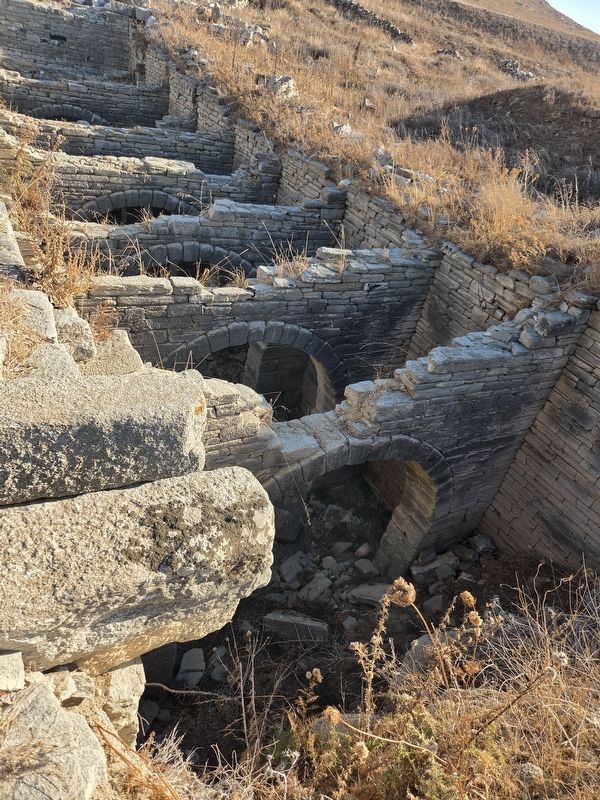
Στα νοτιοδυτικά του Θεάτρου σώζονται λείψανα βωμών και ιερών αφιερωμένων στην Άρτεμη-Εκάτη, στον Απόλλωνα, στο Διόνυσο, στον Ερμή και στον Πάνα. Εντυπωσιακή είναι η μεγάλη δεξαμενή του Θεάτρου, διαστάσεων 25,40 × 6,50 μ. περίπου, στην οποία συγκεντρώνονταν τα νερά της βροχής από το κοίλον, μέσα από ένα αγωγό στην περιφέρεια της ορχήστρας. Πάνω στην οροφή της, που στηριζόταν σε οκτώ ωραία τόξα από γρανίτη, υπήρχαν στόμια πηγαδιών απ’ όπου αντλούσαν το νερό.
Αριστερά και δεξιά από
Photographed by James Hulse, September 23, 2026
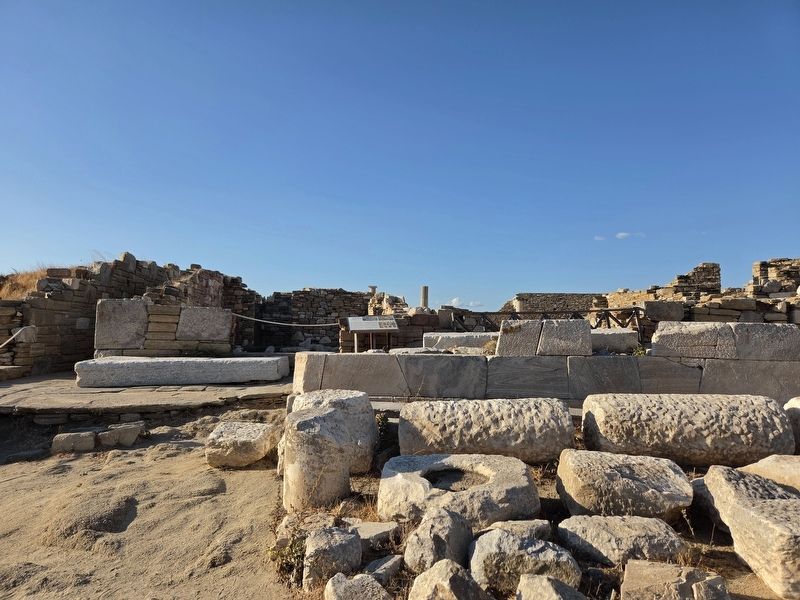
2. Delos Theatre Marker
1445, Ciriaco di Ancona • 1905, École française d’Athènes • 2006, École française d’Athènes
Ειδώλια, αγγεία, λεπτομέρειες τοιχογραφιών και ψηφιδωτών δαπέδων που παριστάνουν ηθοποιούς ή θεατρικά προσωπεία. Σ’ όλα τα σπίτια είναι φανερή η αγάπη των κατοίκων της Δήλου για το θέατρο, ιδιαίτερα για την κωμωδία. 2ος αι. π.Χ. Μουσείο Δήλου.
Κείμενο: P. J. Chatzidakis, Αρχαιολόγος
Initially the stage-building of Delos Theatre was a wooden construction and the spectators were seated on the slope of the low hill. Construction of the stone theatre began ca. 296 BCE. The theatre was completed around 240 BCE and was totally abandoned after the destruction of 88 BCE. When construction began on the theatre, there were no houses in the surrounding district. Gradually, the houses began to climb up from the sea until they were just a few meters away from the koilon and the skene.
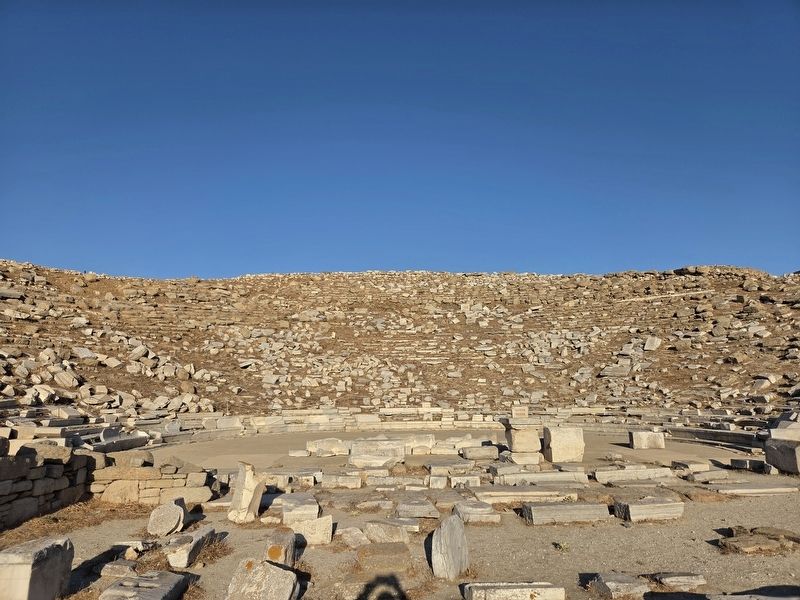
The koilon, the semi-circular auditorium where the audience sat, rests on a sturdy marble retaining wall. It is divided into two horizontal sections (diazomata) with 26 and 17 stepped seats respectively that could accommodate a total of some 6,500 spectators. This number is an indication of the large crowds that would congregate on the island during the festive season, since the permanent inhabitants were still few. Access to the koilon was either by the parodoi, i.e. two large gates on either side of the semi-circular orchestra, by another two entrances at the level of the passageway separating the two sections, or by a last one in the middle of the highest point of the koilon. The seats in the first row (the proedria) have been best preserved and are the only seats with back support, as they were reserved for honoured persons.
The semicircular orchestra, which was the main part of the theatre, was closed on its straight side by the skene, the stage-building and dressing rooms, a rectangular structure with the external dimensions of 15.26 × 6.64 m., with three entrances on the east side and another on the west. In front of the skene was the proskenion, a colonnade 2.67 m. high with Doric semi-columns between which were movable painted panels. The metopes on the proskenion entablature were decorated with relief tripods and bulls’ heads. Later a portico was added to the other three sides of the skene, the same height as the proskenion, with Doric piers, the bases of which have been preserved. The chorus moved in the semi-circular orchestra, while the actors played on top of the proskenion and in the orchestra.
Southwest of the theatre, vestiges of altars and shrines dedicated to Artemis-Hecate, Apollo, Dionysus, Hermes and Pan have been preserved.
There is a remarkable, large reservoir of the Theatre (25.40 × 6.50 m.) in which rainwater flowing down from the koilon was collected through a channel around the perimeter of the orchestra. On its stone roof, which was supported by eight graceful granite arches, were stone well-mouths from which water was drawn.
To the left and right of the main stone-paved road that leads from the Sacred Port to the Theatre is the Theatre Quarter, the oldest district in the
Photographed by James Hulse, September 23, 2026
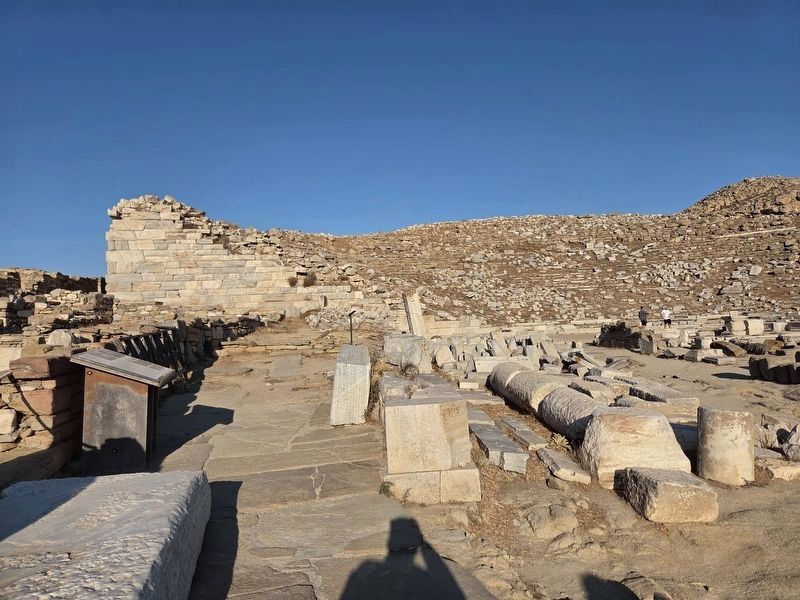
3. Delos Theatre and Marker
The left retaining stone wall of the theatre is located in the background.
1445, Ciriaco di Ancona • 1905, École française d’Athènes • 2006, École française d’Athènes
Terra-cottas, vases, details of wall-paintings and mosaic floors depicting actors or theatre masks. All houses show the obvious affection of the Delians for the theatre, especially for comedy. 2nd cent. BCE. Delos Museum.
Text: P. J. Chatzidakis, Archaeologist
Erected by Hellenic Ministry of Culture.
Topics. This historical marker is listed in these topic lists: Anthropology & Archaeology • Entertainment. A significant historical year for this entry is 296 BCE.
Location. 37° 23.824′ N, 25° 16.059′ E. Marker is in Delos, The Aegean, in Mykonos. It is on Odos Hvris Onomasia. Touch for map. Marker is in this post office area: Delos, The Aegean 846 00, Greece. Touch for directions.

Regionally, it is in Europe, the European Union, the Schengen Area, a coastal Mediterranean country, and the Western World. Historically, it finds itself in what was once the Byzantine Empire, the Ottoman Empire, and specifically the Roman Empire.
Other nearby markers. At least 8 other markers are within walking distance of this marker: The House with the Trident – Delian Houses (within shouting distance of this marker); The House of Cleopatra (about 90 meters away, measured in a direct line); The House with the Dionysus (about 120 meters away); The Theatre Quarter (about 210 meters away); Delos (approx. 0.3 kilometers away); Portico of Philip V (approx. 0.3 kilometers away); The Oikos and the Colossus of the Naxians (approx. 0.4 kilometers away); Temple of the Delians, or Great Temple (approx. 0.4 kilometers away). Touch for a list and map of all markers in Delos.
More about this marker. The marker is at the Archaeological Site of Delos, which you can reach by boat from Mykonos. Admission to the site and the round-trip boat fare are charged separately.
Regarding Delos Theatre. The English text seat counts conflict with the Greek text. The Greek says 27 and 16 rows, while this English version says 26 and 17.
Photographed by James Hulse, September 23, 2026
4. Delos Theatre
Photographed by James Hulse
5. Large reservoir of the Delos Theatre
Credits. This page was last revised on October 4, 2026. It was originally submitted on October 4, 2026, by James Hulse of Medina, Texas. This page has been viewed 8 times since then. Photos: 1, 2, 3, 4, 5. submitted on October 4, 2026, by James Hulse of Medina, Texas.
