Delos in Mykonos, The Aegean, Greece — Ελλάδα (Southeastern Europe, Balkan Peninsula)
The Oikos and the Colossus of the Naxians
Photographed by James Hulse, September 23, 2026
1. The Oikos and the Colossus of the Naxians Marker

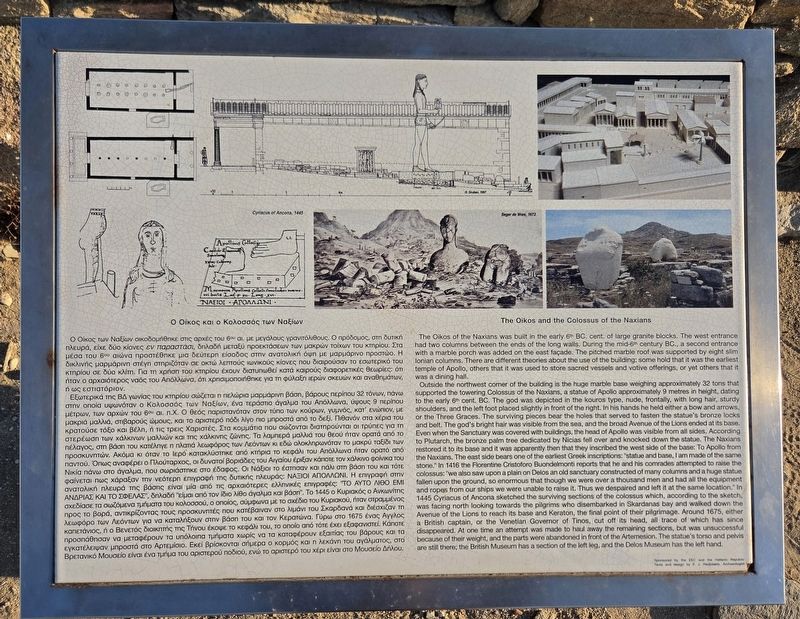
Ο Οίκος των Ναξίων οικοδομήθηκε στις αρχές του 6ου αι. με μεγάλους γρανιτόλιθους. Ο πρόδομος, στη δυτική πλευρά, είχε δύο κίονες εν παραστάσι, δηλαδή μεταξύ προεκτάσεων των μακρών τοίχων του κτηρίου. Στα μέσα του 6ου αιώνα προστέθηκε μια δεύτερη είσοδος στην ανατολική όψη με μαρμάρινο προστώο. Η δικλινής μαρμάρινη στέγη στηριζόταν σε οκτώ λεπτούς ιωνικούς κίονες που διαιρούσαν το εσωτερικό του κτηρίου σε δύο κλίτη. Για τη χρήση του κτηρίου έχουν διατυπωθεί κατά καιρούς διαφορετικές θεωρίες: ότι ήταν ο αρχαιότερος ναός του Απόλλωνα, ότι χρησιμοποιήθηκε για τη φύλαξη ιερών σκευών και αναθημάτων, ή ως εστιατόριον.
Εξωτερικά της ΒΔ γωνίας του κτηρίου σώζεται η πελώρια μαρμάρινη βάση, βάρους περίπου 32 τόνων, πάνω στην οποία υψωνόταν ο Κολοσσός των Ναξίων, ένα τεράστιο άγαλμα του Απόλλωνα, ύψους 9 περίπου μέτρων, των αρχών του 6ου αι. π.Χ. Ο θεός παριστανόταν στον τύπο των κούρων, γυμνός, κατ’ ενώπιον, με μακριά μαλλιά, στιβαρούς ώμους, και το αριστερό πόδι λίγο πιο μπροστά από το δεξί. Πιθανόν στα χέρια του κρατούσε τόξο και βέλη, ή τις τρεις Χάριτες. Στα κομμάτια που σώζονται διατηρούνται οι τρύπες για τη στερέωση των χάλκινων μαλλιών και της χάλκινης ζώνης. Τα λαμπερά
this page online
Photographed by James Hulse, September 23, 2026
2. The Oikos and the Colossus of the Naxians Marker
Κυριακός ο Αγκωνίτης, 1445 • Seger de Vries, 1673 • G. Gruben, 1971
Χρηματοδοτήθηκε από την ΕΟΚ και την Ελληνική Δημοκρατία.
Κείμενα και σχεδιασμός: P. J. Hadjidakis, Αρχαιολόγος
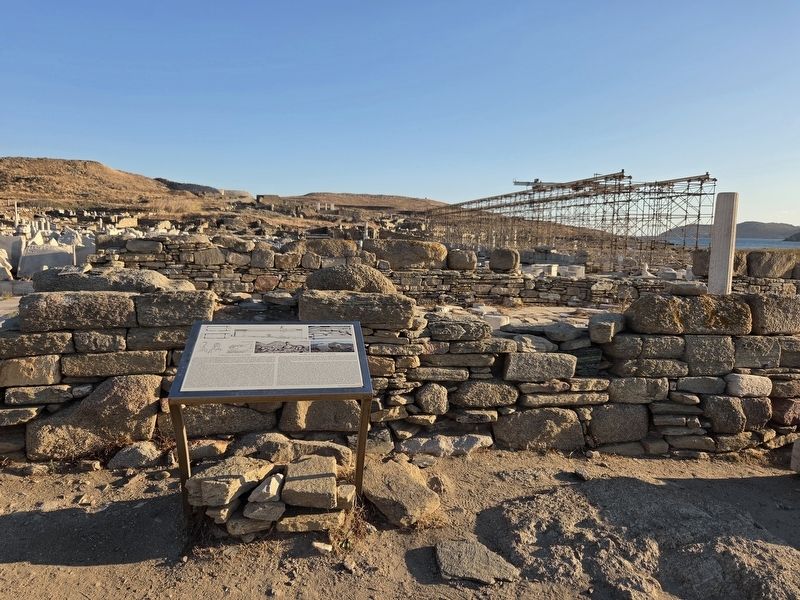
The Oikos of the Naxians was built in the early 6th cent. BC of large granite blocks. The west entrance had two columns between the ends of the long walls. During the mid-6th century BC, a second entrance with a marble porch was added on the east façade. The pitched marble roof was supported by eight slim Ionian columns. There are different theories about the use of the building: some hold that it was the earliest temple of Apollo, others that it was used to store sacred vessels and votive offerings, or yet others that it was a dining hall.
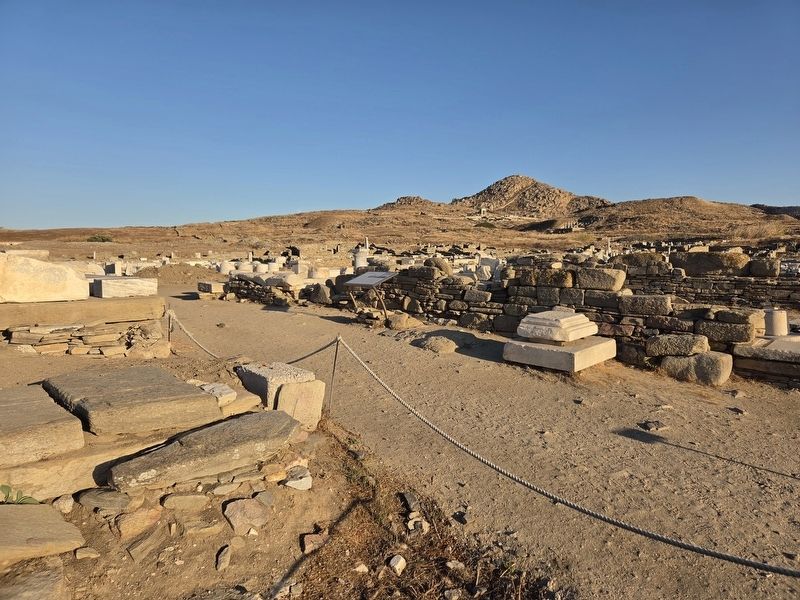
Outside the northwest corner of the building is the huge marble base weighing approximately 32 tons that supported the towering Colossus of the Naxians, a statue of Apollo approximately 9 metres in height, dating to the early 6th cent. BC. The god was depicted in the kouros type, nude, frontally, with long hair, sturdy shoulders, and the left foot placed slightly in front of the right. In his hands he held either a bow and arrows, or the Three Graces. The surviving pieces bear the holes that served to fasten the statue’s bronze locks and belt. The god’s bright hair was visible from the sea, and the broad Avenue of the Lions ended at its base. Even when the Sanctuary was covered with buildings, the head of Apollo was visible from all sides. According to Plutarch, the bronze palm tree dedicated by Nicias fell over and knocked down the statue. The Naxians restored it to its base and it was apparently then that they inscribed the west side of the base: “To Apollo from the Naxians.” The east side bears one of the earliest Greek inscriptions: “Statue and base, I am made of the same stone.” In 1416 the Florentine Cristoforo Buondelmonti reports that he and his comrades attempted to raise the colossus: “We also saw upon a plain on Delos an old sanctuary constructed of many columns and a huge statue fallen upon the ground, so enormous that though we were over a thousand men and had all the equipment and ropes from our ships we were unable to raise it. Thus we despaired and left it at the same location.” In 1445 Cyriacus of Ancona sketched the surviving sections of the colossus which, according to the sketch, was facing north looking towards the pilgrims who disembarked in Skardanas Bay and walked down the Avenue of the Lions to reach its base and Keraton, the final point of their pilgrimage. Around 1675, either a British captain, or the Venetian Governor of Tinos, cut off its head, all trace of which has since disappeared. At one time an attempt was made to haul away the remaining sections, but was unsuccessful because of their weight, and the parts were abandoned in front of the Artemesion. The statue’s torso and pelvis are still there; the British Museum has a section of the left leg, and the Delos Museum has the left hand.
Cyriacus of Ancona, 1445 • Seger de Vries, 1673 • G. Gruben, 1971
Sponsored by the EEC and the Hellenic Republic.
Texts and design by P. J. Hadjidakis, Archaeologist
Erected by Hellenic Republic and European Economic Community.
Topics. This historical marker is listed in this topic list: Anthropology & Archaeology. A significant historical year for this entry is 1445.
Location. 37° 24.017′ N, 25° 16.009′ E. Marker is in Delos, The Aegean, in Mykonos. It is on Odos Hvris Onomasia. Touch for map. Marker is in this post office area: Delos, The Aegean 846 00, Greece. Touch for directions.

Regionally, it is in Europe, the European Union, the Schengen Area, a coastal Mediterranean country, and the Western World. Historically, it finds itself in what was once the Byzantine Empire, the Ottoman Empire, and specifically the Roman Empire.
Other nearby markers. At least 8 other markers are within walking distance of this marker: Temple of the Delians, or Great Temple (a few steps from this marker); Temple of the Athenians (within shouting distance of this marker); The Poros Temple (within shouting distance of this marker); Portico of Philip V (within shouting distance of this marker); Agora of the Italians (about 150 meters away, measured in a direct line); The Theatre Quarter (about 180 meters away); The Lions of the Naxians (about 180 meters away); Delos (about 210 meters away). Touch for a list and map of all markers in Delos.
More about this marker.
Photographed by James Hulse, September 23, 2026
3. The Oikos and the Colossus of the Naxians Marker
Credits. This page was last revised on October 5, 2026. It was originally submitted on October 4, 2026, by James Hulse of Medina, Texas. This page has been viewed 10 times since then. Photos: 1, 2, 3. submitted on October 5, 2026, by James Hulse of Medina, Texas.
