Delos in Mykonos, The Aegean, Greece — Ελλάδα (Southeastern Europe, Balkan Peninsula)
Agora of the Italians
Η Αγορά των Ιταλών
Photographed by James Hulse, September 23, 2026
1. Agora of the Italians Marker

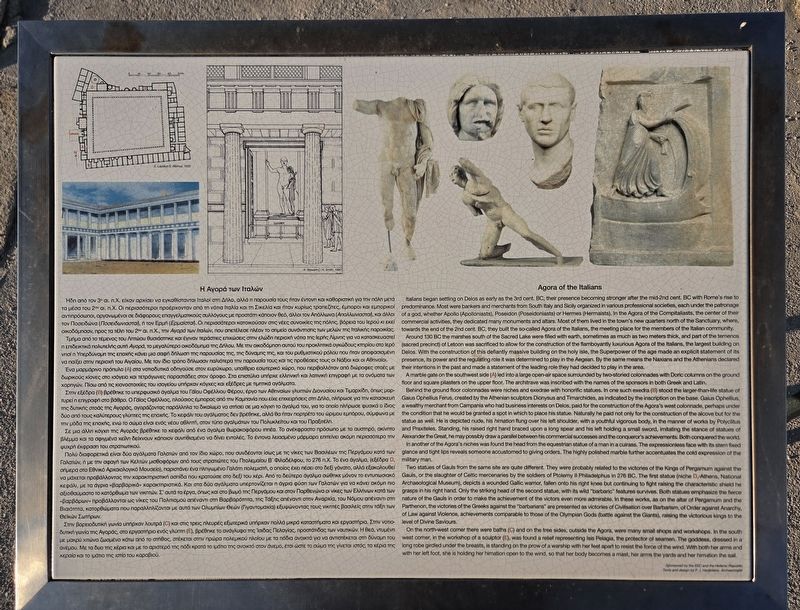
Ήδη από τον 3ο αι. π.Χ., είχαν αρχίσει να εγκαθίστανται Ιταλοί στη Δήλο, αλλά η παρουσία τους ήταν έντονη και καθοριστική για την πόλη μετά τα μέσα του 2ου αι. π.Χ. Οι περισσότεροι προέρχονταν από τη νότια Ιταλία και τη Σικελία και ήταν κυρίως τραπεζίτες, έμποροι και εμπορικοί αντιπρόσωποι, οργανωμένοι σε διάφορους επαγγελματικούς συλλόγους με προστάτη κάποιον θεό, άλλοι τον Απόλλωνα (Απολλωνιαστές), και άλλοι τον Ποσειδώνα (Ποσειδωνιαστές), ή τον Ερμή (Ερμαϊστές). Οι περισσότεροι κατοικούσαν στις νέες συνοικίες της πόλης, βόρεια του Ιερού και εκεί οικοδόμησαν, προς τα τέλη του 2ου αι. π.Χ., την Αγορά των Ιταλών, που απετέλεσε πλέον το σημείο συνάντησης των μελών της ιταλικής παροικίας.
Τμήμα από το τέμενος του Λητώου θυσιάστηκε και έγιναν τεράστιες επιχώσεις στην ελώδη περιοχή νότια της Ιερής Λίμνης για να κατασκευαστεί η επιδεικτικά πολυτελής αυτή Αγορά, το μεγαλύτερο οικοδόμημα της Δήλου. Με την οικοδόμηση αυτού του προκλητικά ογκώδους κτηρίου στο Ιερό νησί η Υπερδύναμη της εποχής κάνει μια σαφή δήλωση της παρουσίας της, της δύναμής της, και του ρυθμιστικού ρόλου που ήταν αποφασισμένη να παίξει στην περιοχή του Αιγαίου. Με τον ίδιο τρόπο δήλωσαν παλιότερα την παρουσία
this page online
Ένα μαρμάρινο πρόπυλο (A) στα νοτιοδυτικά οδηγούσε στον ευρύχωρο, υπαίθριο εσωτερικό χώρο, που περιβαλλόταν από διώροφες στοές με δωρικούς κίονες στο ισόγειο και τετράγωνες παραστάδες στον όροφο. Στα επιστύλια υπήρχε ελληνική και λατινική επιγραφή με τα ονόματα των χορηγών. Πίσω από τις κιονοστοιχίες του ισογείου υπήρχαν κόγχες και εξέδρες με τιμητικά αγάλματα.
Στην εξέδρα (B) βρέθηκε το υπερφυσικό άγαλμα του Γάιου Οφέλλιου Φέρου, έργο των Αθηναίων γλυπτών Διονυσίου και Τιμαρχίδη, όπως μαρτυρεί η επιγραφή στο βάθρο. Ο Γάιος Οφέλλιος, πλούσιος έμπορος από την Καμπανία που είχε επιχειρήσεις στη Δήλο, πλήρωσε για την κατασκευή της δυτικής στοάς της Αγοράς, αγοράζοντας παράλληλα το δικαίωμα να στήσει σε μια κόγχη το άγαλμά του, για το οποίο πλήρωσε φυσικά ο ίδιος δύο από τους καλύτερους γλύπτες της εποχής. Το κεφάλι του αγάλματος δεν βρέθηκε, αλλά θα ήταν πορτρέτο του ώριμου εμπόρου, σύμφωνα με την μόδα της εποχής, ενώ το σώμα είναι ενός νέου αθλητή, στον τύπο αγαλμάτων του Πολυκλείτου και του Πραξιτέλη.
Σε μια άλλη κόγχη της Αγοράς βρέθηκε το κεφάλι από ένα άγαλμα θωρακοφόρου ιππέα. Το ανέκφραστο πρόσωπο με το αυστηρό, ακίνητο βλέμμα και
Photographed by James Hulse, September 23, 2026
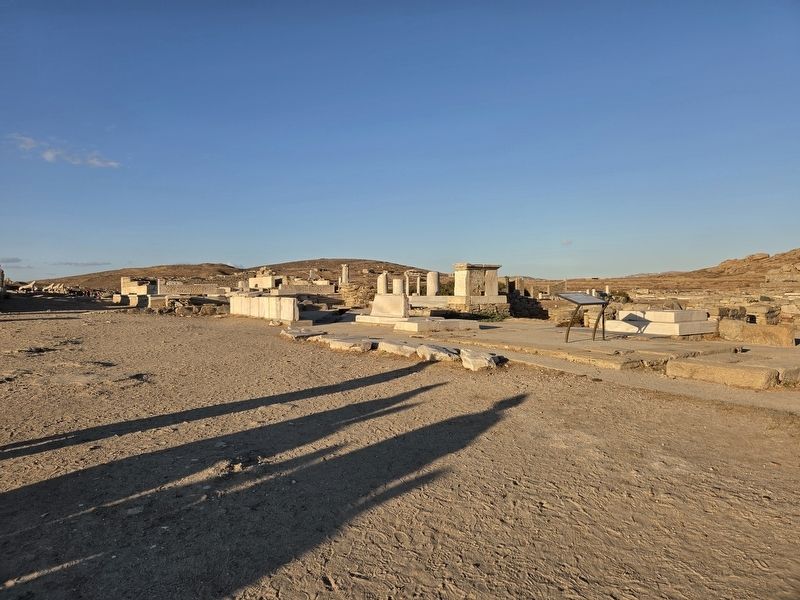
2. Agora of the Italians Marker
Πολύ διαφορετικά είναι δύο αγάλματα Γαλατών από τον ίδιο χώρο, που συνδέονται ίσως με τις νίκες των Βασιλέων της Περγάμου κατά των Γαλατών, ή με την σφαγή των Κελτών μισθοφόρων από τους στρατιώτες του Πτολεμαίου Β΄ Φιλαδέλφου, το 276 π.Χ. Το ένα άγαλμα, (εξέδρα D, σήμερα στο Εθνικό Αρχαιολογικό Μουσείο), παριστάνει ένα πληγωμένο Γαλάτη πολεμιστή, ο οποίος έχει πέσει στο δεξί γόνατο, αλλά εξακολουθεί να μάχεται προβάλλοντας την χαρακτηριστική ασπίδα που κρατούσε στο δεξί του χέρι. Από το δεύτερο άγαλμα σώθηκε μόνον το εντυπωσιακό κεφάλι, με τα άγρια «βαρβαρικά» χαρακτηριστικά. Και στα δύο αγάλματα υπερτονίζεται η άγρια φύση των Γαλατών για να κάνει ακόμη πιο αξιοθαύμαστο το κατόρθωμα των νικητών. Σ’ αυτά τα έργα, όπως και στο βωμό της Περγάμου και στον Παρθενώνα οι νίκες των Ελλήνων κατά των «βαρβάρων» προβάλλονται ως νίκες του Πολιτισμού απέναντι στη Βαρβαρότητα, της Τάξης απέναντι στην Αναρχία, του Νόμου απέναντι στη Βιαιότητα, κατορθώματα που παραλληλίζονται με αυτά των Ολυμπίων Θεών (Γιγαντομαχία) εξυψώνοντας τους νικητές βασιλείς
Photographed by James Hulse, September 23, 2026
3. Agora of the Italians Marker
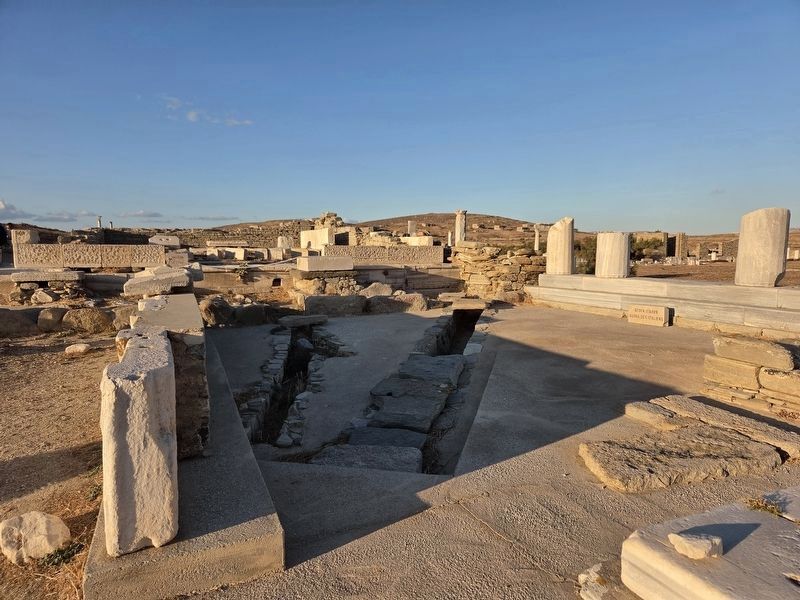
Closeup of the ruins.
Στην βορειοδυτική γωνία υπήρχαν λουτρά (C) και στις τρεις πλευρές εξωτερικά υπήρχαν πολλά μικρά καταστήματα και εργαστήρια. Στην νοτιοδυτική γωνία της Αγοράς, στο εργαστήριο ενός γλύπτη (E), βρέθηκε το ανάγλυφο της Ίσιδος Πελαγίας, προστάτιδος των ναυτικών. Η θεά, ντυμένη με μακρύ χιτώνα ζωσμένο κάτω από το στήθος, στέκεται στην πλώρη πολεμικού πλοίου με τα πόδια ανοικτά για να αντιστέκεται στη δύναμη του ανέμου. Με τα δύο της χέρια και με το αριστερό της πόδι κρατά το ιμάτιό της ανοικτό στον άνεμο, έτσι ώστε το σώμα της γίνεται ιστός, τα χέρια της κεραία και το ιμάτιό της ιστίο του καραβιού.
Χρηματοδοτήθηκε από την ΕΟΚ και την Ελληνική Δημοκρατία.
Κείμενα και σχεδιασμός: P. J. Hadjidakis, Αρχαιολόγος
Italians began settling on Delos as early as the 3rd cent. BC, their presence becoming stronger after the mid-2nd cent. BC with Rome’s rise to predominance. Most were bankers and merchants from South Italy and Sicily organized in various professional societies, each under the patronage of a god, whether Apollo (Apolloniasts), Poseidon (Poseidoniasts) or Hermes (Hermaists). In the Agora of the Compitaliasts, the center of their commercial activities, they dedicated many monuments and altars. Most of them lived in the town’s new quarters north of the Sanctuary, where, towards the end of the 2nd cent. BC, they built the so-called Agora of the Italians, the meeting place for the members of the Italian community.
Around 130 BC the marshes south of the Sacred Lake were filled with earth, sometimes as much as two meters thick, and part of the temenos (sacred precinct) of Letoon was sacrificed to allow for the construction of the flamboyantly luxurious Agora of the Italians, the largest building on Delos. With the construction of this defiantly massive building on the holy isle, the Superpower of the age made an explicit statement of its presence, its power and the regulating role it was determined to play in the Aegean. By the same means the Naxians and the Athenians declared their intentions in the past and made a statement of the leading role they had decided to play in the area.
A marble gate on the southwest side (A) led into a large open-air space surrounded by two-storied colonnades with Doric columns on the ground floor and square pilasters on the upper floor. The architrave was inscribed with the names of the sponsors in both Greek and Latin.
Behind the ground floor colonnades were niches and exedrae with honorific statues. In one such exedra (B) stood the larger-than-life statue of Gaius Ophellius Ferus, created by the Athenian sculptors Dionysus and Timarchides, as indicated by the inscription on the base. Gaius Ophellius, a wealthy merchant from Campania who had business interests on Delos, paid for the construction of the Agora’s west colonnade, perhaps under the condition that he would be granted a spot in which to place his statue. Naturally he paid not only for the construction of the alcove but for the statue as well. He is depicted nude, his himation flung over his left shoulder, with a youthful vigorous body, in the manner of works by Polyclitus and Praxiteles. Standing, his raised right hand braced upon a long spear and his left holding a small sword, imitating the stance of statues of Alexander the Great, he may possibly draw a parallel between his commercial successes and the conqueror’s achievements. Both conquered the world.
In another of the Agora’s niches was found the head from the equestrian statue of a man in a cuirass. The expressionless face with its stern fixed glance and tight lips reveals someone accustomed to giving orders. The highly polished marble further accentuates the cold expression of the military man.
Two statues of Gauls from the same site are quite different. They were probably related to the victories of the Kings of Pergamum against the Gauls, or the slaughter of Celtic mercenaries by the soldiers of Ptolemy II Philadelphus in 276 BC. The first statue (niche D, Athens, National Archaeological Museum), depicts a wounded Gallic warrior, fallen onto his right knee but continuing to fight raising the characteristic shield he grasps in his right hand. Only the striking head of the second statue, with its wild “barbaric” features survives. Both statues emphasize the fierce nature of the Gauls in order to make the achievement of the victors even more admirable. In these works, as on the altar of Pergamum and the Parthenon, the victories of the Greeks against the “barbarians” are presented as victories of Civilisation over Barbarism, of Order against Anarchy, of Law against Violence, achievements comparable to those of the Olympian Gods (battle against the Giants), raising the victorious kings to the level of Divine Saviours.
On the north-west corner there were baths (C) and on the three sides, outside the Agora, were many small shops and workshops. In the south west corner, in the workshop of a sculptor (E), was found a relief representing Isis Pelagia, the protector of seamen. The goddess, dressed in a long robe girdled under the breasts, is standing on the prow of a warship with her feet apart to resist the force of the wind. With both her arms and with her left foot, she is holding her himation open to the wind, so that her body becomes a mast, her arms the yards and her himation the sail.
Sponsored by the EEC and the Hellenic Republic.
Texts and design by P. J. Hadjidakis, Archaeologist
Erected by EEC and the Hellenic Republic.
Topics. This historical marker is listed in this topic list: Anthropology & Archaeology. A significant historical year for this entry is 130 BCE.
Location. 37° 24.091′ N, 25° 16.016′ E. Marker is in Delos, The Aegean, in Mykonos. It is on Odos Hvris Onomasia. Touch for map. Marker is in this post office area: Delos, The Aegean 846 00, Greece. Touch for directions.

Regionally, it is in Europe, the European Union, the Schengen Area, a coastal Mediterranean country, and the Western World. Historically, it finds itself in what was once the Byzantine Empire, the Ottoman Empire, and specifically the Roman Empire.
Other nearby markers. At least 8 other markers are within walking distance of this marker: The Lions of the Naxians (within shouting distance of this marker); The Poros Temple (about 90 meters away, measured in a direct line); Temple of the Athenians (about 120 meters away); Temple of the Delians, or Great Temple (about 120 meters away); The Oikos and the Colossus of the Naxians (about 150 meters away); Portico of Philip V (about 210 meters away); The Theatre Quarter (approx. 0.3 kilometers away); Delos (approx. 0.3 kilometers away). Touch for a list and map of all markers in Delos.
More about this marker. The marker is at the Archaeological Site of Delos, which you can reach by boat from Mykonos. Admission to the site and the round-trip boat fare are charged separately.
Credits. This page was last revised on October 5, 2026. It was originally submitted on October 4, 2026, by James Hulse of Medina, Texas. This page has been viewed 10 times since then. Photos: 1, 2, 3. submitted on October 5, 2026, by James Hulse of Medina, Texas.
