South Kensington in Kensington and Chelsea in Greater London, England, United Kingdom — Northwestern Europe (the British Isles)
Robert Napier
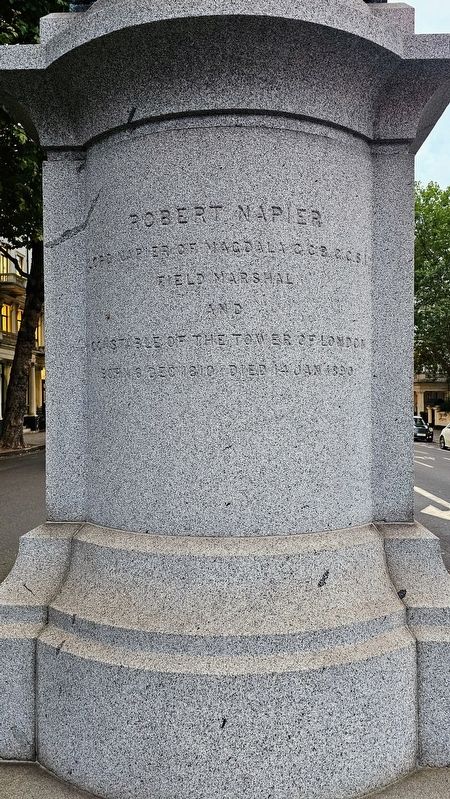
Photographed by Ian Lefkowitz, September 11, 2026
1. Robert Napier Marker
Robert Napier, Lord Napier of Magdala, GCB, GCSI
Field Marshal and Constable of the Tower of London.
Born 6 Dec 1810. died 14 Jan 1890.
(Rear)
Erected by his countrymen, MDCCCXCI
He rests in St Paul's Cathedral
Erected 1891.
Topics. This historical marker is listed in this topic list: Wars, Non-US.
Location. 51° 30.079′ N, 0° 10.816′ W. Marker is in Kensington and Chelsea, England, in Greater London. It is in South Kensington. It is at the intersection of Hyde Park Gate and Kensington Road, in the median on Hyde Park Gate. Touch for map. Marker is at or near this postal address: 1 Hyde Park Gate, Kensington and Chelsea, England SW7 2ET, United Kingdom. Touch for directions.

Regionally, this marker is in London and in the Greater South East. Globally, it is on the Atlantic Ocean, in the North Atlantic Region, in Europe, in Atlantic Europe, on one of the British Isles, in the Western World, and in the Anglosphere. Historically, it finds itself in what was once the Roman Empire.
Other nearby markers. At least 8 other markers are within walking distance of this marker: Benny Hill (within shouting distance of this marker); Robert Baden-Powell (about 90 meters away, measured in a direct line); Enid Bagnold (about 150 meters away); Sir Jacob Epstein (about 150 meters away); Sir Winston Churchill (about 180 meters away); Holy Trinity Church (about 180 meters away); Sir Leslie Stephen (about 210 meters away); Vanessa Bell (about 210 meters away). Touch for a list and map of all markers in Kensington and Chelsea.
Also see . . . Equestrian statue of Robert Napier (Wikipedia).
The Equestrian statue of Robert Napier is a Grade II listed statue at the northern end of Queen's Gate in Kensington. Lord Napier was of a military(Submitted on October 4, 2026, by Ian Lefkowitz of New York, New York.)background and served in India and China. His most significant act, for which he would receive his baronetcy, was leading the British expedition to Abyssinia in 1867–1868. Here he would capture Magdala with the aim of freeing European hostages taken by Tewodros II.
Click or scan to see
this page online
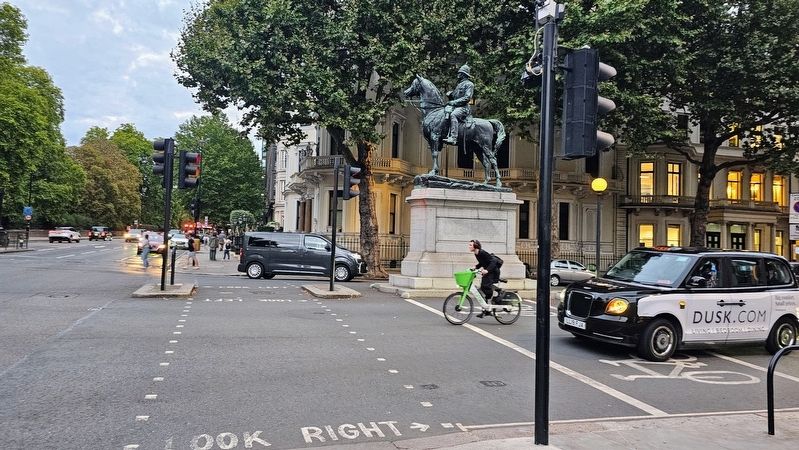
Photographed by Ian Lefkowitz, September 11, 2026
2. Field Marshal Lord Napier of Magdala by Joseph Edgar Boehm
Credits. This page was last revised on October 11, 2026. It was originally submitted on October 4, 2026, by Ian Lefkowitz of New York, New York. This page has been viewed 13 times since then. Photos: 1, 2. submitted on October 4, 2026, by Ian Lefkowitz of New York, New York. • Andrew Ruppenstein was the editor who published this page.
