Near Queenstown in Queen Anne's County, Maryland — The American Northeast (Mid-Atlantic)
“Bloomingdale”
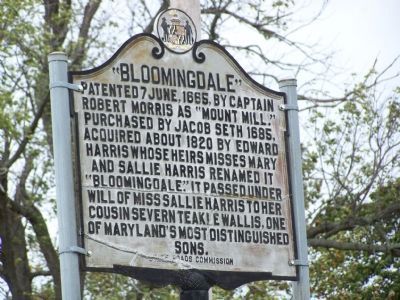
Photographed by Beverly Pfingsten, October 19, 2007
1. "Bloomingdale" Marker
Erected 1939 by State Roads Commission.
Topics and series. This historical marker is listed in these topic lists: Colonial Era • Settlements & Settlers • Women. In addition, it is included in the Maryland Historical Trust, and the National Register of Historic Places (NRHP) series lists. A significant historical date for this entry is June 7, 1665.
Location. 38° 58.25′ N, 76° 7.268′ W. Marker is near Queenstown, Maryland, in Queen Anne's County. It is on U.S. 50 0.1 miles east of Bloomingdale Road, on the right when traveling west. Touch for map. Marker is in this post office area: Queenstown MD 21658, United States of America. Touch for directions.

Regionally, this marker is on the Eastern Shore. It is also in the American Mid-Atlantic, on the
this page online
Other nearby markers. At least 8 other markers are within 3 miles of this marker, measured as the crow flies: Historic Points (about 700 feet away, measured in a direct line); St. Peter’s Church (approx. 0.8 miles away); "Clover Field" (approx. 2 miles away); Chesapeake College (approx. 2.3 miles away); War in the Chesapeake (approx. 2.4 miles away); Surprise at Queenstown (approx. 2.4 miles away); Colonial Courthouse (approx. 2.4 miles away); Queenstown (approx. 2.4 miles away). Touch for a list and map of all markers in Queenstown.
Also see . . .
1. Bloomingdale, patented 1665. A section about Bloomingdale begins on page 127 in Maryland's Colonial Eastern Shore: Historical Sketches of Counties and of Notable Structures, edited
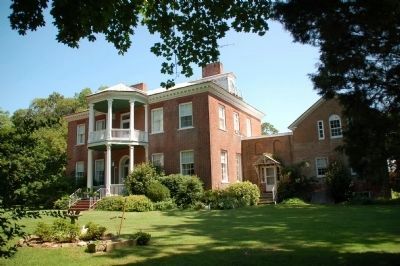
Photographed by Barbara Wallis Barry Savidge, July 20, 2008
2. “Bloomingdale” house
This is Bloomingdale, the final home of my ancestor Severn Teackle Wallis (born in Baltimore 9/8/1816). The house with farmland was bequeathed to him in 1880 by his spinster cousins Mary & Sallie Harris. He resided at Bloomingdale until his death in Baltimore 4/11/1894.
2. Bloomingdale - National Register of Historic Places Nomination Form.
Bloomingdale's importance is primarily its architectural merit; secondarily its builder and subsequent owners. It represents the architectural transition from an English Georgian building style to an American style, which is evident in the interior woodwork. It also represents the tangible achievement of the Seth family after owning the land for over one hundred years (1685-1808).(Submitted on February 24, 2026, by Pete Skillman of Wilmington, Delaware.)
Additional keywords. Severn Teackle Wallis
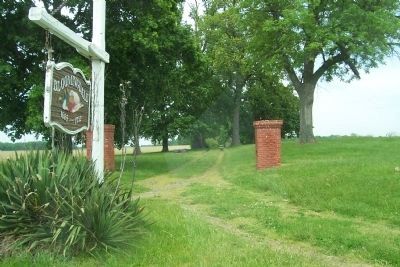
Photographed by Richard E. Miller, April 21, 2012
3. “Bloomingdale”
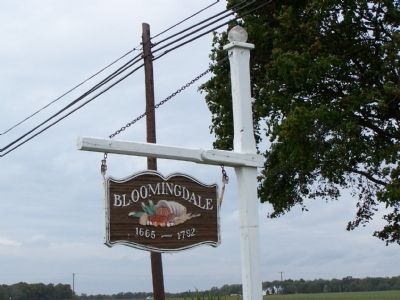
Photographed by Beverly Pfingsten, October 19, 2007
4. Sign at entrance lane.
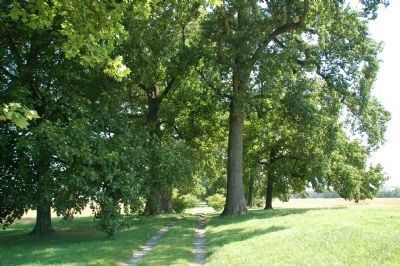
Photographed by Barbara Wallis Barry Savidge, July 20, 2008
5. driveway to“Bloomingdale” house
This photo shows the long (approx. 400-500 ft) beautiful tree-lined driveway, from Md. Rt. 50 Bloomingdale marker, up to the house, with farm fields on either side.
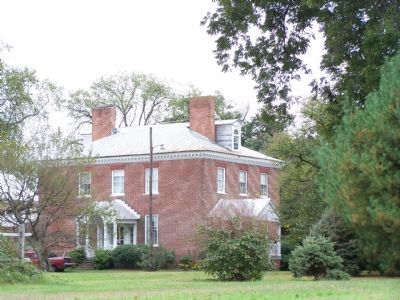
Photographed by Beverly Pfingsten, October 19, 2007
6. Bloomingdale Farm
Credits. This page was last revised on February 24, 2026. It was originally submitted on October 24, 2007, by Bill Pfingsten of Bel Air, Maryland. This page has been viewed 9,137 times since then and 365 times this year. Photos: 1. submitted on October 24, 2007, by Bill Pfingsten of Bel Air, Maryland. 2. submitted on July 20, 2008, by Barbara Wallis Barry Savidge of Linden, Virginia. 3. submitted on June 28, 2013, by Richard E. Miller of Oxon Hill, Maryland. 4. submitted on October 24, 2007, by Bill Pfingsten of Bel Air, Maryland. 5. submitted on July 20, 2008, by Barbara Wallis Barry Savidge of Linden, Virginia. 6. submitted on October 24, 2007, by Bill Pfingsten of Bel Air, Maryland. • J. J. Prats was the editor who published this page.
