Buckeye Furnace in Jackson County, Ohio — The American Midwest (Great Lakes)
Cold & Hot Blast Iron Making
Photographed by Craig Doda, August 9, 2026
1. Cold & Hot Blast Iron Making Marker
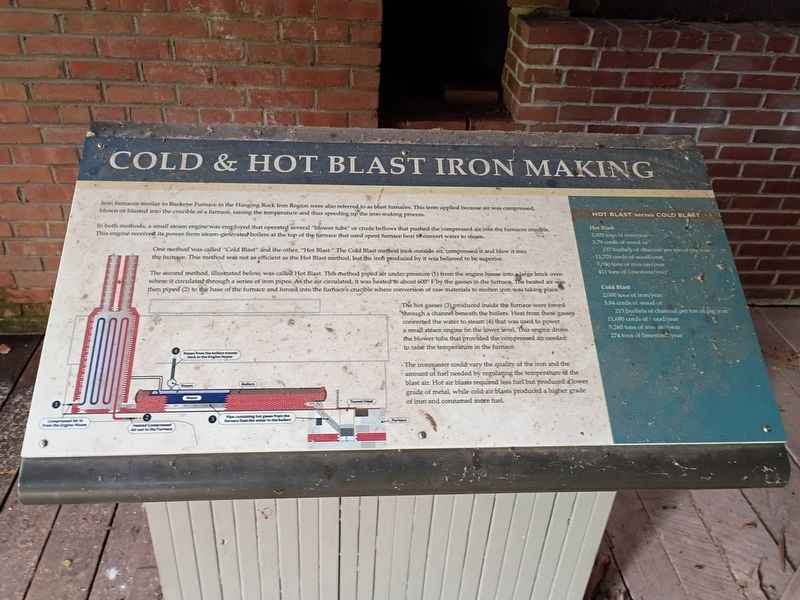
Iron furnaces similar to Buckeye Furnace in the Hanging Rock Iron Region were also referred to as blast furnaces. This term applied because air was compressed, blown or blasted into the crucible of a furnace, raising the temperature and thus speeding up the iron-making process.
In both methods, a small steam engine was employed that operated several "blower tubs" or crude bellows that pushed the compressed air into the furnaces crucible. This engine received its power from steam-generated boilers at the top of the furnace that used spent furnace heat to convert water to steam.
One method was called "Cold Blast" and the other, "Hot Blast." The Cold Blast method took outside air, compressed it and blew it into the furnace. This method was not as efficient as the Hot Blast method, but the iron produced by it was believed to be superior.
The second method, illustrated below, was called Hot Blast. This method piped air under pressure (1) from the engine house into a large brick oven where it circulated through a series of iron pipes. As the air circulated, it was heated to about 600° F by the gasses in the furnace. The
this page online
The hot gasses (3) produced inside the furnace were forced through a channel beneath the boilers. Heat from these gasses converted the water to steam (4) that was used to power a small steam engine on the lower level. This engine drove the blower tubs that provided the compressed air needed to raise the temperature in the furnace.
The ironmaster could vary the quality of the iron and the amount of fuel needed by regulating the temperature of the blast air. Hot air blasts required less fuel but produced a lower grade of metal, while cold air blasts produced a higher grade of iron and consumed more fuel.
Hot Blast
3,000 tons of iron/year
3.79 cords of wood or 137 bushels of charcoal per ton of pig iron
11,370 cords of wood/year
7,890 tons of iron ore/year
411 tons of limestone/year
Cold Blast
2,000 tons of iron/year
5.84 cords of wood or
215 bushels of charcoal per ton of pig iron
11,680 cords of wood/year
5,260 tons of iron ore/year
274
Photographed by Craig Doda, August 9, 2026
2. Cold & Hot Blast Iron Making Marker
Erected by Ohio Historical Society.
Topics and series. This historical marker is listed in this topic list: Indigenous Peoples and Communities. In addition, it is included in the Ohio Historical Society / The Ohio History Connection series list.
Location. 39° 3.378′ N, 82° 27.43′ W. Marker is in Buckeye Furnace, Ohio, in Jackson County. It is at the intersection of Buckeye Park Road and Buckeye Road, on the right when traveling north on Buckeye Park Road. Touch for map. Marker is at or near this postal address: 196 Buckeye Park Rd, Wellston OH 45692, United States of America. Touch for directions.

Regionally, this marker is in Southern Ohio Hill Country. It is also in the American Midwest, in Appalachia, and specifically in Northern Appalachia. Globally, it is in North America, the Western Hemisphere, the Western World, and the Anglosphere. Historically, it finds itself in what was once the Haudenosaunee (Iroquois) Confederacy, the territory of the Mississippian Culture, and the Northwest Territory.
Other nearby markers. At least 8 other markers are within walking distance of this marker: Engine House (a few steps from this marker); Labor at Charcoal Iron Furnace (a few steps from this marker); Shipment of Iron (a few steps from this marker); Bridge Loft/Charging House (a few steps from this marker); a different marker also named Stockyard (within shouting distance of this marker); a different marker also named Stock Shed (within shouting distance of this marker); Charging The Furnace (within shouting distance of this marker); Casting (within shouting distance of this marker). Touch for a list and map of all markers in Buckeye Furnace.
Other markers no longer nearby. Stock Shed (was a few steps from this marker but has been replaced with another marker now near it); Stockyard (was within shouting distance of this marker but has been replaced with another marker now near it).
Credits. This page was last revised on October 6, 2026. It was originally submitted on October 5, 2026, by Craig Doda of Napoleon, Ohio. This page has been viewed 7 times since then. Photos: 1, 2. submitted on October 5, 2026, by Craig Doda of Napoleon, Ohio. • Devry Becker Jones was the editor who published this page.
