Chilton in Calumet County, Wisconsin — The American Midwest (Great Lakes)
Brothertown Methodist Episcopal Church
⎯⎯⎯
Thomas Commuck (1804-1855)
Photographed by Mallory Hanson, 2026
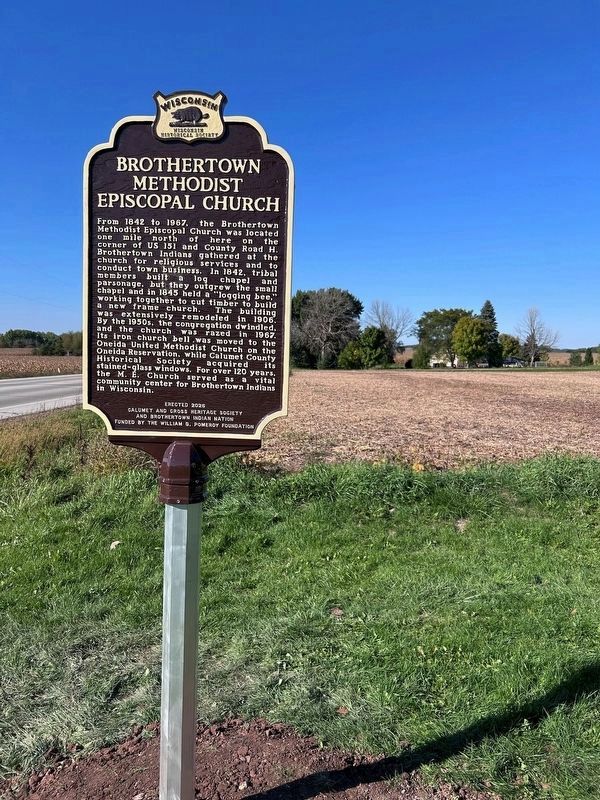
1. Brothertown Methodist Episcopal Church Marker
Brothertown Methodist Episcopal Church
From 1842 to 1967, the Brothertown Methodist Episcopal Church was located one mile north of here on the corner of US 151 and County Road H. Brothertown Indians gathered at the church for religious services and to conduct town business. In 1842, tribal members built a log chapel and parsonage, but they outgrew the small chapel and in 1845 held a “logging bee,” working together to cut timber to build a new frame church. The building was extensively remodeled in 1906. By the 1950s, the congregation dwindled, and the church was razed in 1967. Its iron church bell was moved to the Oneida United Methodist Church on the Oneida Reservation, while Calumet County Historical Society acquired its stained-glass windows. For over 120 years, the M. E. Church served as a vital community center for Brothertown Indians in Wisconsin.
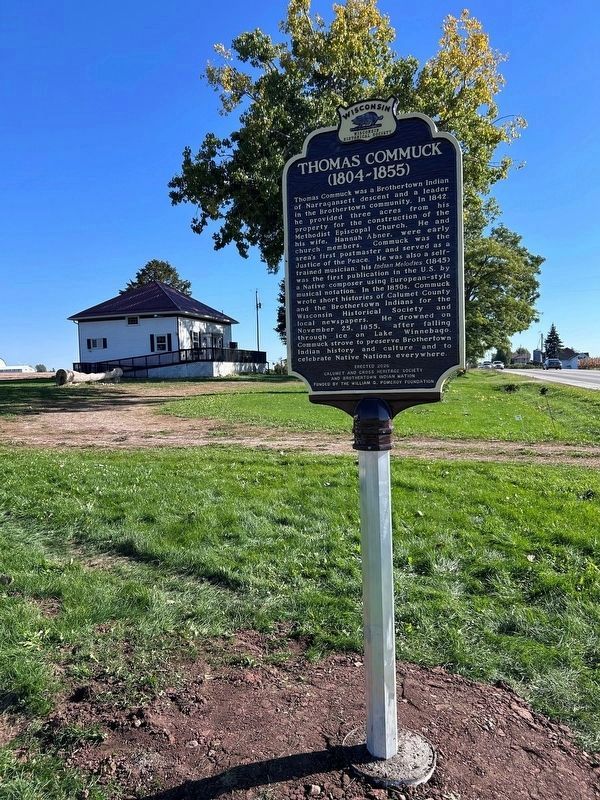
Thomas Commuck (1804-1855)
Thomas Commuck was a Brothertown Indian of Narragansett descent and a leader in the Brothertown community. In 1842, he provided three acres from his property for the construction of the Methodist Episcopal Church. He and his wife, Hannah
this page online
Erected 2026 by Calumet and Cross Heritage Society; Wisconsin Historical Society. (Marker Number 647.)
Topics and series. This historical marker is listed in these topic lists: Indigenous Peoples and Communities • Religion & Religious Structures. In addition, it is included in the William G. Pomeroy Foundation, and the Wisconsin Historical Society series lists. A significant historical date for this entry is November 25, 1855.
Location. 43° 57.39′ N, 88° 18.302′ W. Marker is in Chilton, Wisconsin, in Calumet County. It is on U.S. 151, on
2026
2. Brothertown Methodist Episcopal Church Marker

Regionally, this marker is in the Fox River Valley. It is also in the American Midwest and in the Corn Belt. Globally, it is in North America, the Western Hemisphere, the Western World, and the Anglosphere. Historically, it finds itself in what was once the territory of the Mississippian Culture and also the Northwest Territory.
Other nearby markers. At least 8 other markers are within 9 miles of this marker, measured as the crow flies: The Dick Family Cemetery (approx. 2.8 miles away); The Brothertown Indians of Wisconsin (approx. 3.1 miles away); Old St. Johannes (approx. 4½ miles away); Father Caspar Rehrl / St. John the Baptist Parish (approx. 5.6 miles away); St. John The Baptist Church (approx. 5.6 miles away); Stockbridge Harbor (approx. 8 miles away); Edward S. Bragg (approx. 8.8 miles away); Kiekhaefer Park (approx. 8.9 miles away).
Also see . . .
1. U.S. Congressman Glenn Grothman to Unveil Historical Marker (Brothertown Indian Nation). Full title: U.S. Congressman Glenn Grothman to Unveil Historical Marker at Brothertown Indian Nation Cultural Center
On Saturday, October 17, 2026, a dual-sided historical marker erected by the Wisconsin Historical Society (WHS) will be unveiled in Brothertown by the Honorable Glenn Grothman, U.S. Representative for Wisconsin’s 6th District. The marker, which will be installed on a parcel of original reservation land owned by the Brothertown Indian Nation, honors Brothertown’s Methodist Episcopal Church on one side and composer Thomas Commuck (Narragansett-Brothertown) on the other. ..(Submitted on October 13, 2026.)
2. Thomas Commuck (Wikipedia). Overview:
Thomas Commuck (January 18, 1804 – November 25, 1855) was an American composer and historian. His 1845 collection Indian Melodies has been described as the first published musical work by a Native American.(Submitted on October 13, 2026.)
Credits. This page was last revised on October 13, 2026. It was originally submitted on October 5, 2026, by Mallory Hanson of Madison, Wisconsin. This page has been viewed 18 times since then. Photos: 1. submitted on October 5, 2026, by Mallory Hanson of Madison, Wisconsin. 2. submitted on October 5, 2026. • Andrew Ruppenstein was the editor who published this page.
