Feuerbach in Stuttgart, Baden-Württemberg, Germany — Central Europe
Wie gut kennen Sie Feuerbach?
⎯⎯⎯
How Well Do You Know Feuerbach?
Photographed by James Hulse, September 10, 2026
1. Wie gut kennen Sie Feuerbach? / How Well Do You Know Feuerbach? Marker

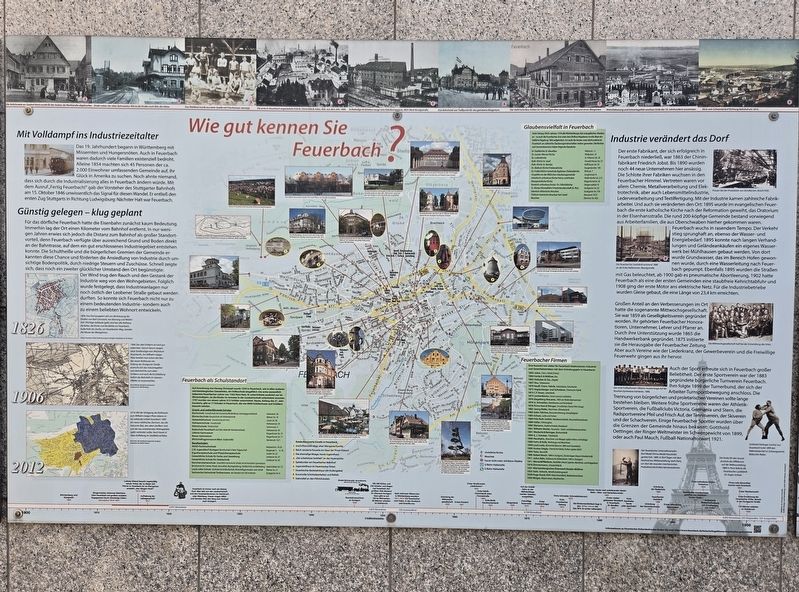
Mit Volldampf ins Industriezeitalter
Das 19. Jahrhundert begann in Württemberg mit Missernten und Hungersnöten. Auch in Feuerbach waren dadurch viele Familien existenziell bedroht. Alleine 1854 machten sich 45 Personen der ca. 2.000 Einwohner umfassenden Gemeinde auf, ihr Glück in Amerika zu suchen. Noch ahnte niemand, dass sich durch die Industrialisierung alles in Feuerbach ändern würde. Mit dem Ausruf „Fertig Feuerbach!“ gab der Vorsteher des Stuttgarter Bahnhofs am 15. Oktober 1846 unwissentlich das Signal für diesen Wandel. Er entließ den ersten Zug Stuttgarts in Richtung Ludwigsburg: Nächster Halt war Feuerbach.
Günstig gelegen – klug geplant
Für das dörfliche Feuerbach hatte die Eisenbahn zunächst kaum Bedeutung. Immerhin lag der Ort einen Kilometer vom Bahnhof entfernt. In nur wenigen Jahren erwies sich jedoch die Distanz zum Bahnhof als großer Standortvorteil, denn Feuerbach verfügte über ausreichend Grund und Boden direkt an der Bahntrasse, auf dem ein gut erschlossenes Industriegebiet entstehen konnte. Die Schultheiße und die bürgerlichen Gremien der Gemeinde erkannten
this page online
Industrie verändert das Dorf
Der erste Fabrikant, der sich erfolgreich in Feuerbach niederließ, war 1863 der Chininfabrikant Friedrich Jobst. Bis 1890 wurden noch 44 neue Unternehmen hier ansässig. Die Schlote ihrer Fabriken wuchsen in den Feuerbacher Himmel. Vertreten waren vor allem Chemie, Metallverarbeitung und Elektrotechnik, aber auch Lebensmittelindustrie, Lederverarbeitung und Textilfertigung. Mit der Industrie kamen zahlreiche Fabrikarbeiter. Und auch sie veränderten den Ort: 1895 wurde im evangelischen Feuerbach die erste katholische Kirche nach der Reformation geweiht, das Oratorium in der Elsenhansstraße. Die rund
Photographed by James Hulse, September 10, 2026
2. Wie gut kennen Sie Feuerbach? / How Well Do You Know Feuerbach? Marker
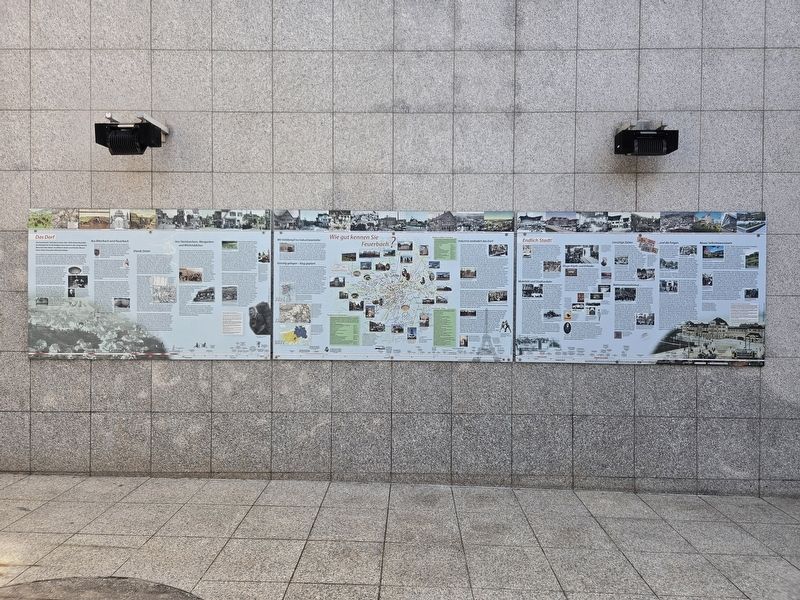
Middle marker of the three markers.
Großen Anteil a den Verbesserungen im Ort hatte die sogenannte Mittwochsgesellschaft. Sie war 1859 als Geselligkeitsverein gegründet worden. Ihr gehörten Feuerbacher Honoratioren, Unternehmer, Lehrer und Pfarrer an. Durch ihre Unterstützung wurde 1865 die Handwerkerbank gegründet. 1875 initiierte sie die Herausgabe der Feuerbacher Zeitung. Aber auch Vereine wie der Liederkranz, der Gewerbeverein
Photographed by James Hulse, September 10, 2026
3. Wie gut kennen Sie Feuerbach? / How Well Do You Know Feuerbach? Marker
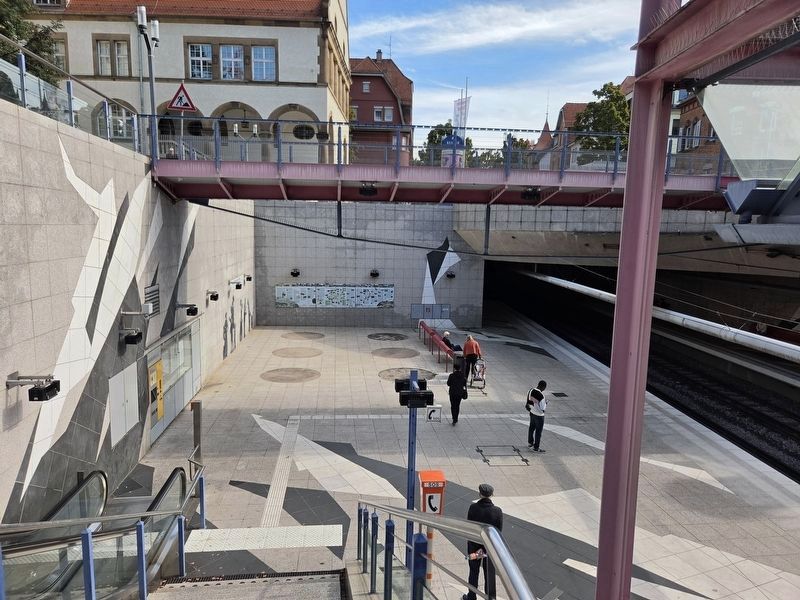
The markers are located on the lower level at the subway station.
Auch der Sport erfreute sich in Feuerbach großer Beliebtheit. Der erste Sportverein war der 1883 gegründete bürgerliche Turnverein Feuerbach. Ihm folgte 1898 der Turnerbund, der sich der Arbeiter-Turnsportbewegung anschloss. Die Trennung von bürgerlichen und proletarischen Vereinen sollte lange bestehen bleiben. Weitere frühe Sportvereine waren der Athletik-Sportverein, die Fußballclubs Victoria, Germania und Stern, die Radsportvereine Pfeil und Frisch Auf, der Tennisverein, der Skiverein und der Schachverein. Einige Feuerbacher Sportler wurden über die Grenzen der Gemeinde hinaus bekannt: Gotthold Oettinger, der Ringer-Weltmeister im Schwergewicht von 1899, oder auch Paul Mauch, Fußball-Nationaltorwart 1921.
Bildunterschriften
Die Hufschmiede am Gasthof Hirsch wurde für den Ausbau der Marktstraße abgebrochen.
Direkt neben der alten Bahnstation führte die Straße noch über die Gleise.
Das Waldbad wurde aus einer Quelle mit Frischwasser versorgt.
Die erste in Feuerbach angesiedelte Fabrik: Chininfabrik Jobst, Abb. aus dem Jahr 1890.
Aufwändige Architektur zeugt vom Fabrikantenstolz, MEA-Werk Borsigstraße.
Das Bahnhofshotel war Treffpunkt für das gehobene Bürgertum.
Der Stroh’sche Bau mitten im Ort verfügte über einen großen Saal und einen Biergarten.
Wohnbebauung und Industriegebiet wachsen Ende des 19. Jahrhunderts zusammen.
Blick vom Schwarzenhof Richtung Bahnhof um 1910.
1826: Das Dorf gruppiert sich um die Kreuzung der Straßen von Bad Cannstatt, von Botnang und Weilimdorf. Wichtige Gebäude (gelb) sind das alte Rathaus, die Kelter, die Kirche und die Mühle am Feuerbach. Außerhalb des Dorfes, am Feuerbacher Weg, standen die Häuser der Weingärtner.
1906: Der alte Ortskern ist noch gut erkennbar. Darum herum zeugen neue Straßenzüge vom Wachstum Feuerbachs. Am Wilhelm-Geiger-Platz bereitet man schon den Bau des neuen Rathauses vor. Entlang der Stuttgarter Straße erstreckt sich das Industriegebiet vom Bahnhof bis zum alten Ortskern und auch die Erschließung östlich des Bahnhofs im Gewann Affalter ist auszumachen.
2010: Mit der Verlegung des Rathauses zum Wilhelm-Geiger-Platz (oberes rotes Gebäude) erhielt Feuerbach 1909 ein neues städtisches Zentrum, das die Industrie (lila), den alten Dorfkern (rot) und die neu entstehenden Wohngebiete (gelb) verbinden sollte. Noch heute ist diese Aufteilung im Stadtbild sichtbar.
Frauen bei der Produktion von Zündkerzen, Bosch 1920.
Die Feuerbacher Gasfabrik entstand 1888 an der Ecke Heilbronner-/Borsigstraße.
Die Mittwochsgesellschaft half bei der Entwicklung des Ortes.
Der erste Fußballverein Viktoria musste lange auf der feuchten Eyachwiese trainieren, 1906.
Gotthold Oettinger (rechts) aus Feuerbach holte 1899 den Weltmeistertitel im Schwergewicht. Bildarchiv Rieker.
Der Feuerbacher Unternehmersohn Karl Model (Firma Model Haushaltsgeräte) fuhr 1889 in fünf Tagen mit dem Hochrad zur Weltausstellung nach Paris, um dort die neuesten mechanischen Produktionstechniken kennenzulernen.
Die Farbe für den Grundanstrich des Eiffelturms auf der Weltausstellung 1889 in Paris lieferte die Feuerbacher Lackfabrik Dr. Eugen Schaal.
Informationen zu Feuerbacher Kulturdenkmalen finden Sie unter http://www.feuerbach.de/historie/begehbares-feuerbacher-gedaechtnis
How Well Do You Know Feuerbach?
Full Steam Ahead into the Industrial Age
The 19th century began in Württemberg with crop failures and famine. These also threatened the livelihoods of many families in Feuerbach. In 1854 alone, 45 people from the community of approximately 2,000 inhabitants left to seek their fortune in America. No one yet suspected that industrialization would change everything in Feuerbach. With the call “Ready, Feuerbach!” the stationmaster at Stuttgart’s railway station unknowingly signaled this transformation on October 15, 1846. He dispatched Stuttgart’s first train toward Ludwigsburg. Its next stop was Feuerbach.
Well Located – Wisely Planned
Initially, the railway had little importance for the village of Feuerbach. The settlement was a kilometer from the station. Within only a few years, however, this distance proved to be a major advantage: Feuerbach had sufficient land directly beside the railway where an industrial district with good transport connections could develop. The mayors and municipal committees recognized this opportunity and encouraged industry through careful land policies, low taxes and subsidies. Another favorable circumstance soon became apparent: the wind carried industrial smoke and odors away from the residential areas. It was therefore decided that new industrial facilities could be built only east of Leobener Straße. Feuerbach was consequently able to develop into both an important industrial center and a popular place to live.
Industry Changes the Village
The first manufacturer to establish a successful business in Feuerbach was quinine producer Friedrich Jobst in 1863. By 1890, another 44 companies had settled here. Their factory chimneys rose into Feuerbach’s skyline. The principal industries were chemicals, metalworking and electrical engineering, alongside food production, leather processing and textile manufacturing. Industry brought numerous factory workers, who also changed the community. In 1895, the first Catholic church since the Reformation was consecrated in Protestant Feuerbach: the Oratory on Elsenhansstraße. Its congregation of approximately 200 consisted mainly of working families who had moved here from Upper Swabia. Feuerbach grew rapidly. Traffic increased sharply, as did the demand for water and energy. After lengthy negotiations and land purchases, its own waterworks was built near Mühlhausen in 1895. Groundwater obtained near Hofen was pumped from there to Feuerbach through a pipeline. Gas street lighting was also introduced in 1895. From 1900, pneumatic equipment was used to empty privies. In 1902, Feuerbach became one of the first communities to introduce dust-free refuse collection, and in 1908 the first motor was connected to the electricity network. Railway tracks totaling 23.4 kilometers were built for the industrial businesses.
The Wednesday Society played a major role in improvements to the community. Founded in 1859 as a social club, its members included prominent residents, business owners, teachers and pastors. Its support helped establish the Handwerkerbank in 1865. In 1875, it initiated publication of the Feuerbacher Zeitung. Organizations such as the Liederkranz choral society, the trade association and the volunteer fire brigade also emerged from it.
Sports were likewise popular in Feuerbach. Its first sports club was the middle-class Turnverein Feuerbach, founded in 1883. In 1898, it was followed by the Turnerbund, which joined the workers’ gymnastics movement. The separation between middle-class and working-class clubs continued for many years. Other early clubs included an athletics club; the Victoria, Germania and Stern football clubs; the Pfeil and Frisch Auf cycling clubs; and tennis, skiing and chess clubs. Some Feuerbach athletes became known beyond the community, including Gotthold Oettinger, the 1899 heavyweight wrestling world champion, and Paul Mauch, a goalkeeper for the national football team in 1921.
Photo Captions
The farrier’s workshop at the Hirsch Inn was demolished for the widening of Marktstraße.
Beside the old railway station, the road still crossed the tracks.
The woodland swimming pool was supplied with fresh water from a spring.
The first factory established in Feuerbach: Jobst’s quinine factory, illustration from 1890.
Elaborate architecture reflects the manufacturers’ pride: the MEA factory on Borsigstraße.
The railway station hotel was a meeting place for the prosperous middle class.
The Stroh building in the center of the settlement had a large hall and a beer garden.
Residential development and the industrial district grew together at the end of the 19th century.
View from Schwarzenhof toward the railway station around 1910.
1826: The village clustered around the junction of the roads from Bad Cannstatt, Botnang and Weilimdorf. Important buildings, shown in yellow, included the old town hall, wine press, church and mill on the Feuerbach stream. The winegrowers’ houses stood outside the village on Feuerbacher Weg.
1906: The old village center remained clearly recognizable. New streets around it reflected Feuerbach’s growth. Preparations were already being made for the new town hall at Wilhelm-Geiger-Platz. The industrial district extended along Stuttgarter Straße from the railway station to the old village center. Development east of the station in the Affalter area was also visible.
2010: With the relocation of the town hall to Wilhelm-Geiger-Platz, shown as the upper red building, Feuerbach gained a new civic center in 1909. It was intended to connect the industrial district, shown in purple, the old village center, shown in red, and the newly developing residential areas, shown in yellow. This division remains visible in the town today.
Women producing spark plugs at Bosch, 1920.
Feuerbach’s gasworks was built in 1888 at the corner of Heilbronner Straße and Borsigstraße.
The Wednesday Society helped develop the community.
The first football club, Viktoria, had to train on the wet Eyach meadow for many years, 1906.
Gotthold Oettinger, on the right, from Feuerbach won the heavyweight world championship in 1899. Rieker photo archive.
Karl Model, the son of a Feuerbach businessman from the Model household-appliance company, rode a penny-farthing bicycle to the Paris World’s Fair in 1889. The journey took five days. He went to learn about the latest mechanical production techniques.
The Dr. Eugen Schaal paint factory in Feuerbach supplied the paint used for the Eiffel Tower’s base coat at the 1889 Paris World’s Fair.
Information about Feuerbach’s cultural monuments is available at http://www.feuerbach.de/historie/begehbares-feuerbacher-gedaechtnis
Erected 2012 by AG Erlebbare Stadtgeschichte.
Topics. This historical marker is listed in these topic lists: Agriculture • Disasters • Industry & Commerce • Settlements & Settlers. A significant historical date for this entry is October 15, 1846.
Location. 48° 48.709′ N, 9° 9.553′ E. Marker is in Feuerbach, Baden-Württemberg, in Stuttgart. It is on Wilhelm-Geiger-Platz. The markers are located at the lower level of the subway station. Touch for map. Marker is at or near this postal address: Wilhelm-Geiger-Platz 10, Feuerbach BW 70469, Germany. Touch for directions.

Regionally, this marker is in German Swabia. Globally, it is in Europe, the European Union, Atlantic Europe, Central Europe, the Schengen Area, Western Europe, and the Western World. Historically, it finds itself in what was once the Roman Empire, the Holy Roman Empire, and the former West Germany.
Other nearby markers. At least 8 other markers are within walking distance of this marker: Endlich Stadt! / A Town at Last! (here, next to this marker); Das Dorf / The Village (here, next to this marker); Die gute Schneiderkanne! / The Good Schneider Watering Can! (here, next to this marker); Wilhelm Geiger (here, next to this marker); Robert Bosch in Feuerbach (here, next to this marker); Auguste Happold (here, next to this marker); Schule in Feuerbach / Schools in Feuerbach (here, next to this marker); Der Talkrabb / The Valley Crow (here, next to this marker).
Credits. This page was last revised on October 7, 2026. It was originally submitted on October 6, 2026, by James Hulse of Medina, Texas. This page has been viewed 6 times since then. Photos: 1, 2, 3. submitted on October 6, 2026, by James Hulse of Medina, Texas.
