Dinkelsbühl in Ansbach, Bavaria, Germany — Central Europe
Ausgezehrt und ausgepresst
Der 30jährige Krieg in Dinkelsbühl
⎯⎯⎯
Exhausted and Drained
The Thirty Years’ War in Dinkelsbühl
Photographed by James Hulse, September 14, 2026
1. Ausgezehrt und ausgepresst / Exhausted and Drained Marker

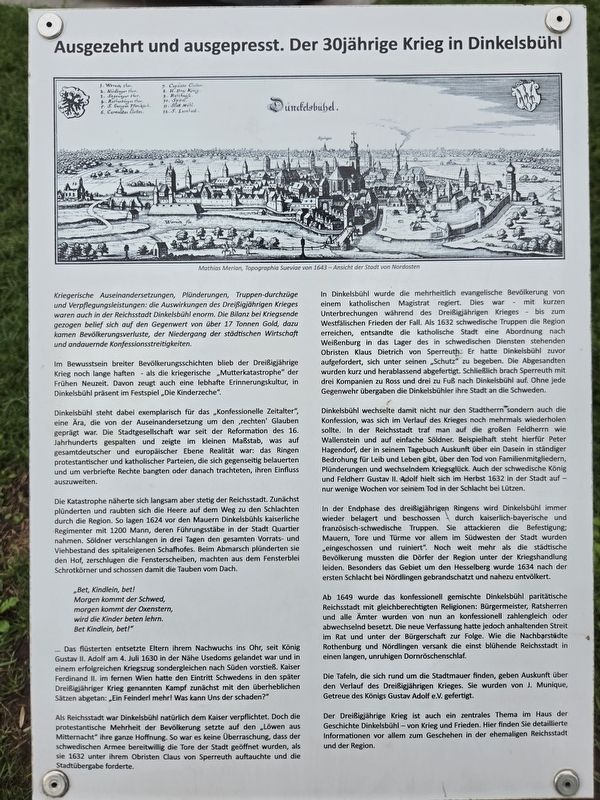
Kriegerische Auseinandersetzungen, Plünderungen, Truppen-durchzüge und Verpflegungsleistungen: die Auswirkungen des Dreißigjährigen Krieges waren auch in der Reichsstadt Dinkelsbühl enorm. Die Bilanz bei Kriegsende gezogen belief sich auf den Gegenwert von über 17 Tonnen Gold, dazu kamen Bevölkerungsverluste, der Niedergang der städtischen Wirtschaft und andauernde Konfessionsstreitigkeiten.
Im Bewusstsein breiter Bevölkerungsschichten blieb der Dreißigjährige Krieg noch lange haften – als die kriegerische „Mutterkatastrophe“ der Frühen Neuzeit. Davon zeugt auch eine lebhafte Erinnerungskultur, in Dinkelsbühl präsent im Festspiel „Die Kinderzeche“.
Dinkelsbühl steht dabei exemplarisch für das „Konfessionelle Zeitalter“, eine Ära, die von der Auseinandersetzung um den ‚rechten‘ Glauben geprägt war. Die Stadtgesellschaft war seit der Reformation des 16. Jahrhunderts gespalten und zeigte im kleinen Maßstab, was auf gesamtdeutscher und europäischer Ebene Realität war: das Ringen protestantischer und katholischer Parteien, die sich gegenseitig belauerten
this page online
Die Katastrophe näherte sich langsam aber stetig der Reichsstadt. Zunächst plünderten und raubten sich die Heere auf dem Weg zu den Schlachten durch die Region. So lagen 1624 vor den Mauern Dinkelsbühls kaiserliche Regimenter mit 1200 Mann, deren Führungsstäbe in der Stadt Quartier nahmen. Söldner verschlangen in drei Tagen den gesamten Vorrats- und Viehbestand des spitaleigenen Schafhofes. Beim Abmarsch plünderten sie den Hof, zerschlugen die Fensterscheiben, machten aus dem Fensterblei Schrotkörner und schossen damit die Tauben vom Dach.
„Bet, Kindlein, bet!
Morgen kommt der Schwed,
morgen kommt der Oxenstern,
wird die Kinder beten lehrn.
Bet Kindlein, bet!“
… Das flüsterten entsetzte Eltern ihrem Nachwuchs ins Ohr, seit König Gustav II. Adolf am 4. Juli 1630 in der Nähe Usedoms gelandet war und in einem erfolgreichen Kriegszug sondergleichen nach Süden vorstieß. Kaiser Ferdinand II. im fernen Wien hatte den Eintritt Schwedens in den später Dreißigjähriger Krieg genannten Kampf zunächst mit den überheblichen Sätzen abgetan: „Ein Feinderl mehr!
Photographed by James Hulse, September 14, 2026
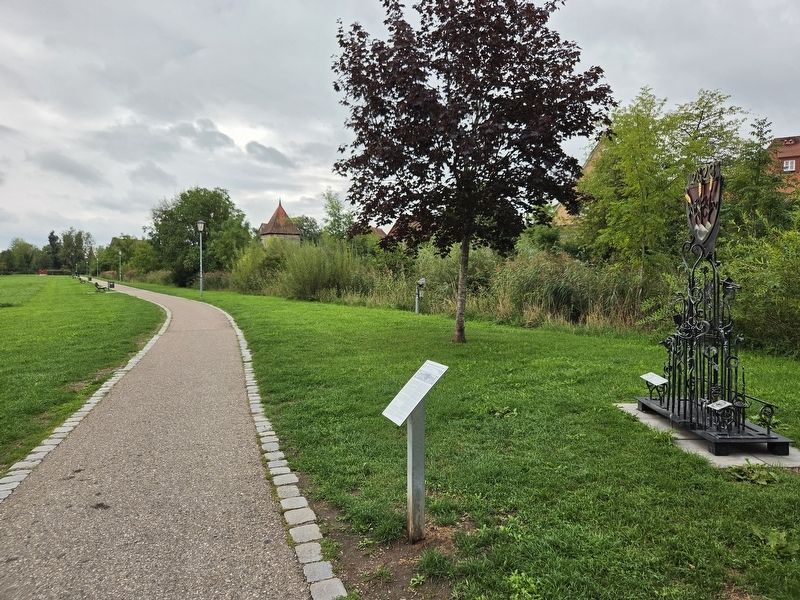
2. Ausgezehrt und ausgepresst / Exhausted and Drained Marker
Als Reichsstadt war Dinkelsbühl natürlich dem Kaiser verpflichtet. Doch die protestantische Mehrheit der Bevölkerung setzte auf den „Löwen aus Mitternacht“ ihre ganze Hoffnung. So war es keine Überraschung, dass der schwedischen Armee bereitwillig die Tore der Stadt geöffnet wurden, als sie 1632 unter ihrem Obristen Claus von Sperreuth auftauchte und die Stadtübergabe forderte.
In Dinkelsbühl wurde die mehrheitlich evangelische Bevölkerung von einem katholischen Magistrat regiert. Dies war – mit kurzen Unterbrechungen während des Dreißigjährigen Krieges – bis zum Westfälischen Frieden der Fall. Als 1632 schwedische Truppen die Region erreichen, entsandte die katholische Stadt eine Abordnung nach Weißenburg in das Lager des in schwedischen Diensten stehenden Obristen Klaus Dietrich von Sperreuth. Er hatte Dinkelsbühl zuvor aufgefordert, sich unter seinen „Schutz“ zu begeben. Die Abgesandten wurden kurz und herablassend abgefertigt. Schließlich brach Sperreuth mit drei Kompanien zu Ross und drei zu Fuß nach Dinkelsbühl auf. Ohne jede Gegenwehr übergaben die Dinkelsbühler ihre Stadt an die Schweden.
Dinkelsbühl
Photographed by James Hulse, September 14, 2026
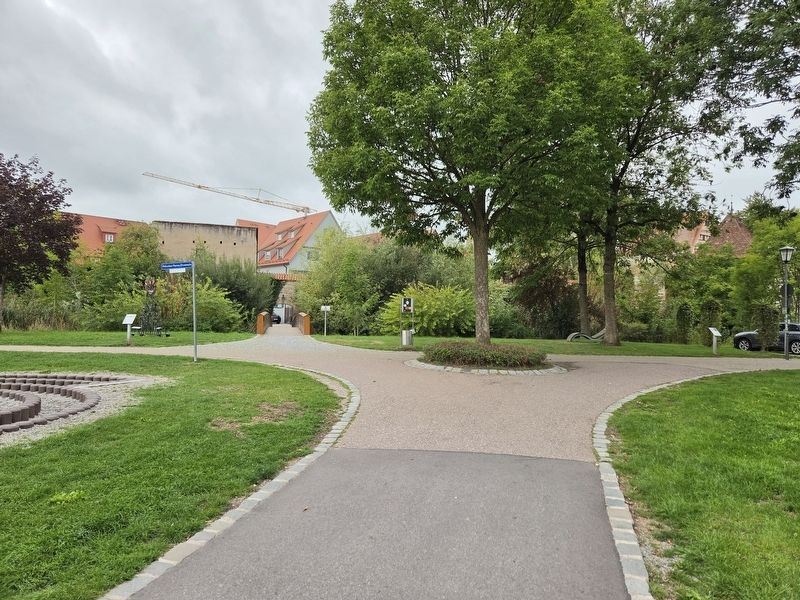
3. Ausgezehrt und ausgepresst / Exhausted and Drained Marker (Left Side)
In der Endphase des dreißigjährigen Ringens wird Dinkelsbühl immer wieder belagert und beschossen durch kaiserlich-bayerische und französisch-schwedische Truppen. Sie attackieren die Befestigung; Mauern, Tore und Türme vor allem im Südwesten der Stadt wurden „eingeschossen und ruiniert“. Noch weit mehr als die städtische Bevölkerung mussten die Dörfer der Region unter der Kriegshandlung leiden. Besonders das Gebiet um den Hesselberg wurde 1634 nach der ersten Schlacht bei Nördlingen gebrandschatzt und nahezu entvölkert.
Ab 1649
Photographed by James Hulse, September 14, 2026
4. Ausgezehrt und ausgepresst / Exhausted and Drained Marker
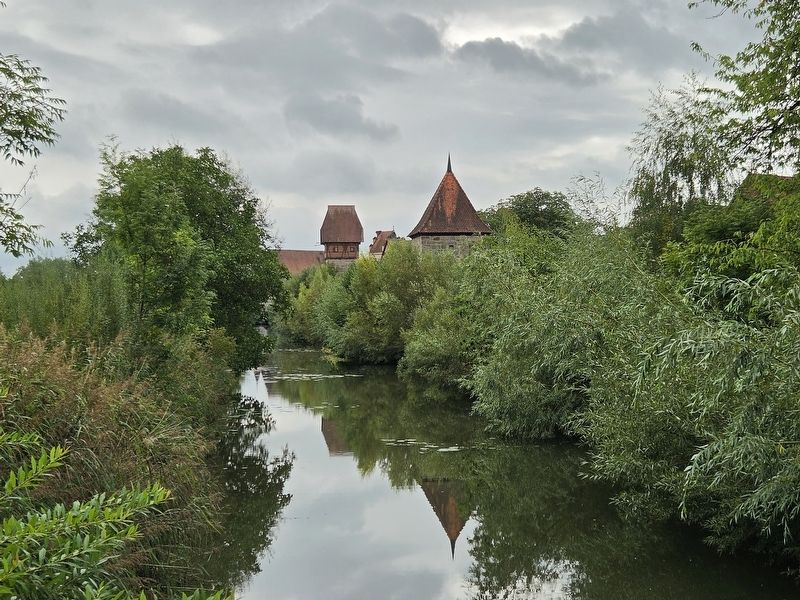
The view of Dinkelsbühl from the entrance to the city.
Die Tafeln, die sich rund um die Stadtmauer finden, geben Auskunft über den Verlauf des Dreißigjährigen Krieges. Sie wurden von J. Munique, Getreue des Königs Gustav Adolf e.V. gefertigt.
Der Dreißigjährige Krieg ist auch ein zentrales Thema im Haus der Geschichte Dinkelsbühl – von Krieg und Frieden. Hier finden Sie detaillierte Informationen vor allem zum Geschehen in der ehemaligen Reichsstadt und der Region.
Bildunterschrift: Mathias Merian, Topographia Sueviae von 1643 – Ansicht der Stadt von Nordosten
Exhausted and Drained. The Thirty Years’ War in Dinkelsbühl
Armed conflicts, looting, troops passing through and the obligation to supply provisions: the effects of the Thirty Years’ War were enormous in the imperial city of Dinkelsbühl as well. The losses calculated at the end of the war amounted to the equivalent of more than 17 tons of gold. Added to this were population losses, the decline of the city’s economy and continuing religious disputes.
The Thirty Years’ War remained deeply rooted in the memory of much of the population for a long time as the defining military catastrophe of the early modern period. A lively culture of remembrance bears witness to this, represented in Dinkelsbühl by the historical pageant “Die Kinderzeche.”
Dinkelsbühl illustrates the “Age of Confessionalism,” an era shaped by disputes over the ‘true’ faith. Since the Reformation of the 16th century, the city’s society had been divided. On a small scale, it reflected what was happening throughout Germany and Europe: a struggle between Protestant and Catholic factions, which watched each other suspiciously, feared for their legally guaranteed rights or sought to expand their influence.
The catastrophe approached the imperial city slowly but steadily. At first, armies traveling to battles looted and robbed their way through the region. In 1624, imperial regiments numbering 1,200 men camped outside Dinkelsbühl’s walls, while their officers took quarters in the city. Within three days, mercenaries consumed all the provisions and livestock of the sheep farm belonging to the hospital. When they left, they looted the farm, smashed the windows, made shot from the lead in the window frames and used it to shoot pigeons off the roof.
“Pray, little child, pray!
Tomorrow the Swede will come,
tomorrow Oxenstierna will come,
he will teach the children to pray.
Pray, little child, pray!”
… Terrified parents whispered these words into their children’s ears after King Gustav II Adolf landed near Usedom on July 4, 1630, and advanced south in an exceptionally successful military campaign. In distant Vienna, Emperor Ferdinand II initially dismissed Sweden’s entry into the conflict later called the Thirty Years’ War with the arrogant words: “One little enemy more! What harm can he do Us?”
As an imperial city, Dinkelsbühl naturally owed allegiance to the emperor. However, the Protestant majority placed all its hopes in the “Lion of the North.” It was therefore no surprise that the city gates were willingly opened to the Swedish army when it appeared in 1632 under Colonel Claus von Sperreuth and demanded the city’s surrender.
Dinkelsbühl’s predominantly Protestant population was governed by a Catholic city council. Apart from brief interruptions during the Thirty Years’ War, this remained the case until the Peace of Westphalia. When Swedish troops reached the region in 1632, the Catholic city government sent a delegation to Weißenburg, to the camp of Colonel Klaus Dietrich von Sperreuth, who served in the Swedish army. He had previously demanded that Dinkelsbühl place itself under his “protection.” The delegates were dismissed curtly and condescendingly. Sperreuth then set out for Dinkelsbühl with three companies of cavalry and three of infantry. Without offering any resistance, the people of Dinkelsbühl surrendered their city to the Swedes.
Dinkelsbühl thereby changed both its ruler and its religious denomination, something that would happen several more times during the war. Great commanders such as Wallenstein and ordinary mercenaries passed through the imperial city. One example was Peter Hagendorf, whose diary describes a life under constant threat of injury and death, the deaths of family members, looting and the changing fortunes of war. The Swedish king and commander Gustav II Adolf also stayed in the city in autumn 1632, only a few weeks before his death at the Battle of Lützen.
During the final phase of the thirty-year struggle, Dinkelsbühl was repeatedly besieged and bombarded by imperial-Bavarian and French-Swedish troops. They attacked its fortifications; walls, gates and towers, especially in the southwest of the city, were “shot to pieces and ruined.” The villages of the region suffered even more from the fighting than the city’s population. The area around Hesselberg was particularly devastated and almost depopulated in 1634 after the First Battle of Nördlingen.
From 1649, religiously mixed Dinkelsbühl became an imperial city governed on the principle of equal rights for both denominations. Mayors, councillors and all public offices were thereafter filled in equal numbers by members of each denomination or alternated between them. However, the new constitution led to continuing disputes within the council and among the citizens. Like the neighboring cities of Rothenburg and Nördlingen, the once prosperous imperial city slipped into a long, uneasy slumber.
The panels around the city walls explain the course of the Thirty Years’ War. They were made by J. Munique, Getreue des Königs Gustav Adolf e.V.
The Thirty Years’ War is also a central subject at the House of History Dinkelsbühl – Of War and Peace. Here you can find detailed information, particularly about events in the former imperial city and the surrounding region.
Image caption: Mathias Merian, Topographia Sueviae, 1643 – View of the city from the northeast.
Topics. This historical marker is listed in this topic list: Wars, Non-US. A significant historical date for this entry is July 4, 1630.
Location. 49° 4.125′ N, 10° 19.379′ E. Marker is in Dinkelsbühl, Bayern (Bavaria), in Ansbach. It is on Inselweg 0.1 kilometers south of Wörnitzstraße, on the right when traveling south. Touch for map. Marker is at or near this postal address: Inselweg 5, Dinkelsbühl BY 91550, Germany. Touch for directions.

Regionally, this marker is in German Franconia and on the Romantic Road. Globally, it is in Europe, the European Union, Atlantic Europe, Central Europe, the Schengen Area, Western Europe, and the Western World. Historically, it finds itself in what was once the Holy Roman Empire and also the former West Germany.
Other nearby markers. At least 8 other markers are within walking distance of this marker: Prager Fenstersturz / The Defenestration of Prague (a few steps from this marker); Heinz J. Ansbacher (about 120 meters away, measured in a direct line); Die Kriegsparteien formieren sich / The Warring Parties Take Shape (about 120 meters away); Wörnitztor / Wörnitz Gate (about 150 meters away); Schlacht am Weißen Berg bei Prag / Battle of White Mountain near Prague (about 150 meters away); Letzte Schlachten und ein Friede mit Auswirkungen / Final Battles and a Peace (about 180 meters away); Stauferstele (about 180 meters away); Kläre Hamburger (about 240 meters away). Touch for a list and map of all markers in Dinkelsbühl.
Credits. This page was last revised on October 8, 2026. It was originally submitted on October 7, 2026, by James Hulse of Medina, Texas. This page has been viewed 8 times since then. Photos: 1, 2, 3, 4. submitted on October 8, 2026, by James Hulse of Medina, Texas.
