Crofton in Knox County, Nebraska — The American Midwest (Upper Plains)
From Dinosaurs to a Prairie Dog
George Shannon Trail
| — | Lewis and Clark National Historic Trail | — |
Photographed by Cosmos Mariner, August 7, 2021
1. From Dinosaurs to a Prairie Dog Marker
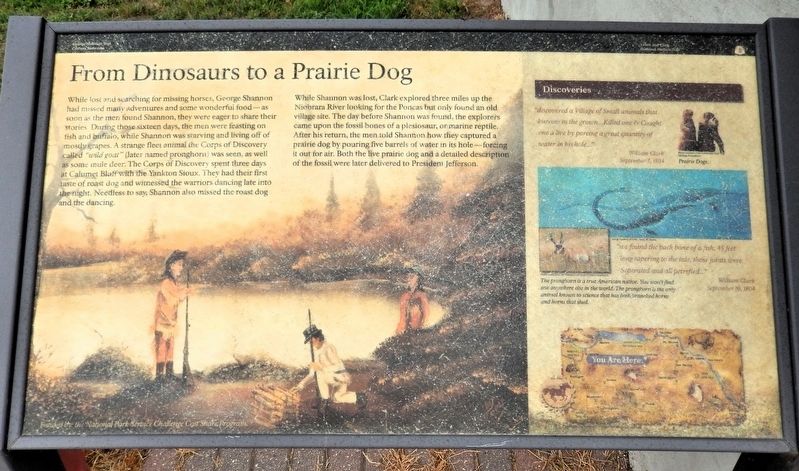
While lost and searching for missing horses, George Shannon had missed many adventures and some wonderful food — as soon as the men found Shannon, they were eager to share their stories. During those sixteen days, the men were feasting on fish and buffalo, while Shannon was starving and living off of mostly grapes. A strange fleet animal the Corps of Discovery called “wild goat” (later named pronghorn) was seen, as well as some mule deer. The Corps of Discovery spent three days at Calumet Bluff with the Yankton Sioux. They had their first taste of roast dog and witnessed the warriors dancing late into the night. Needless to say, Shannon also missed the roast dog and the dancing.
While Shannon was lost, Clark explored three miles up the Niobrara River looking for the Poncas but only found an old village site. The day before Shannon was found, the explorers came upon the fossil bones of a plesiosaur, or marine reptile. After his return, the men told Shannon how they captured a prairie dog by pouring five barrels of water in its hole — forcing it out for air. Both the live prairie dog and a detailed description of the fossil
this page online
Discoveries
“discovered a Village of Small animals that burrow in the grown… Killed one & Cought one a live by poreing a great quantity of water in his hole…”
William Clark, September 7, 1804
We found the back bone of a fish, 45 feet long tapering to the tale, those joints were Seperated and all petrefied…”
William Clark, September 10, 1804
[captions]
• Prairie Dogs
• The pronghorn is a true American native. You won’t find one anywhere else in the world. The pronghorn is the only animal known to science that has both branched horns and horns that shed.
Erected by National Park Service, U.S. Department of the Interior.
Topics and series. This historical marker is listed in these topic lists: Animals • Exploration • Indigenous Peoples and Communities • Paleontology. In addition, it is included in the Lewis & Clark Expedition series list. A significant historical month for this entry is September 1804.
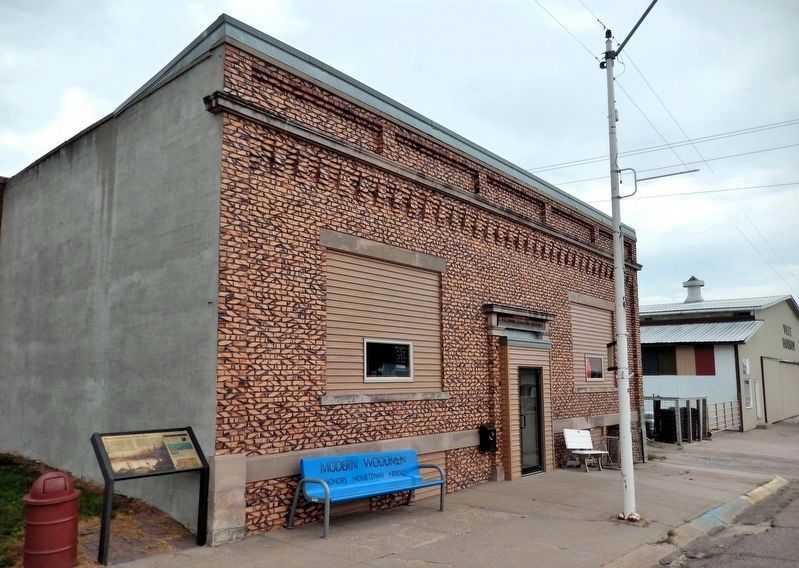
Location. 42° 43.936′ N, 97° 29.79′ W. Marker is in Crofton, Nebraska, in Knox County. It is on Main Street just east of West 3rd Street, on the right when traveling east. The marker is beside
Photographed by Cosmos Mariner, August 7, 2021
2. From Dinosaurs to a Prairie Dog Marker
Looking southwest along Main Street. The marker is beside the sidewalk at the northeast corner of the building at this location.

Regionally, this marker is in Eastern Nebraska and in the Niobrara Valley. It is also in the American Midwest, in the Corn Belt, and on the prairies. Globally, it is in North America, the Western Hemisphere, the Western World, and the Anglosphere. Historically, it finds itself in what was once the Louisiana Purchase.
Other nearby markers. At least 8 other markers are within 11 miles of this marker, measured as the crow flies: Honor. Celebrate. Grow. (here, next to this marker); Historic Missouri Valley (approx. 8.1 miles away); The Great Missouri River (approx. 8.1 miles away); Meeting the Yankton Sioux (approx. 8.2 miles away); Scenic Missouri Valley (approx. 8.2 miles away); Meridian Highway (approx. 8.2 miles away); Flood of 1881 Leaves Lost Settlements in its Wake (approx. 10½ miles away in South Dakota); Crossroads of Culture (approx. 10.6 miles away in South Dakota). Touch for a list and map of all markers in Crofton.
Also see . . .
1. George Shannon (c. 1785–1836) (Wikipedia).
Excerpt: George Shannon was an American explorer, lawyer, and politician. He was the youngest member of the Lewis and Clark Expedition (not counting the infant Jean Baptiste Charbonneau), joining at the age of 17, was born in Pennsylvania of Irish ancestry. He joined the Corps of Discovery in August 1803, as one of the three men (and Seaman) from Pittsburgh recruited by Lewis as he was waiting for the completion of the voyage's vessels in the city.(Submitted on October 7, 2026, by Cosmos Mariner of Cape Canaveral, Florida.)
On August 26, 1804, he was sent to retrieve two pack horses; he was separated from the party for sixteen days and nearly starved, as he went without food for twelve days except for some grapes and rabbits. At first, he thought he was behind the expedition, so he sped up thinking he could catch up. Then, getting hungry, he went downstream to look for a trading party he could stay with.
2. The Shannon Trail.
Excerpt: The Shannon Trail is 180 mile self-guided tour through unique communities in northeast Nebraska portraying statues of Private George Shannon with information on the life of Private George Shannon, the youngest member of the Lewis and Clark Expedition. There are 16 communities in Knox and Cedar Counties that are part of the trail, and two Native American tribes are in Knox County (the Santee Sioux and the Ponca Tribe of Nebraska).(Submitted on October 7, 2026, by Cosmos Mariner of Cape Canaveral, Florida.)
Credits. This page was last revised on October 7, 2026. It was originally submitted on October 7, 2026, by Cosmos Mariner of Cape Canaveral, Florida. This page has been viewed 5 times since then. Photos: 1, 2. submitted on October 7, 2026, by Cosmos Mariner of Cape Canaveral, Florida.
