Chesterton in Porter County, Indiana — The American Midwest (Great Lakes)
In Grateful Remembrance of Mrs Rose Howe
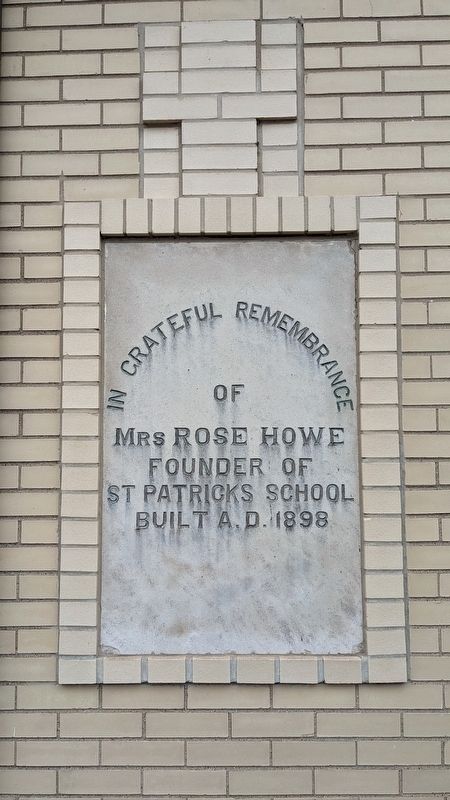
Photographed by Daniel Barriball, March 7, 2025
1. In Grateful Remembrance of Mrs Rose Howe Marker
Built A.D. 1898
Topics. This historical marker is listed in these topic lists: Education • Religion & Religious Structures • Women. A significant historical year for this entry is 1898.
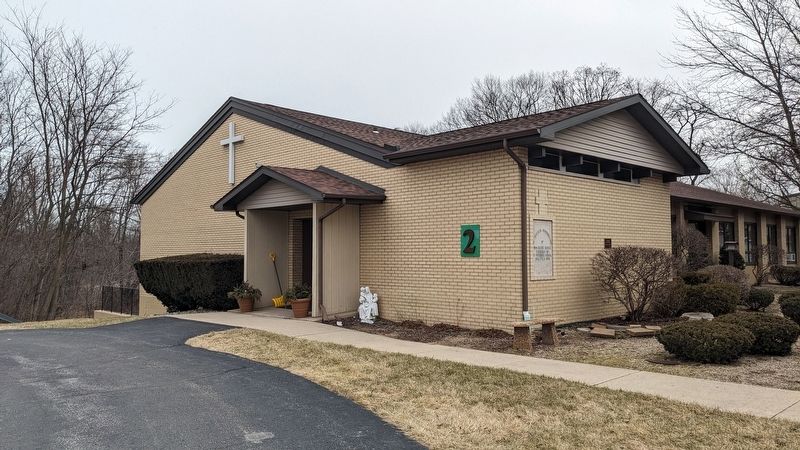
Location. 41° 37.18′ N, 87° 2.884′ W. Marker is in Chesterton, Indiana, in Porter County. It can be reached from North Calumet Road 0.2 miles north of Woodlawn Avenue. The marker is located on the southwest corner of building 2 of St. Patrick School. Touch for map. Marker is at or near this postal address: 642 N Calumet Rd, Chesterton IN 46304, United States of America. Touch for directions.

Regionally, this marker is in Northwest Indiana, specifically on the Indiana Dunes and Lake Michigan Shore, and in the Calumet Region. It is also in the American Midwest and in the Corn Belt. Globally, it is in North America, on the Great Lakes, in the Western Hemisphere, in the Western World, and in the Anglosphere. Historically, it finds itself in what was once the territory of the Mississippian Culture and also the Northwest Territory.
Other nearby markers. At least 8 other markers are within one mile of this marker, measured as the crow flies: Chesterton's Historic 100 Block Broadway (approx. 0.6 miles away); Chesterton Bandstand (approx. 0.7 miles away); Lustron Home (approx. 0.8 miles away); Chesterton Veterans Memorial (approx. 0.9 miles away); Indiana Dunes Indigenous Cultural Trail (approx. one mile away); Beirut Memorial Monument (approx. one mile away); Mark Randall Taylor - Age 20 (approx. one mile away); In Memory of Joseph Bailly (approx. one mile away). Touch for a list and map of all markers in Chesterton.
More about this marker. This marker is on the grounds of St. Patrick School. Note: This is private property. For security purposes, do not visit during school hours.
Regarding In Grateful Remembrance of Mrs Rose Howe.
The
this page online
Miss Howe and the School
CHESTERTON, IND., Sept. 17, 1898
MR.BOWSER:— I note in the last issue of THE TRIBUNE you pay a perhaps otherwise deserved tribute to the activity of the Catholics of St. Patrick’s parish, but wholly unmerited in the connection mentioned, the school building being a donation of one individual solely, but Father Kroll having donated the property on which the building stands.
Ten years ago my mother and myself began laying aside quarterly, a small sum of money for the purpose of paying the expenses of defending her will, should it meet with legal opposition. As it did not meet with opposition, the sum (as she directed should be in this case) was devoted to educationalpurposes. It was until last March on deposit with the Sisters of Providence at St. Mary’s Convent, near Terre Haute, Indiana. The whole sum turned over by them then was, interest and principal, $2,900. I consider it the product chiefly of my own activity in doing my own housework and making my own garments, etc. etc. At the time it was laid aside I practiced many little economies of various kinds, and could have turned the sum to my own purposes very readily without anyone being the wiser.Photographed by Daniel Barriball, March 7, 20252. Wide angle view of In Grateful Remembrance of Mrs Rose Howe Marker
I believe the School Sisters of Notre Dame—the order in charge of our school here, have a sort of rule or custom compelling them to ignore all donations and donors, and ascribe to the activity of of (sic) the congregation or the pastor every individual effort and the more thoroughly individualized an affair is, the more vociferously do they ascribe it to an impersonal activity. The congregation will accept the school as a donation, but never, never will they accept as a burden on their activity. This is what those who wish to rob my mother and myself of the merit of the good work do not understand. I think herein lay the chief hinderance to the completion of the building, a fear lest perhaps the burden of payment was going to fall upon the congregation. I must insist upon this mistake being rectified. Credit to whom credit is due.
FRANCES R. HOWE
In the above, Miss Howe reveals a phase of her character that, to say the least, is surprising to the people here. That admonition “Let not thy right hand know what thy left hand does?” is evidently not her guiding rule. Instead she is determined not to allow her light to shine under a bushel. We supposed that Miss Howe was a member of St. Patrick’ (sic) congregation, and if she is, then she is a part of it. We have been told that Wm. Ruhe gave $500 toward that school. We are also told that Henry Weitzel gave $500 to establish a parochial school in this town. We were also told that the late Mrs. Howe left $3,000 to establish this school. We also understand that all these people were members of St. Patrick’s congregation. If this be true, then to the congregation as a congregation, and not to Miss Howe, a simple agent instructed to carry out her mother’s wishes, belongs whatever credit there may be. All the members are not wealthy. Some are very poor. Many of these fathers and mothers are toiling hard to raise their children to be useful members of society, and the burden of supporting this unendowed institution will fall as heavily on their weak shoulders, as will the burden of building it upon one who has been so fortunate in life as to have nothing more laborious to do than spend the inheritance of her ancestors. We are very sure that no member of St. Patrick’s congregation desires to appropriate any credit that properly belongs to Miss Howe, and we also know that the rank and file had no wish for a pretentious school building they could not pay for, and there are some who will never allow their children to step a foot inside its walls because of the spirit Miss Howe has shown in the matter. Her letter is construed as an insult to the whole congregation. Miss Howe’s opportunities for doing good and helping suffering humanity are almost limitless. But her brass band way of doling out her philanthropic acts makes her efforts obnoxious. THE TRIBUNE has no desire to enter a controversy with Miss Howe over that school house, but since she insists upon being properly placed before the public, we cheerfully perform the task.
Credits. This page was last revised on October 8, 2026. It was originally submitted on March 7, 2025, by Daniel Barriball of Chesterton, Indiana. This page has been viewed 179 times since then and 49 times this year. Last updated on October 7, 2026, by Daniel Barriball of Chesterton, Indiana. Photos: 1, 2. submitted on March 7, 2025, by Daniel Barriball of Chesterton, Indiana. • Devry Becker Jones was the editor who published this page.
