Gouda, South Holland, Netherlands — Northwestern Europe
Regina (1908)
| — | Museumhaven Gouda | — |
Photographed by Andrew Ruppenstein, September 2, 2026
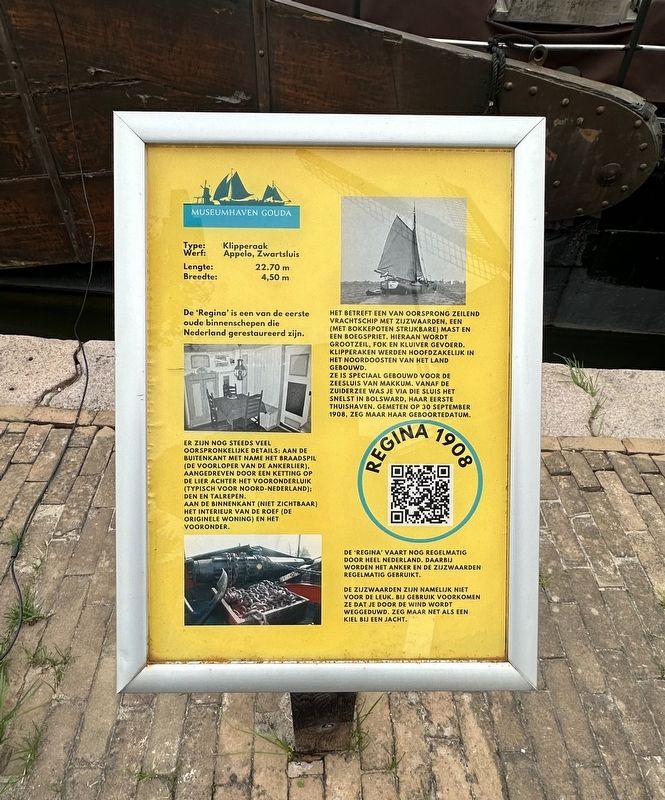
1. Regina (1908) Marker

Werf: Appelo, Zwartsluis
Lengte: 22.70 m
Breedte: 4,50 m
De 'Regina' is een van de eerste oude binnenschepen die Nederland gerestaureerd zijn.
Er zijn nog steeds veel oorspronkelijke details: aan de buitenkant met name het braadspil (de voorloper van de ankerlier), aangedreven door een ketting op de lier achter het vooronderluik (typisch voor noord-nederland); den en talrepen. Aan de binnenkant (niet zichtbaar) het interieur van de roef (de originele woning) en het vooronder.
Het betreft een van oorsprong zeilend vrachtschip met zijzwaarden, een (met bokkepoten strijkbare) mast en een boegspriet. hieraan wordt grootzeil, fok en kluiver gevoerd. klipperaken werden hoofdzakelijk in het noordoosten van het land gebouwd.
Ze is speciaal gebouwd voor de zeesluis van Makkum. Zanaf de Zuiderzee was je via die sluis het Snelst in Bolsward, haar eerste thuishaven. Gemeten op 30 september 1908, zeg maar haar geboortedatum.
De 'Regina' vaart nog regelmatig door heel Nederland. Daarbij worden het anker en de zijzwaarden regelmatig gebruikt.
De zijzwaarden zijn namelijk
this page online
Type: Klipperaak
Shipyard: Appelo, Zwartsluis
Length: 22.70 m
Beam: 4.50 m
The 'Regina' is one of the first historic inland vessels to be restored in the Netherlands.
Many original details remain: on the outside, notably the windlass (the precursor to the anchor winch) — driven by a chain connected to the winch located behind the forepeak hatch (a feature typical of Northern Netherlands) — as well as the washboards and lanyards. Inside (though not visible) are the original interiors of the aft cabin (the living quarters) and the forepeak.
It is a vessel that was originally a sailing cargo ship, featuring leeboards, a mast that can be lowered using a sheerlegs arrangement, and a bowsprit; it carries a mainsail, a jib, and a flying jib. Klipperaken (clipper-style barges) were primarily built in the northeastern part of the country. She was built specifically for the sea lock at Makkum. That lock offered the fastest route from the Zuiderzee to Bolsward, her original home
Photographed by Andrew Ruppenstein, September 2, 2026
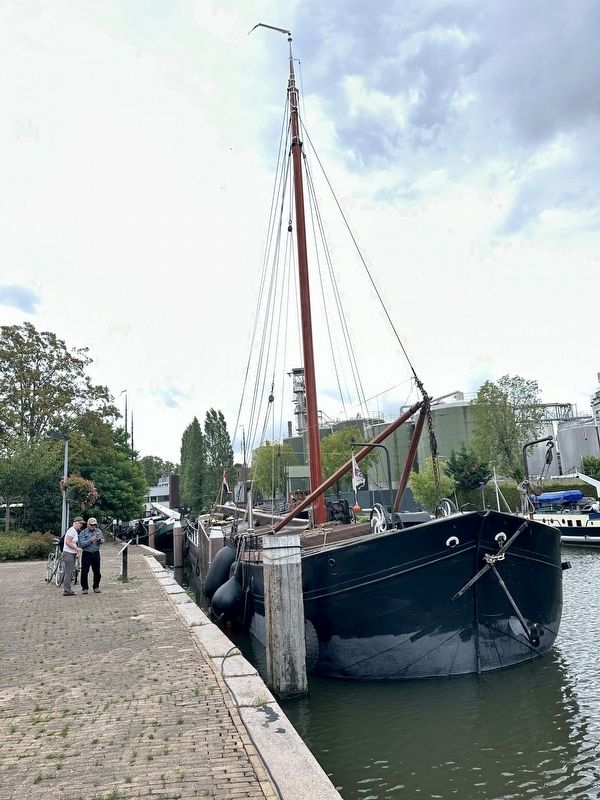
2. Regina (1908) and marker
The marker is visible here next to the two people reading it.
The 'Regina' still sails regularly throughout the Netherlands, frequently making use of her anchor and leeboards.
You see, the leeboards aren't just for show. When in use, they prevent you from being pushed sideways by the wind — much like the keel on a yacht.
Topics. This historical marker is listed in this topic list: Waterways & Vessels. A significant historical date for this entry is September 30, 1908.
Location. 52° 0.449′ N, 4° 42.461′ E. Marker is in Gouda, Zuid-Holland (South Holland). It is on Vest, on the right when traveling east. Touch for map. Marker is at or near this postal address: Vest 65, Gouda, Zuid-Holland 2801 TW, Netherlands. Touch for directions.

Regionally, it is in Europe, the European Union, Atlantic Europe, the Benelux Low Countries, the Schengen Area, Western Europe, and the Western World. Historically, it finds itself in what was once the Roman Empire and specifically also the Holy Roman Empire.
Other nearby markers. At least 8 other markers are within walking distance of this marker: Molen de Rode Leeuw / “Red Lion” Windmill (a few steps from this marker); IJsfabriek William Barendsz / William Barendsz Ice Factory (about 90 meters away, measured in a direct line); Asschuur / Ash Shed (about 120 meters away); Kaaspakhuizen / Cheese Warehouses (about 180 meters away); Mallegatsluis / Mallegat Lock (approx. 0.3 kilometers away); Lutherse Kerk, voormalige Sint-Joostkapel / Lutheran Church, formerly the St. Joost Chapel (approx. 0.3 kilometers away); Woonhuis van Arie Blanken / Residence of Arie Blanken (approx. 0.3 kilometers away); St. Theodorus-stichting / St. Theodorus Foundation (approx. 0.3 kilometers away). Touch for a list and map of all markers in Gouda.
Also see . . . Regina (Museumhaven Gouda, in Dutch). The QR code on the marker leads to this page, with more information on the ship. Excerpt (in translation):
The Regina was launched from the Appelo shipyard in Zwartsluis in 1908. She entered the water under the name Regina and was later known as Verwisseling and Twee Gebroeders. The identity of the first owner—and the reason for the ship's construction—remains unknown. We suspect the *Regina* was built to order, as her dimensions differ from the standard for that era; she is relatively short and has a blunt bow. Was she built for a specific lock? We do not know.(Submitted on October 8, 2026.)
We do know, however, that the person who commissioned her had money to spend. For instance, the Regina was fitted with "protection plates": iron plates were riveted to both sides as a preventive measure for the areas most likely to strike the bottom in shallow water. Furthermore, the cabin interior featured a more luxurious finish than usual. Not only were the cabin's cupboard doors given a faux-wood finish (painted to resemble wood grain), but those in the forepeak were treated the same way. The first owner surely had a specific purpose in mind for the vessel, yet she was sold again after just three years. What happened? We do not know.
The next owner is known: Jan Lambrechts purchased the ship in 1911. In 1923, he sold it to Johannes and Gerrit van der Sloot, who operated the vessel until 1959—initially transporting peat in the Veenkoloniën (peat colonies) and later timber in the Zaan region. She was one of the last ships to operate without an auxiliary engine. When Johannes passed away in 1970, Gerrit sold the vessel.
The new owner restored the ship—making it one of the first in the Netherlands to undergo such a restoration—and converted it into a houseboat.
Credits. This page was last revised on October 8, 2026. It was originally submitted on October 8, 2026, by Andrew Ruppenstein of Lamorinda, California. This page has been viewed 3 times since then. Photos: 1, 2. submitted on October 8, 2026, by Andrew Ruppenstein of Lamorinda, California.
