Golden in Columbia-Shuswap, British Columbia — Canada’s West Coast (North America)
Riverboat Tales
Photographed by Cosmos Mariner, July 3, 2022
1. Riverboat Tales Marker
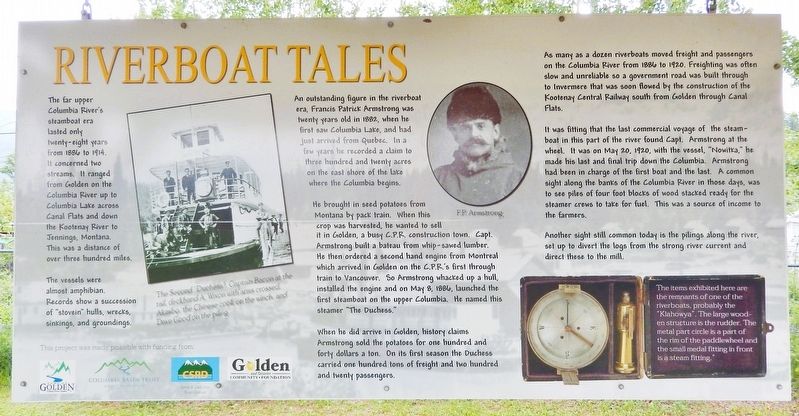
The far upper Columbia River’s steamboat era lasted only twenty-eight years, from 1886 to 1914. It concerned two streams. It ranged from Golden on the Columbia River up to Columbia Lake across Canal Flats and down the Kootenay River to Jennings, Montana. This was a distance of over three hundred miles.
The vessels were almost amphibian. Records show a succession of “stovein” hulls, wrecks, sinkings, and groundings.
An outstanding figure in the riverboat era, Francis Patrick Armstrong was twenty years old in 1882, when he first saw Columbia Lake, and had just arrived from Quebec. In a few years he recorded a claim to three hundred and twenty acres on the east shore of the lake where the Columbia begins.
He brought in seed potatoes from Montana by pack train. When this crop was harvested, he wanted to sell it in Golden, a busy C.P.R. construction town. Capt. Armstrong built a bateau from whip-sawed lumber. He then ordered a second hand engine from Montreal which arrived in Golden on the C.P.R.’s first through train to Vancouver. So Armstrong whacked up a hull, installed the engine and on May 8, 1886, launched the first steamboat
this page online
When he did arrive in Golden, history claims Armstrong sold the potatoes for one hundred and forty dollars a ton. On its first season the Duchess carried one hundred tons of freight and two hundred and twenty passengers.
As many as a dozen riverboats moved freight and passengers on the Columbia River from 1886 to 1920. Freighting was often slow and unreliable so a government road was built through to Invermere that was soon followed by the construction of the Kootenay Central Railway south from Golden through Canal Flats.
It was fitting that the last commercial voyage of the steamboat in this part of the river found Capt. Armstrong at the wheel. It was on May 20, 1920, with the vessel, “Nowitka,” he made his last and final trip down the Columbia. Armstrong had been in charge of the first boat and the last. A common sight along the banks of the Columbia River in those days, was to see piles of four foot blocks of wood stacked ready for the steamer crews to take for fuel. This was a source of income to the farmers.
Another sight still common today is the pilings along the river,

2. Marker detail: The Second “Duchess”
Captain Bacon at the rail, deckhand A. Wixon with arms crossed. Akimbo, the Chinese cook on the winch, and Dave Good on the piling.
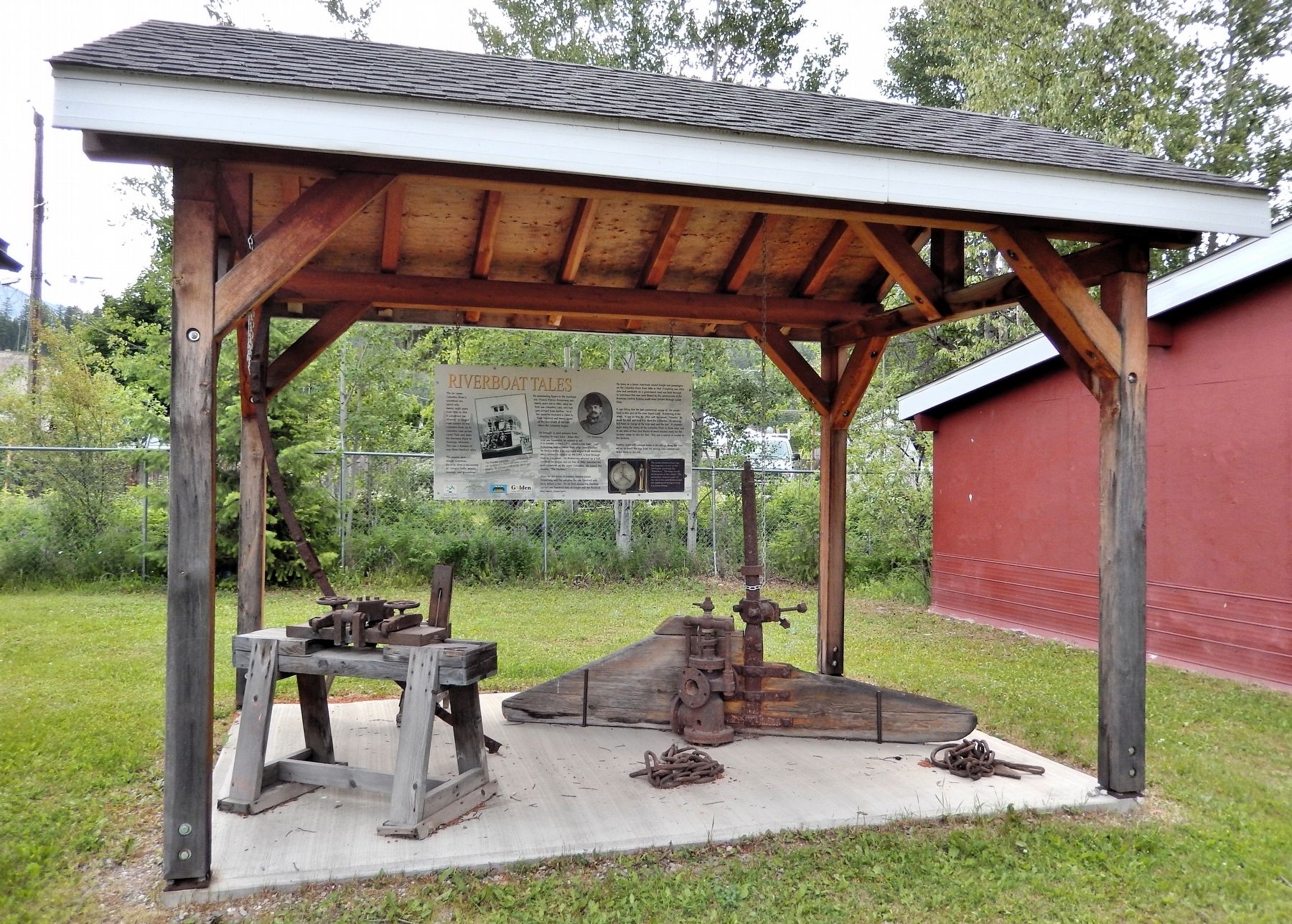
The items exhibited here are the remnants of one of the riverboats, probably the “Klahowya”. The large wooden structure is the rudder. The metal part circle is a part of the rim of the paddlewheel and the small metal fitting in front is a steam fitting.
Erected by Golden & District Historical Society.
Topics. This historical marker is listed in these topic lists: Industry & Commerce • Railroads & Streetcars • Settlements & Settlers • Waterways & Vessels. A significant historical date for this entry is May 8, 1886.
Location. 51° 17.513′ N, 116° 57.627′ W. Marker is in Golden, British Columbia, in Columbia-Shuswap. It can be reached from the intersection of 11 Avenue South and 14 Street South, on the right when traveling north. The marker and exhibit are on the Golden & District Museum grounds. Touch for map. Marker is at or near this postal address: 1302 11 Avenue South, Golden BC V0A 1H0, Canada. Touch for directions.

Regionally, this marker is in the BC Interior and in Thompson-Okanagan. Globally, it is in North America, in the
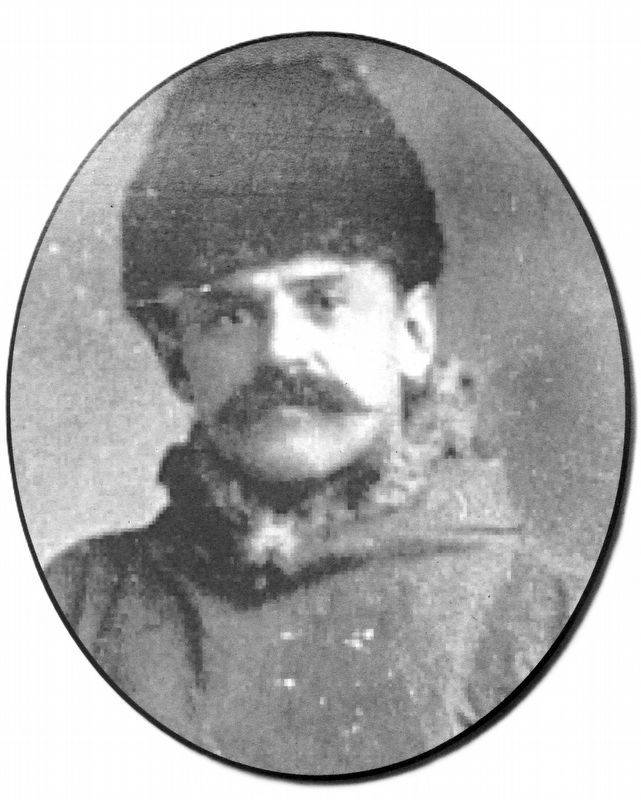
3. Marker detail: Francis Patrick Armstrong
Other nearby markers. At least 4 other markers are within 10 kilometers of this marker, measured as the crow flies: History of Mountain Tourism in Golden (approx. 0.7 kilometers away); Rivers & Railways (approx. 0.7 kilometers away); Golden Sikhs (approx. 1.1 kilometers away); Kicking Horse Canyon (approx. 9.4 kilometers away).
Also see . . . Nowitka (In The Windermere blog).
Excerpt: The Nowitka was a sternwheel steamboat launched at Golden in 1911 by George Rury for the Columbia River Lumber Company, which was itself headed by Captain Francis Patrick Armstrong. Its name is the Chinook jargon word meaning “yes” or “yes indeed.” It was an amalgamation of scavenged pieces. The engines had been built in 1840 and used in a Montreal ferry before being brought to the Columbia Valley by Captain Armstrong to be used in the first steamboat in the valley, the Duchess. They were later transferred into the second Duchess then(Submitted on October 10, 2026, by Cosmos Mariner of Cape Canaveral, Florida.)the steamboat Ptarmigan. The boiler was “modern,” having been built for a sawmill. The pilot house and capstan of the Nowitka, meanwhile, came from the North Star, and her steering wheel was taken from a Lower Columbia River steamboat the City of Salem. 4. Marker detail: Compass
The Nowitka was built to run opposite of the Klahowya, a luxurious tourist vessel, as a less glamourous vessel used for hauling freight and pushing barges ahead for the transport of large loads. It was allowed to carry ten passengers and had 4.3 horsepower. After the opening of the Kootenay Central Railway in the valley in 1915, steamboats could no longer compete, and the Nowitka was taken out of service. The Nowitka’s retirement did not last. It has the distinction of being the last commercial steamboat on the Upper Columbia River in 1920. Armstrong’s last voyage with the Nowitka demonstrated the changes on the Upper Columbia River. The Duchess, at 74 feet long, was the longest vessel that Armstrong thought would be able to navigate the river in 1886. In contrast, the 1920 Nowitka, combined with barges ahead of her, “made up a craft 246 feet long and 23 feet beam.” Armstrong also reportedhaving taken advantage of this trip to “rescue” some ore that he had abandoned on the bank twenty-four years previously. As he recalled, “It was the last chance and I took it.” Following the trip, the Nowitka was abandoned alongside the sawmill wharf at Golden.Photographed by Cosmos Mariner, July 3, 20225. Riverboat Tales Marker & Exhibit
Credits. This page was last revised on October 10, 2026. It was originally submitted on October 9, 2026, by Cosmos Mariner of Cape Canaveral, Florida. This page has been viewed 7 times since then. Photos: 1, 2, 3, 4, 5. submitted on October 10, 2026, by Cosmos Mariner of Cape Canaveral, Florida.
