Rapid City in Pennington County, South Dakota — The American Midwest (Upper Plains)
Works Progress Administration
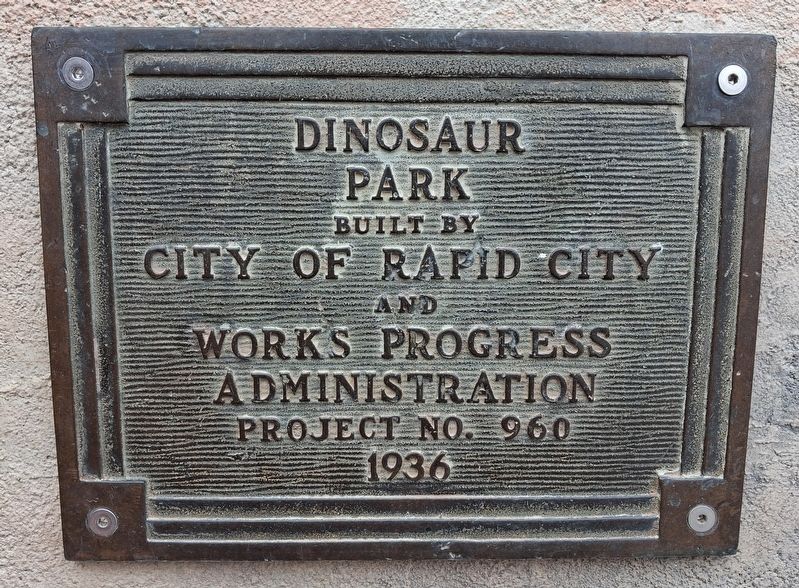
Project No. 960
Photographed by William Fischer, Jr., September 20, 2026
1. Works Progress Administration Marker
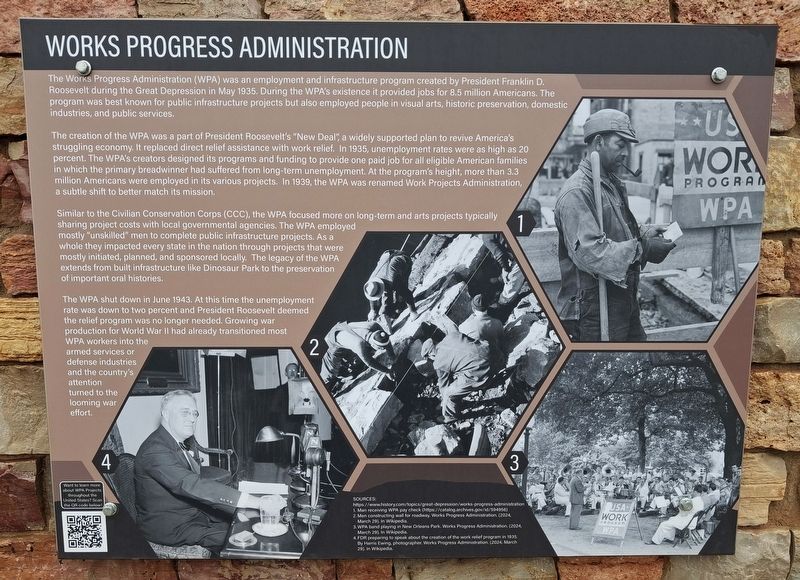
The Works Progress Administration (WPA) was an employment and infrastructure program created by President Franklin D. Roosevelt during the Great Depression in May 1935. During the WPA's existence it provided jobs for 8.5 million Americans. The program was best known for public infrastructure projects but also employed people in visual arts, historic preservation, domestic industries, and public services.
The creation of the WPA was a part of President Roosevelt's "New Deal", a widely supported plan to revive America's struggling economy. It replaced direct relief assistance with work relief. In 1935, unemployment rates were as high as 20 percent. The WPA's creators designed its programs and funding to provide one paid job for all eligible American families in which the primary breadwinner had suffered from long-term unemployment. At the program's height, more than 3.3 million Americans were employed in its various projects. In 1939, the WPA was renamed Work Projects Administration, a subtle shift to better match its mission.
Similar to the Civilian Conservation Corps (CCC), the WPA focused more on long-term
this page online
The WPA shut down in June 1943. At this time the unemployment rate was down to two percent and President Roosevelt deemed the relief program was no longer needed. Growing war production for World War II had already transitioned most WPA workers into the armed services or defense industries and the country's attention turned to the looming war effort.
[Photo captions read]
1. Man receiving WPA pay check.
2. Men constructing wall for roadway.
3. WPA band playing in New Orleans Park.
4. FDR preparing to speak about the creation of the work relief program in 1935.
Erected by City of Rapid City.
Topics. This historical marker is listed in these topic lists: Arts, Letters, Music • Charity & Public Work
Photographed by William Fischer, Jr., September 20, 2026
2. Works Progress Administration Marker
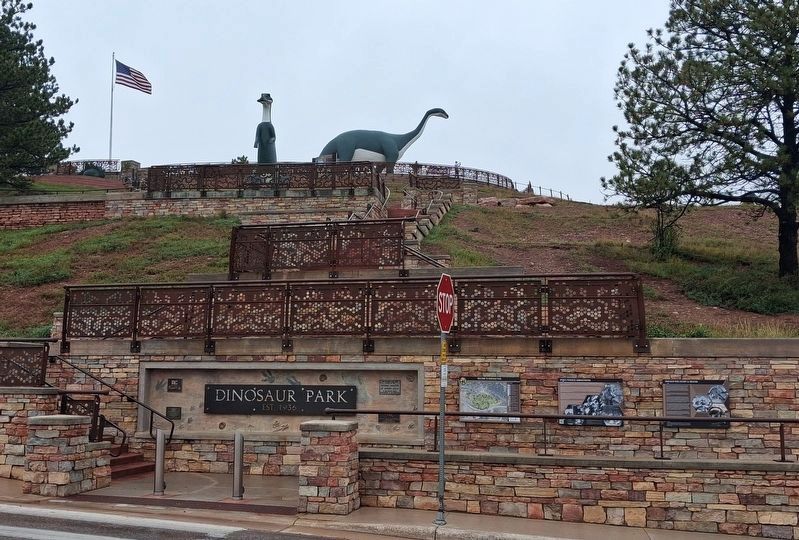
Location. 44° 4.683′ N, 103° 14.697′ W. Marker is in Rapid City, South Dakota, in Pennington County. It is on Skyline Drive, on the right when traveling south. Marker is at the entrance to Dinosaur Park. Touch for map. Marker is at or near this postal address: 940 Skyline Drive, Rapid City SD 57701, United States of America. Touch for directions.

Regionally, this marker is in West River and in the Badlands. It is also in the American Black Hills, in the Lewis & Clark Corridor, on the prairies, and on the Northern Plains. Globally, it is in North America, the Western Hemisphere, the Western World, and the Anglosphere. Historically, it finds itself in what was once Rupert’s Land and also the Louisiana Purchase.
Other nearby markers. At least 8 other markers are within walking distance of this marker: Dinosaur Park History & Creation (here, next to this marker); Trachodon (a few steps from this marker); Dimetrodon (within shouting distance of this marker); Stegosaurus (within shouting distance of this marker); Protoceratops
Photographed by William Fischer, Jr., September 20, 2026
3. Works Progress Administration Marker
At right side of photo

Photographed by William Fischer, Jr., September 20, 2026
4. Works Progress Administration QR Code on Marker
Credits. This page was last revised on October 9, 2026. It was originally submitted on October 9, 2026, by William Fischer, Jr. of Reynoldsburg, Ohio. This page has been viewed 7 times since then. Photos: 1, 2, 3, 4. submitted on October 9, 2026, by William Fischer, Jr. of Reynoldsburg, Ohio.
