Dinkelsbühl in Ansbach, Bavaria, Germany — Central Europe
Waffenstillstand von Ulm und weitere Kämpfe
1635–1648 Schwedisch-Französischer Krieg
⎯⎯⎯
The Truce of Ulm and Further Fighting
1635–1648 Swedish–French War
| — | 1647 | — |
Photographed by James Hulse, September 14, 2026
1. Waffenstillstand von Ulm und weitere Kämpfe / The Truce of Ulm and Further Fighting Marker

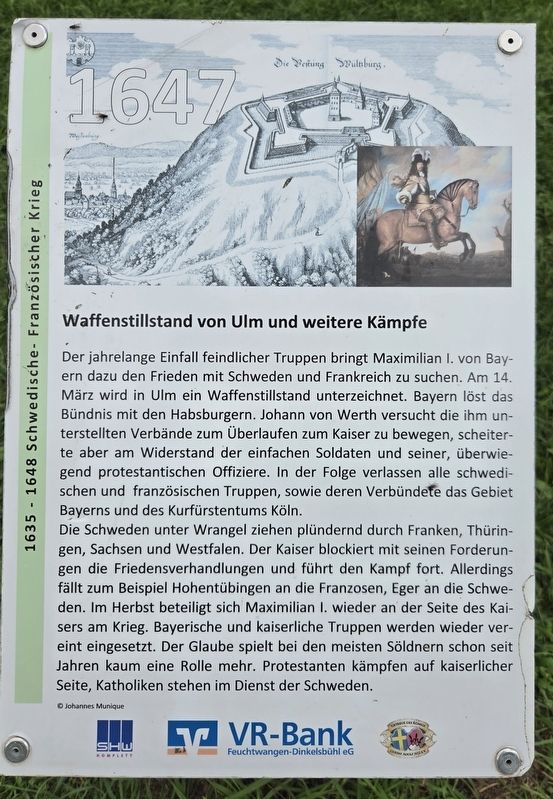
Der jahrelange Einfall feindlicher Truppen bringt Maximilian I. von Bayern dazu, den Frieden mit Schweden und Frankreich zu suchen. Am 14. März wird in Ulm ein Waffenstillstand unterzeichnet. Bayern löst das Bündnis mit den Habsburgern. Johann von Werth versucht, die ihm unterstellten Verbände zum Überlaufen zum Kaiser zu bewegen, scheitert aber am Widerstand der einfachen Soldaten und seiner überwiegend protestantischen Offiziere. In der Folge verlassen alle schwedischen und französischen Truppen sowie deren Verbündete das Gebiet Bayerns und des Kurfürstentums Köln.
Die Schweden unter Wrangel ziehen plündernd durch Franken, Thüringen, Sachsen und Westfalen. Der Kaiser blockiert mit seinen Forderungen die Friedensverhandlungen und führt den Kampf fort. Allerdings fällt zum Beispiel Hohentübingen an die Franzosen, Eger an die Schweden. Im Herbst beteiligt sich Maximilian I. wieder an der Seite des Kaisers am Krieg. Bayerische und kaiserliche Truppen werden wieder vereint eingesetzt. Der Glaube spielt bei den meisten Söldnern schon seit Jahren kaum eine Rolle mehr. Protestanten
this page online
© Johannes Munique
The Truce of Ulm and Further Fighting
Years of invasions by enemy troops prompted Maximilian I of Bavaria to seek peace with Sweden and France. A truce was signed at Ulm on 14 March, and Bavaria dissolved its alliance with the Habsburgs. Johann von Werth tried to persuade the units under his command to defect to the emperor, but the ordinary soldiers and his predominantly Protestant officers resisted. Consequently, Swedish and French troops and their allies withdrew from Bavaria and the Electorate of Cologne.
The Swedes under Wrangel plundered their way through Franconia, Thuringia, Saxony and Westphalia. The emperor obstructed the peace negotiations with his demands and continued the war. Nevertheless, Hohentübingen, for example, fell to the French and Eger to the Swedes. In the autumn, Maximilian I rejoined the war on the emperor’s side, and Bavarian and imperial troops again operated together. Religion had long ceased to matter to most mercenaries: Protestants fought for the emperor, while Catholics served the
Photographed by James Hulse
2. Waffenstillstand von Ulm und weitere Kämpfe / The Truce of Ulm and Further Fighting Marker
Erected by SHW Komplett, VR-Bank Feuchtwangen-Dinkelsbühl eG and Octavus Rex König Gustav Adolf 1632 e.V.
Topics. This historical marker is listed in this topic list: Wars, Non-US.
Location. 49° 4′ N, 10° 19.489′ E. Marker is in Dinkelsbühl, Bayern (Bavaria), in Ansbach. It is on Bäuerlinsgäßlein just west of Am Brühl. Touch for map. Marker is at or near this postal address: Bäuerlinsgäßlein 3, Dinkelsbühl BY 91550, Germany. Touch for directions.

Regionally, this marker is in German Franconia and on the Romantic Road. Globally, it is in Europe, the European Union, Atlantic Europe, Central Europe, the Schengen Area, Western Europe, and the Western World. Historically, it finds itself in what was once the Holy Roman Empire and also the former West Germany.
Other nearby markers. At least 8 other markers are within walking distance of this marker: Stadtmühle / Town Mill (within shouting distance of this marker); Sicherung der habsburgischen Kernlande / Securing the Habsburg Heartlands (within shouting distance of this marker); Letzte Schlachten und ein Friede mit Auswirkungen / Final Battles and a Peace
Photographed by James Hulse, September 14, 2026
3. Waffenstillstand von Ulm und weitere Kämpfe / The Truce of Ulm and Further Fighting Marker
Credits. This page was last revised on October 11, 2026. It was originally submitted on October 10, 2026, by James Hulse of Medina, Texas. This page has been viewed 3 times since then. Photos: 1, 2, 3. submitted on October 11, 2026, by James Hulse of Medina, Texas.
