Dinkelsbühl in Ansbach, Bavaria, Germany — Central Europe
Frankreich bringt sich in Stellung
⎯⎯⎯
France positions itself
| — | 1624 | — |
Photographed by James Hulse, September 14, 2026
1. Frankreich bringt sich in Stellung / France positions itself Marker

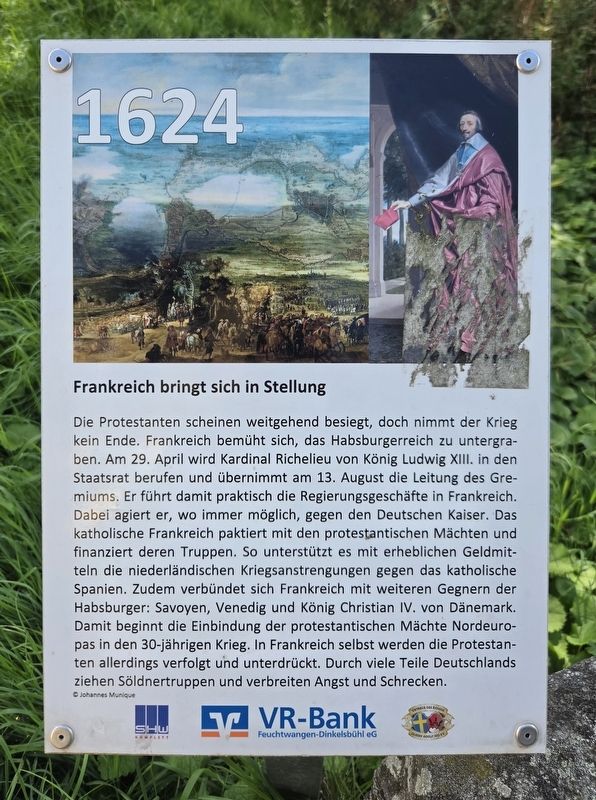
Die Protestanten scheinen weitgehend besiegt, doch nimmt der Krieg kein Ende. Frankreich bemüht sich, das Habsburgerreich zu untergraben. Am 29. April wird Kardinal Richelieu von König Ludwig XIII. in den Staatsrat berufen und übernimmt am 13. August die Leitung des Gremiums. Er führt damit praktisch die Regierungsgeschäfte in Frankreich. Dabei agiert er, wo immer möglich, gegen den Deutschen Kaiser. Das katholische Frankreich paktiert mit den protestantischen Mächten und finanziert deren Truppen. So unterstützt es mit erheblichen Geldmitteln die niederländischen Kriegsanstrengungen gegen das katholische Spanien. Zudem verbündet sich Frankreich mit weiteren Gegnern der Habsburger: Savoyen, Venedig und König Christian IV. von Dänemark. Damit beginnt die Einbindung der protestantischen Mächte Nordeuropas in den 30-jährigen Krieg. In Frankreich selbst werden die Protestanten allerdings verfolgt und unterdrückt. Durch viele Teile Deutschlands ziehen Söldnertruppen und verbreiten Angst und Schrecken.
© Johannes Munique
France positions itself
The Protestants
this page online
Erected by SHW Komplett, VR-Bank Feuchtwangen-Dinkelsbühl eG and Getreue des Königs Gustav Adolf 1632 e.V.
Topics. This historical marker is listed in this topic list: Wars, Non-US. A significant historical year for this entry is 1632.
Location. 49° 4.355′ N, 10° 19.148′ E. Marker is in
Photographed by James Hulse, September 14, 2026
2. Frankreich bringt sich in Stellung / France positions itself Marker

Regionally, this marker is in German Franconia and on the Romantic Road. Globally, it is in Europe, the European Union, Atlantic Europe, Central Europe, the Schengen Area, Western Europe, and the Western World. Historically, it finds itself in what was once the Holy Roman Empire and also the former West Germany.
Other nearby markers. At least 8 other markers are within walking distance of this marker: Dänemark greift ein – Wallenstein als Gegengewicht / Denmark intervenes – Wallenstein as a counterwe (within shouting distance of this marker); Der Kaiser hat den Sieg vor Augen / The emperor has victory in sight (about 90 meters away, measured in a direct line); Die Gerichtstafeln in den Dinkelsbühler Stadttoren (about 90 meters away); Rothenburger Tor / Rothenburg Gate (about 90 meters away); Spital / Hospital
Photographed by James Hulse, September 14, 2026
3. Frankreich bringt sich in Stellung / France positions itself Marker
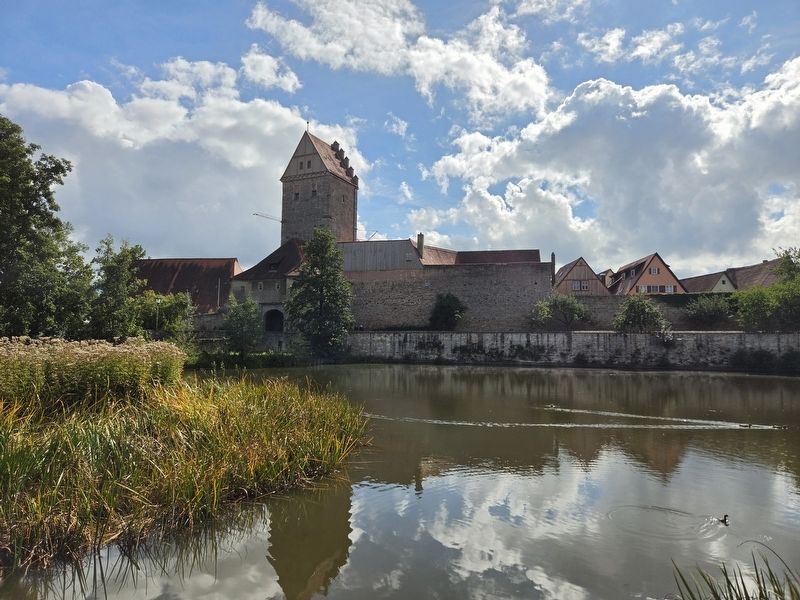
The view from the marker.
Credits. This page was last revised on October 11, 2026. It was originally submitted on October 11, 2026, by James Hulse of Medina, Texas. This page has been viewed 4 times since then. Photos: 1, 2, 3. submitted on October 11, 2026, by James Hulse of Medina, Texas.
