University of Saskatchewan - Management Area in Saskatoon in Corman Park No. 344, Saskatchewan — The Prairie Region (North America)
Dr. Henry Taube
Photographed by Cosmos Mariner, July 18, 2022
1. Dr. Henry Taube Marker
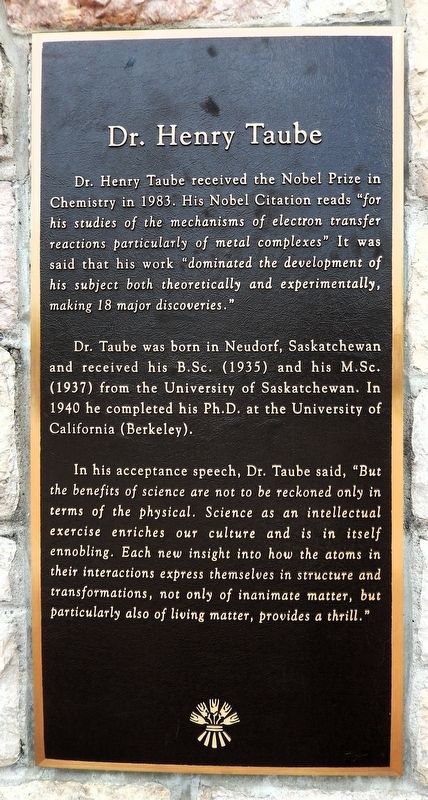
Dr. Henry Taube received the Nobel Prize in Chemistry in 1983. His Nobel Citation reads “for his studies of the mechanisms of electron transfer reactions particularly of metal complexes.” It was said that his work “dominated the development of his subject both theoretically and experimentally, making 18 major discoveries.”
Dr. Taube was born in Neudorf, Saskatchewan and received his B.Sc. (1935) and his M.Sc. (1937) from the University of Saskatchewan. In 1940 he completed his Ph.D. at the University of California (Berkeley).
In his acceptance speech, Dr. Taube said, “But the benefits of science are not to be reckoned only in terms of the physical. Science as an intellectual exercise enriches our culture and is in itself ennobling. Each new insight into how the atoms in their interactions express themselves in structure and transformations, not only of inanimate matter, but particularly also of living matter, provides a thrill.”
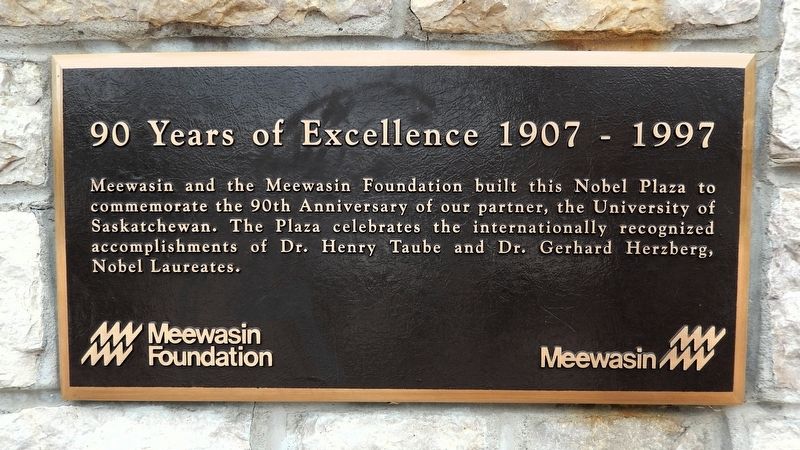
Erected 1997 by Meewasin Foundation.
Topics. This historical marker is listed in these topic lists: Education • Science & Medicine. A significant historical year for this entry is 1983.
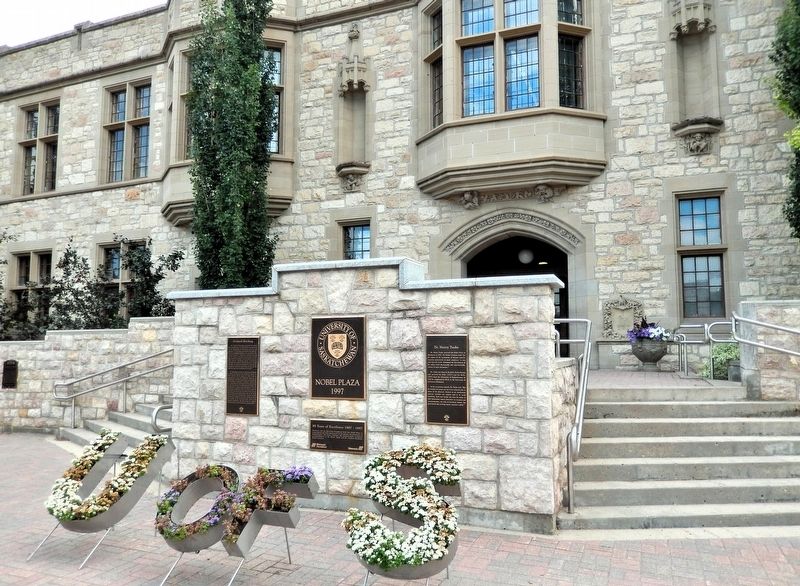
Location. 52° 7.845′ N, 106° 37.976′ W. Marker is in Saskatoon, Saskatchewan, in Corman Park No. 344. It is in the University of Saskatchewan - Management Area. It can be reached from Administration Place north of Campus Drive. The marker is at the Peter MacKinnon Building entrance on the University of Saskatchewan campus. Touch for map. Marker is at or near this postal address: 107 Administration Place, Saskatoon SK S7N 5E5, Canada. Touch for directions.

Regionally, this marker is in Heartland Saskatchewan. It is also in the Prairies. Globally, it is in North America, the Western Hemisphere, the Western World, and the Anglosphere. Historically, it finds itself in what was once
this page online
Other nearby markers. At least 8 other markers are within 11 kilometers of this marker, measured as the crow flies: Gerhard Herzberg (here, next to this marker); College Building (a few steps from this marker); a different marker also named College Building (a few steps from this marker); Saskatoon Land Titles Building (approx. 2 kilometers away); Firehall No. 3 (approx. 2.1 kilometers away); C.P.R. Station, Saskatoon/Gare du C.P. (Saskatoon) (approx. 2.6 kilometers away); Little Chief Service Station (approx. 2.9 kilometers away); Wanuskewin (approx. 10.7 kilometers away). Touch for a list and map of all markers in Saskatoon.
Related markers. Click here for a list of markers that are related to this marker. University of Saskatchewan Nobel Plaza
Also see . . . Henry Taube FRSC (1915-2005) (Wikipedia).
Excerpt: Canadian-born American chemist who was awarded the 1983 Nobel Prize in Chemistry. He was the second Canadian-born chemist to win the Nobel Prize, and remains the only Saskatchewanian-born Nobel laureate. In addition to the Nobel Prize, Taube also received many(Submitted on October 14, 2026, by Cosmos Mariner of Cape Canaveral, Florida.)other major scientific awards, including the Priestley Medal in 1985 and two Guggenheim Fellowships early in his career (1949 and 1955), as well as numerous honorary doctorates. His research focused on redox reactions, transition metals and the use of isotopically labeled compounds to follow reactions. He had over 600 publications including one book and had mentored over 200 students during his career.Photographed by Cosmos Mariner, July 18, 20222. Dr. Henry Taube MarkerThe marker is in the University of Saskatchewan Nobel Plaza, on the front wall of the Peter MacKinnon Building entrance staircase. It is mounted on the right side of the staircase front wall.
After completing his education, Taube remained in the United States, becoming an instructor in chemistry at Berkeley until 1941. Taube became a naturalized citizen of the United States in 1942. From Berkeley, he served as an instructor and assistant professor at Cornell University until 1946. During World War II, Taube served on the National Defense Research Committee. Taube spent time at the University of Chicago as an assistant professor, associate professor and as a full professor from 1946 to 1961. He served as chair of the chemistry department in Chicago from 1956 to 1959, but did not enjoy administrative work. After leaving Chicago, Taube worked as a professor at Stanford University until 1986, a position that allowed him to focuson research, while also teaching classes at the undergraduate and graduate levels. He became a Professor Emeritus at Stanford in 1986, but he continued to perform research until 2001 and visited his labs every day until his death in 2005. In addition to his academic duties, Taube also served as a consultant at Los Alamos National Laboratory from 1956 until the 1970s.Photographed by Cosmos Mariner, July 18, 20223. University of Saskatchewan Nobel Plaza
Photographed by Cosmos Mariner, July 18, 2022
4. Nobel Plaza Dedication
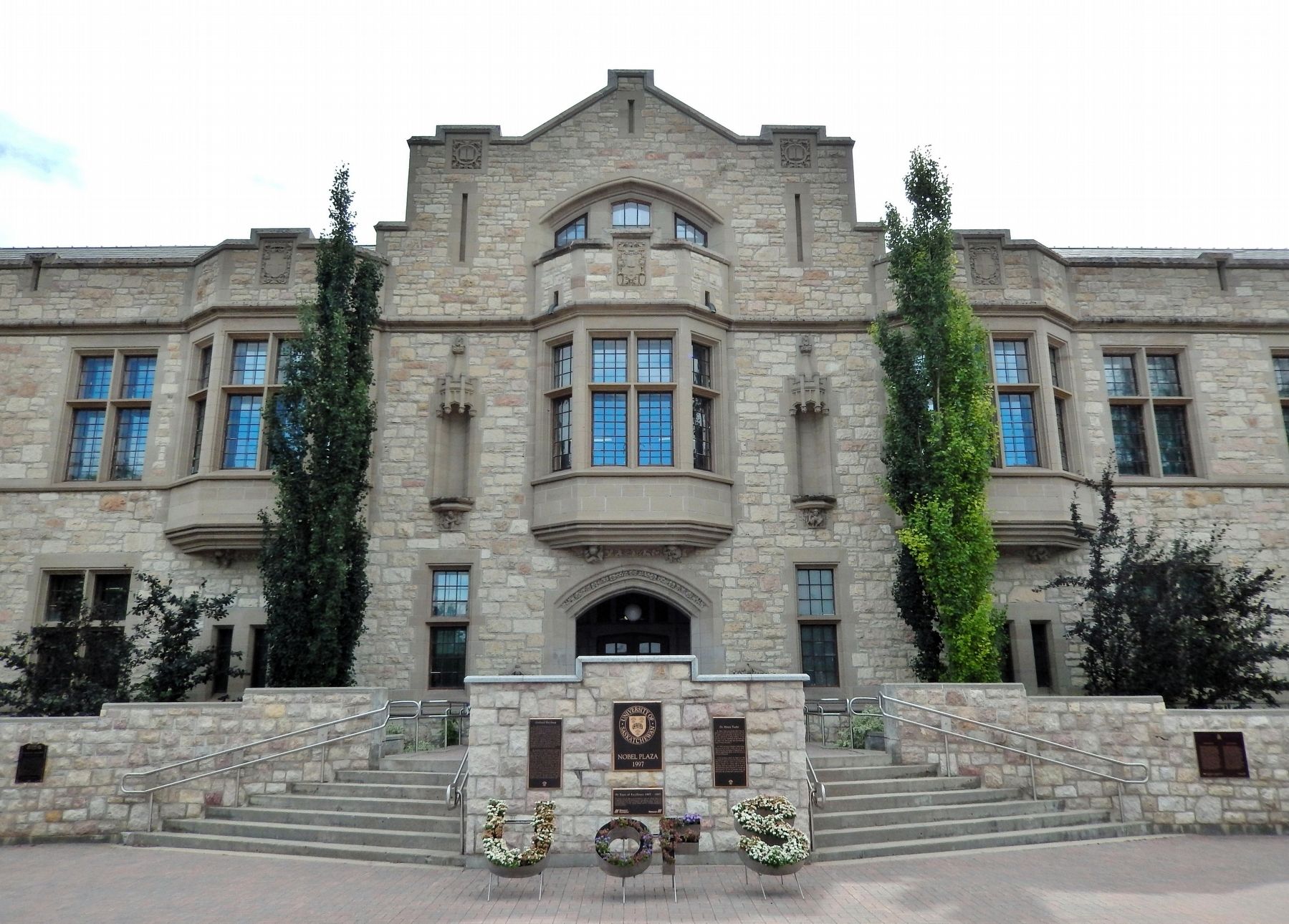
Photographed by Cosmos Mariner, July 18, 2022
5. University of Saskatchewan Peter MacKinnon Building Entrance
Credits. This page was last revised on October 14, 2026. It was originally submitted on October 12, 2026, by Cosmos Mariner of Cape Canaveral, Florida. This page has been viewed 9 times since then. Photos: 1, 2, 3, 4, 5. submitted on October 14, 2026, by Cosmos Mariner of Cape Canaveral, Florida.
