Downtown in Rapid City in Pennington County, South Dakota — The American Midwest (Upper Plains)
The Growth of Rapid City
The Downtown Rapid City Historic District
Photographed by William Fischer, Jr., September 20, 2026
1. The Growth of Rapid City Marker
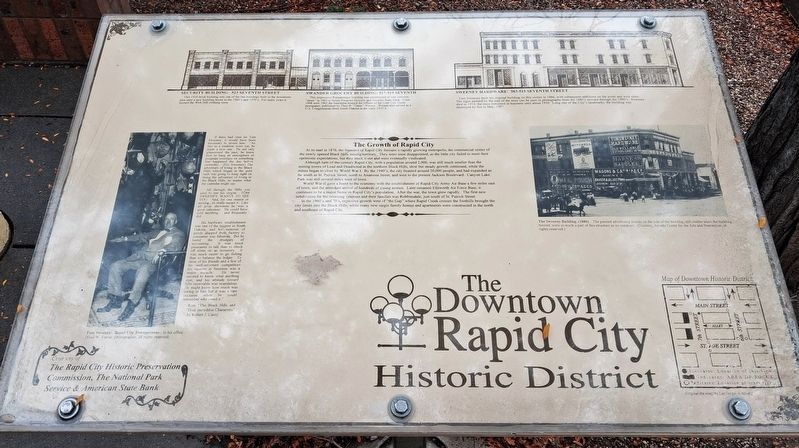
At its start in 1876, the founders of Rapid City foresaw a rapidly growing metropolis, the commercial center of the newly opened Black Hills mining territory. They were soon disappointed, as the little city failed to meet their optimistic expectations, but they stuck it out and were eventually vindicated.
Although turn-of-the-century Rapid City, with a population around 2,000, was still much smaller than the mining towns of Lead and Deadwood in the northern Black Hills, slow but steady growth continued, while the mines began to close by World War I. By the 1940's, the city boasted around 20,000 people, and had expanded as far south as St. Patrick Street, north to Anamosa Street, and west to the present Jackson Boulevard. Canyon Lake Park was still several miles west of town.
World War II gave a boost to the economy with the establishment of Rapid City Army Air Base a few miles east of town, and the attendant arrival of hundreds of young airmen. Later renamed Ellsworth Air Force Base, it continues to be a major factor in Rapid City's population. After the war, the town grew rapidly. The first new subdivision for the
this page online
In the 1960's and 70's, explosive growth west of "the Gap" where Rapid Creek crosses the foothills brought the city limits into the Black Hills, while many new single family homes and apartments were constructed in the north and southeast of Rapid City.
If there had been no Tom Sweeney, it would have been necessary to invent him. "As fast as a tradition wore out, he made a new one. He not only glamorized the past, he knew how to hang an atmosphere of poignant nostalgia on something that happened the day before yesterday. (For Sweeney) The adventure of living in the Black Hills which began in the gold rush was going to keep right on being the adventure of living in the Black Hills, no matter what the calendar might say.
All through the Hills you used to see his slogan: TOM SWEENEY WANTS TO SEE YOU. And, for one reason or another, he really meant it. Like all great showmen he was a great salesman. He could have sold anything - and frequently did.
His hardware establishment was one of the biggest in South Dakota, and his turnover of goods shipped
Photographed by William Fischer, Jr., September 20, 2026
2. The Growth of Rapid City Marker
Not visible, to right of photo
from "The Black Hills and Their Incredible Characters" by Robert J. Casey
[Left photo caption reads]
Tom Sweeney: Rapid City Entrepreneur. In his office.
[Right photo caption reads]
The Sweeney Building. (1886) The painted advertising murals on the side of the building, still visible when the building burned, were as much a part of this structure as its windows.
[Top Left building illustration]
SECURITY BUILDING: 523 SEVENTH STREET
This 1930 brick building was one of the last buildings built in the downtown area until a new building boom in the 1960's and 1970's. For many years it housed the Web Hill clothing store.
[Top Center building illustration]
SWANDER GROCERY BUILDING: 517-519 SEVENTH
This impressive Romanesque building was constructed of cast concrete "stone" in 1905 to house Swander Grocery and Security State Bank. From 1908 until 1965 the basement housed the offices of the Gate City Guide newspaper, published by Theo B. "Dates" Werner. Werner also served as a U.S. Congressman from South Dakota in the early 1930's.
[Top Right building illustration]
SWEENEY BUILDING: 503-515 SEVENTH STREET
Tom Sweeney built his original building on this corner in 1886, with subsequent additions on the south and west sides. The signs painted on the side of the store can be seen in photographs from the 1880's onward through the 1990's. Sweeney died in 1914; the store remained in business until about 1950. Long one of the City's landmarks, the building was destroyed by fire in May, 1997.
Erected by the Rapid City Historic Preservation Commission, the National Park Service & American State Bank.
Topics. This historical marker is listed in these topic lists: Architecture • Immigration • Industry & Commerce • Settlements & Settlers. A significant historical year for this entry is 1876.
Location. 44° 4.874′ N, 103° 13.727′ W. Marker is in Rapid City, South Dakota, in Pennington County. It is in Downtown. It is at the intersection of 7th Street and Main Street (Business Interstate 90), on the right when traveling north on 7th Street. Touch for map. Marker is at or near this postal address: 631 Main Street, Rapid City SD 57701, United States of America. Touch for directions.

Regionally, this marker is in West River and in the Badlands. It is also in the American Black Hills, in the Lewis & Clark Corridor, on the prairies, and on the Northern Plains. Globally, it is in North America, the Western Hemisphere, the Western World, and the Anglosphere. Historically, it finds itself in what was once Rupert’s Land and also the Louisiana Purchase.
Other nearby markers. At least 8 other markers are within walking distance of this marker: James Monroe (here, next to this marker); Rapid City's Downtown Historic District (a few steps from this marker); Lyndon B. Johnson (a few steps from this marker); Rapid City Area Vietnam War Honored Dead (a few steps from this marker); John Quincy Adams (within shouting distance of this marker); The National Humane Alliance Fountain (within shouting distance of this marker); 601st Bomb Squadron Army B-17 25226 Crash (within shouting distance of this marker); Vanishing Elements of Our Past (within shouting distance of this marker). Touch for a list and map of all markers in Rapid City.
Credits. This page was last revised on October 12, 2026. It was originally submitted on October 12, 2026, by William Fischer, Jr. of Reynoldsburg, Ohio. This page has been viewed 6 times since then. Photos: 1, 2. submitted on October 12, 2026, by William Fischer, Jr. of Reynoldsburg, Ohio.
