Downtown in Rapid City in Pennington County, South Dakota — The American Midwest (Upper Plains)
The Gossages and Rapid City
The Downtown Rapid City Historic District

Photographed by William Fischer, Jr., September 20, 2026
1. The Gossages and Rapid City Marker
The Gossages and Rapid City
Joseph Gossage and his wife, Alice, were a major influence in Rapid City's early days. The founder of the Rapid City Journal in 1878, Gossage was an untiring promoter of Rapid City, active in such enterprises as the formation of the first library association.
It was Mrs. Gossage, however, who became better known. After her husband's death, she continued to publish the newspaper, set a moral tone for the residents, and, to judge contemporary accounts, was involved in almost everything else in the society of the town. Her name appears time and again in accounts of the doings of the town.
The Rapid City Daily Journal reported, in the July 6, 1936 anniversary issue, one of the many stories told to illustrate the part Alice Gossage played in the developing life of Rapid City. It is built around the reply of a little girl, about 1915, when her mother was trying to work a lesson into their conversation. They had been for a ride behind the family horse, and the little girl seemed a bit discontented with what there was to do when they got home. Her mother told her she should be happy
this page online
[Left photo caption reads]
Horse Race Stockamn's Days. Location: Main Street looking west to the Gap and Cowboy hill. (Fred W. Farrar, photographer, all rights reserved) From 1898 to 1910 the main event of the year was the meeting of the South Dakota Stockgrowers Association. It was held in Rapid City on April 11-13 each year. These were the days set for all ranchers to come to Rapid City and do business buying supplies, have a few drinks and a good time. Also, it was the occasion for all the concession men from South Omaha, Chicago and Sioux City to have a vacation and a celebration and create good business relations with the men who shipped cattle. Every store in Rapid City prospered from the Stockmen's Meeting. [Carl Leedy, Black Hills Pioneers Stories]
[Right photo caption
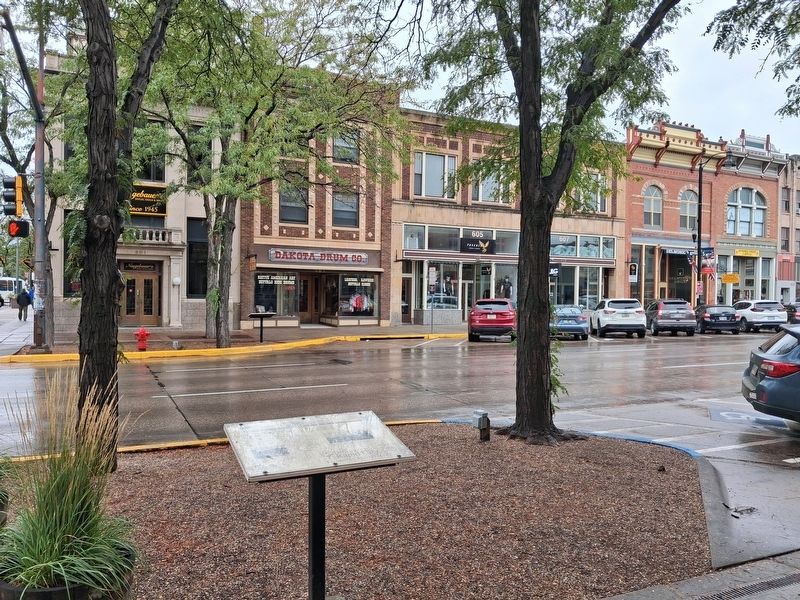
Photographed by William Fischer, Jr., September 20, 2026
2. The Gossages and Rapid City Marker
Main Street Car Display (1929). Location: 500 block on Main Street looking east. Business signs starting on the right: Doherty Drugs, Rice[?] Studios, Schuster Market, McNamara Brothers, Wildman Grocery & Bakery, Flynn's Books, Ottmann Drugs, J.C. Penney Co., Power and Light, Pennington County Bank, [Elks] Building on southeast side of Sixth and Main Streets. Alex Johnson [Hotel] in background.
[Top building streetscape illustration, left to right, reads]
PENNINGTON COUNTY BANK: 601 MAIN ST.
In 1888, a substantial stone building with a tall, conical turret was built on this corner to house the popular Pennington County Bank. Destroyed in a fire, it was replaced in 1915 by this dignified building with its still visible, impressive, interior marble paneling. The classical style Main Street facade bears both dates.
DAKOTA POWER COMPANY: 603 MAIN ST.
When the Dakota Power Company moved from the Clower Building across Main Street, the facade of this building was decorated with light sockets to advertise the wonder of electricity. In 1941, the firm became Black Hills Power and Light. This building is part of the Haines Block
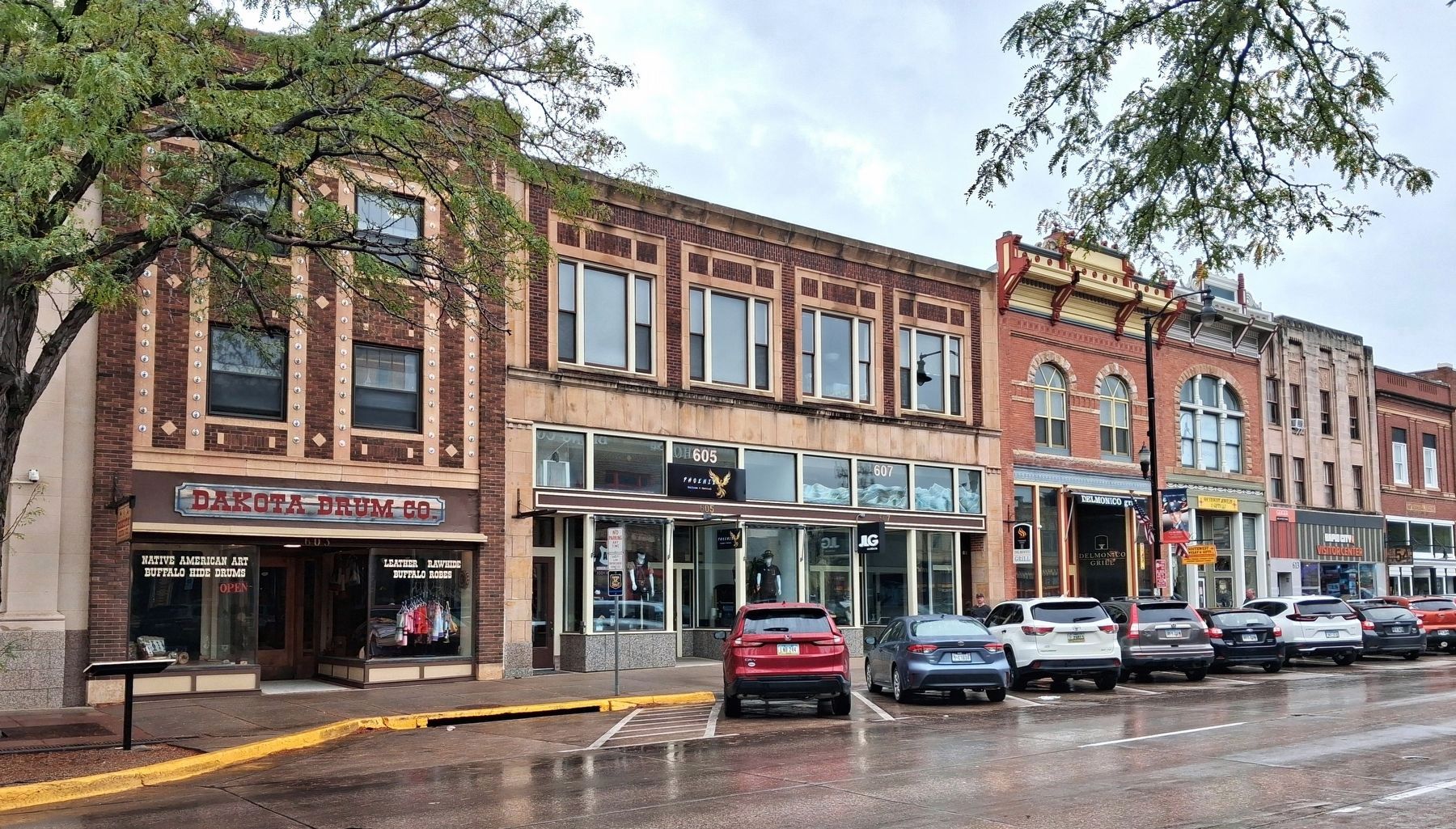
Photographed by William Fischer, Jr., September 20, 2026
3. Part of 600 Block of Main Street (odd numbers)
Mentioned in marker
J.C. PENNEY COMPANY: 605 MAIN ST.
These buildings date from 1908 and were covered with a green metal facade from the 1950's until 1996. It was the location of the J.C. Penney department store on the main floor and mezzanine. The office, above the front doors, was connected to the sales desks by a system of wire-born cartridges which carried money and receipts back and forth, to the amazement of small children watching the process.
611 MAIN STREET
[Illegible], this [illegible] building housed the Elks Club lodge rooms on its upper floor. It once shared an elaborate cornice with the building to the east. The facade was restored in 1987.
613 MAIN STREET
In 1903, this 1887 building housed Jones & Co. Bakery and Grocery. It had a typical storefront with cast iron pillars and large plate glass windows at street level, topped with multi-paned windows above. The upper floors now display a typical Art Deco facade, an architectural style popular in the 1920's and 1930's.
McNAMARA BROTHERS BUILDING[:] 615 MAIN STREET
The bachelor McNamara brothers operated a book store here for many years. The present brick building replaced their original one-story false-front frame building in 1919.
RISE BUILDING: 617-619 MAIN STREET
Original photos from the late 1920's show only the west half of this building; a one-story wooden building between it and the McNamara Building housing the Schuster Meat Market. A careful look at the brickwork today reveals two separate structures with a common front. Carl Rise was a prominent Rapid City photographer in the 1920's and 1930's. The older half of this brick building, built in the 1920's was his studio and camera shop. It originally had a tiles mansard roof (see photo below [right photo]).
621 MAIN STREET
This one-story building dates from 1927, when it housed Doherty Drugs. In its basement today is a large fireplace constructed of hundreds of varieties of Black Hills rocks, proudly displaying the name Doherty.
THE JOHNSON & REPUBLICAN BLOCKS: 623-628 MAIN STREET
Three buildings dating from 1903[?], 1889 and 1900 (left to right) were covered by a false front of the F.W. Woolworth's in the 1940's. After nearly 50 years the facades of these buildings were rebuilt in 1995. While not a historic reconstruction, the new facades complement the older buildings in the block. Before the turn of the century, the "Daily Republican" newspaper was in the central portion of these buildings.
FIRST NATIONAL BANK: 631 MAIN STREET
In 1882 the First National Bank built Rapid City's first brick business building on this corner. In 1914 the present building, constructed in the Classical style to reflect the bank's stability and soundness, replaced it. The interior still displays the paneling typical of this style of commercial building. The bank (now Norwest) remained in this building until 1958. The building later briefly housed the American State Bank, now across the street.
Erected by Rapid City Historic Preservation Commission, the National Park Service and MAC Construction.
Topics and series. This historical marker is listed in these topic lists: Architecture • Industry & Commerce • Settlements & Settlers • Women. In addition, it is included in the National Register of Historic Places (NRHP) series list. A significant historical year for this entry is 1878.
Location. 44° 4.873′ N, 103° 13.63′ W. Marker is in Rapid City, South Dakota, in Pennington County. It is in Downtown. It is at the intersection of Main Street (Business Interstate 90) and 6th Street, on the right when traveling west on Main Street. Touch for map. Marker is at or near this postal address: 606 Main Street, Rapid City SD 57701, United States of America. Touch for directions.

Regionally, this marker is in West River and in the Badlands. It is also in the American Black Hills, in the Lewis & Clark Corridor, on the prairies, and on the Northern Plains. Globally, it is in North America, the Western Hemisphere, the Western World, and the Anglosphere. Historically, it finds itself in what was once Rupert’s Land and also the Louisiana Purchase.
Other nearby markers. At least 8 other markers are within walking distance of this marker: Hooky Jack Leary (a few steps from this marker); Mitakuye Oyasin (a few steps from this marker); John Adams (within shouting distance of this marker); George Herbert Walker Bush (within shouting distance of this marker); 601st Bomb Squadron Army B-17 25226 Crash (about 300 feet away, measured in a direct line); Tourism and Hotels (about 400 feet away); Early Rapid City History (about 400 feet away); George Washington (about 400 feet away). Touch for a list and map of all markers in Rapid City.
Also see . . . Rapid City Historic Commercial District Nomination Form. (Submitted on October 16, 2026, by William Fischer, Jr. of Reynoldsburg, Ohio.)
Credits. This page was last revised on October 16, 2026. It was originally submitted on October 12, 2026, by William Fischer, Jr. of Reynoldsburg, Ohio. This page has been viewed 12 times since then. Photos: 1, 2. submitted on October 12, 2026, by William Fischer, Jr. of Reynoldsburg, Ohio. 3. submitted on October 13, 2026, by William Fischer, Jr. of Reynoldsburg, Ohio.
