Cäcilien-Viertel in Köln, North Rhine-Westphalia, Germany — Central Europe
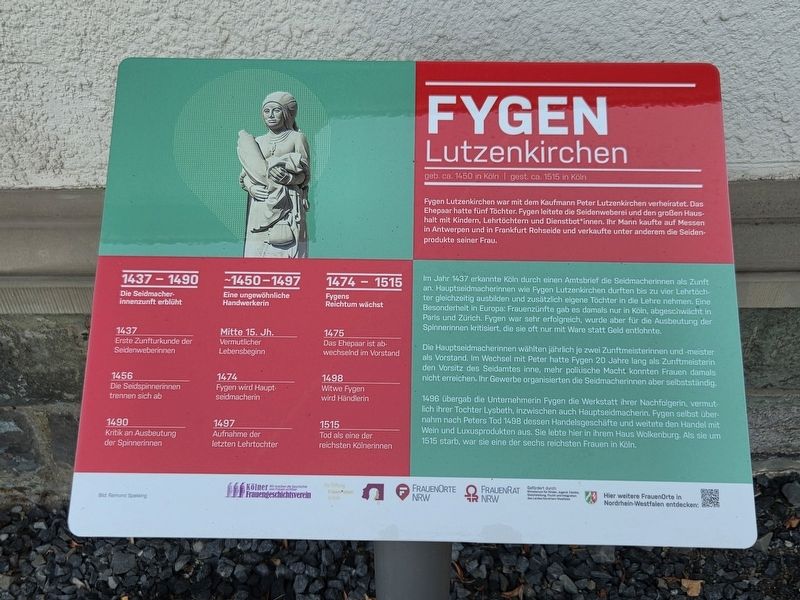
Fygen Lutzenkirchen
Photographed by James Hulse, October 6, 2026
1. Fygen Lutzenkirchen Marker

geb. ca. 1450 in Köln | gest. ca. 1515 in Köln
Fygen Lutzenkirchen war mit dem Kaufmann Peter Lutzenkirchen verheiratet. Das Ehepaar hatte fünf Töchter. Fygen leitete die Seidenweberei und den großen Haushalt mit Kindern, Lehrtöchtern und Dienstbot*innen. Ihr Mann kaufte auf Messen in Antwerpen und in Frankfurt Rohseide und verkaufte unter anderem die Seidenprodukte seiner Frau.
1437 – 1490: Die Seidmacherinnenzunft erblüht
1437 – Erste Zunfturkunde der Seidenweberinnen
1456 – Die Seidspinnerinnen trennen sich ab
1490 – Kritik an Ausbeutung der Spinnerinnen
~1450–1497: Eine ungewöhnliche Handwerkerin
Mitte 15. Jh. – Vermutlicher Lebensbeginn
1474 – Fygen wird Hauptseidmacherin
1497 – Aufnahme der letzten Lehrtochter
1474 – 1515: Fygens Reichtum wächst
1475 – Das Ehepaar ist abwechselnd im Vorstand
1498 – Witwe Fygen wird Händlerin
1515 – Tod als eine der reichsten Kölnerinnen
Im Jahr 1437 erkannte Köln durch einen Amtsbrief die Seidmacherinnen als Zunft an. Hauptseidmacherinnen wie Fygen Lutzenkirchen durften bis zu vier Lehrtöchter gleichzeitig ausbilden und
this page online
Die Hauptseidmacherinnen wählten jährlich je zwei Zunftmeisterinnen und -meister als Vorstand. Im Wechsel mit Peter hatte Fygen 20 Jahre lang als Zunftmeisterin den Vorsitz des Seidamtes inne, mehr politische Macht konnten Frauen damals nicht erreichen. Ihr Gewerbe organisierten die Seidmacherinnen aber selbstständig.
1496 übergab die Unternehmerin Fygen die Werkstatt ihrer Nachfolgerin, vermutlich ihrer Tochter Lysbeth, inzwischen auch Hauptseidmacherin. Fygen selbst übernahm nach Peters Tod 1498 dessen Handelsgeschäfte und weitete den Handel mit Wein und Luxusprodukten aus. Sie lebte hier in ihrem Haus Wolkenburg. Als sie um 1515 starb, war sie eine der sechs reichsten Frauen in Köln.
Bild: Raimond Spekking
Fygen Lutzenkirchen
Born around 1450 in Cologne; died around 1515 in Cologne.
Fygen Lutzenkirchen was married
Photographed by James Hulse, October 6, 2026
2. Fygen Lutzenkirchen Marker
1437–1490: The Women Silk Makers’ Guild Flourishes
1437 – First guild charter for women silk weavers
1456 – Women silk spinners form a separate organization
1490 – Criticism of the exploitation of women spinners
About 1450–1497: An Unusual Craftswoman
Mid-fifteenth century – Probable time of birth
1474 – Fygen becomes a master silk maker
1497 – Admission of her last female apprentice
1474–1515: Fygen’s Wealth Grows
1475 – The couple alternates in serving on the guild’s governing board
1498 – The widowed Fygen becomes a merchant
1515 – Dies as one of Cologne’s wealthiest women
In 1437, Cologne officially recognized the women silk makers as a guild. Master silk makers such as Fygen Lutzenkirchen could train up to four female apprentices at the same time, in addition to their own daughters. Women’s guilds were unusual in Europe: they existed then only in Cologne, with more limited forms in Paris and Zurich. Fygen was very successful, but she was criticized for exploiting the spinners, whom she often paid in goods rather than money.
The master silk makers annually elected two women and two men as guild leaders. Alternating with Peter, Fygen chaired the silk guild as a guild mistress for twenty years. Women could attain no greater political power at that time, although the women silk makers independently organized their trade.
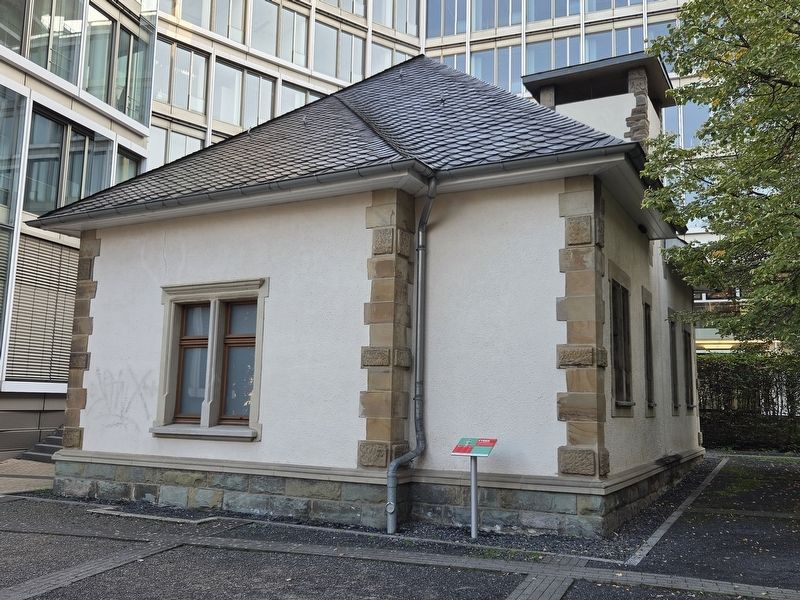
In 1496, Fygen handed over the workshop to her successor, probably her daughter Lysbeth, who had also become a master silk maker. After Peter’s death in 1498, Fygen took over his trading business and expanded trade in wine and luxury goods. She lived here in her house, Wolkenburg. When she died around 1515, she was one of the six wealthiest women in Cologne.
Image: Raimond Spekking
Erected by Cologne Women’s History Association – We Make History, Women’s Lives in Cologne Foundation, Women’s Places NRW, Women’s Council NRW, Funded by the Ministry for Children, Youth, Family, Equality, Refugees and Integration of the State of North Rhine-Westphalia.
Topics. This historical marker is listed in these topic lists: Industry & Commerce • Women. A significant historical year for this entry is 1450.
Location. 50° 56.09′ N, 6° 57.138′ E. Marker is in Köln, Nordrhein-Westfalen (North Rhine-Westphalia). It is in Cäcilien-Viertel. It is at the intersection of Cäcilienkloster and Cäcilienstraße, on the left when traveling south on Cäcilienkloster. Touch for map. Marker is at or near this postal address: Cäcilienkloster 4, Köln HE 50676, Germany. Touch for directions.

Regionally, this marker is in the German Rhineland. Globally, it is in Europe, the European Union, Atlantic Europe, Central Europe, the Schengen Area, Western Europe, and the Western World. Historically, it finds itself in what was once the Roman Empire, the Holy Roman Empire, the Hanseatic League, and the former West Germany.
Other nearby markers. At least 8 other markers are within walking distance of this marker: St. Cäcilien / Museum Schnütgen (within shouting distance of this marker); St. Peter (within shouting distance of this marker); Antoniterkirche (about 180 meters away, measured in a direct line); Mathilde Joseph (about 180 meters away); At This Location (about 180 meters away); Margarete Pins (about 210 meters away); Liddy Pins (about 210 meters away); Romm (about 210 meters away). Touch for a list and map of all markers in Köln.
Credits. This page was last revised on October 15, 2026. It was originally submitted on October 14, 2026, by James Hulse of Medina, Texas. This page has been viewed 10 times since then. Photos: 1, 2. submitted on October 15, 2026, by James Hulse of Medina, Texas.
