Cäcilien-Viertel in Köln, North Rhine-Westphalia, Germany — Central Europe
Ester Ettel Oszkowski
Photographed by James Hulse, October 6, 2026
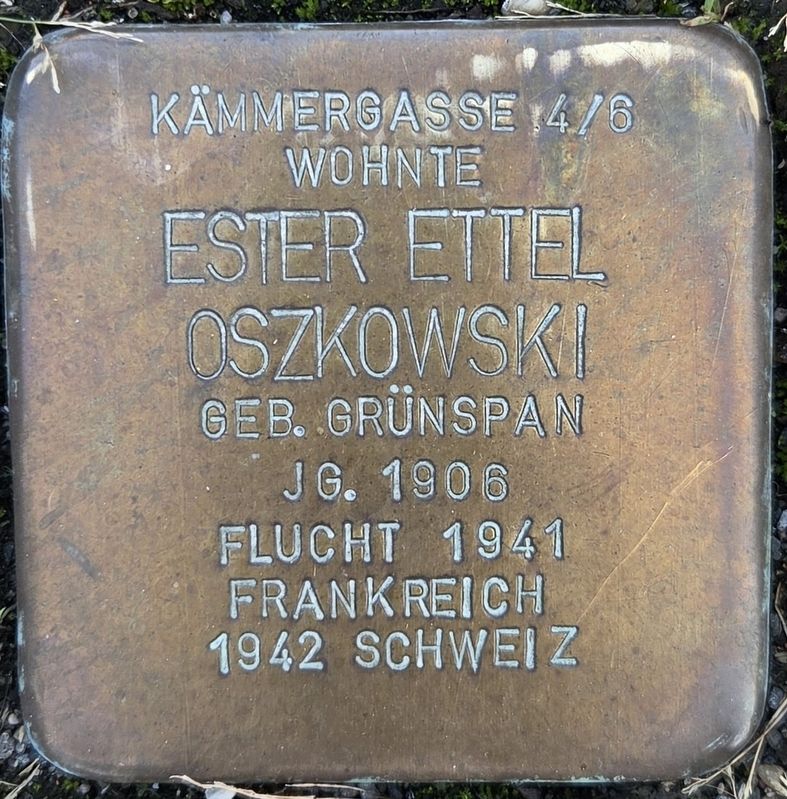
1. Ester Ettel Oszkowski Marker

Wohnte
Ester Ettel
Oszkowski
Geb. Grünspan
Jg. 1906
Flucht 1941
Frankreich
1942 Schweiz
Ester Ettel Oszkowski, née Grünspan, lived at Kämmergasse 4/6. She was born in 1906 and fled to France in 1941, then to Switzerland in 1942.
Topics and series. This historical marker is listed in these topic lists: War, World II • Women. In addition, it is included in the Stolpersteine series list. A significant historical year for this entry is 1906.
Location. 50° 55.954′ N, 6° 57.171′ E. Marker is in Köln, Nordrhein-Westfalen (North Rhine-Westphalia). It is in Cäcilien-Viertel. It is at the intersection of Kämmergasse and Großer Griechenmarkt, on the left when traveling south on Kämmergasse. Touch for map. Marker is at or near this postal address: Kämmergasse 14, Köln HE 50676, Germany. Touch for directions.

Regionally, this marker is in the German Rhineland. Globally, it is in Europe, the European Union, Atlantic Europe, Central Europe, the Schengen Area, Western Europe, and the Western World. Historically, it finds itself in what was once the Roman Empire, the Holy Roman Empire, the Hanseatic League, and the former West Germany.
Other nearby markers. At least 8 other markers are within walking distance of this marker: Marian Oszkowski (here, next to this marker); Abram Oszkowski (here, next to this marker); Toni Oszkowski (here, next to this marker); Samuel Oszkowski (here, next to this marker); Romm (a few steps from this marker); Rommni (a few steps from this marker); a different marker also named Romm (a few steps from this marker); Willy Kaufmann
this page online
Also see . . . Stolperstein. Wikipedia
A Stolperstein (in English "stumbling block") is a ten-centimetre (four-inch) concrete cube bearing a brass plate inscribed with the name and life dates of victims of Nazi extermination or persecution. The Stolpersteine project, initiated by the German artist Gunter Demnig in 1992, aims to commemorate persons at the last place that they chose freely to reside, work or study (with exceptions possible on a case-by-case basis) before they fell victim to Nazi terror, forced euthanasia, eugenics, deportation to a concentration or extermination camp, or escaped persecution by emigration or suicide. As of June 2023, 100,000 Stolpersteine have been laid, making the Stolpersteine project the world's largest decentralized memorial.(Submitted on October 15, 2026, by James Hulse of Medina, Texas.)
Photographed by James Hulse, October 6, 2026
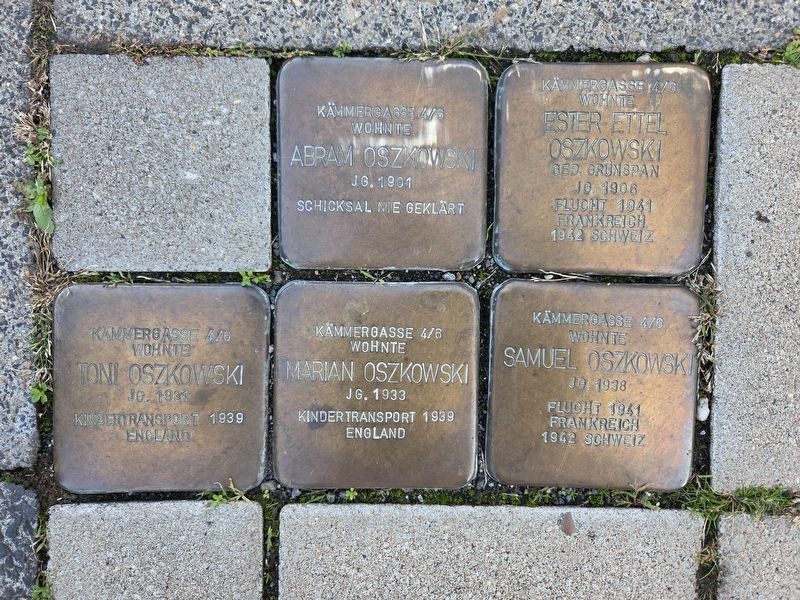
2. Ester Ettel Oszkowski Marker
The Stolpersteine (Stumbling Stones) for the Oszkowski family consist of five individual stones placed together.
Photographed by James Hulse
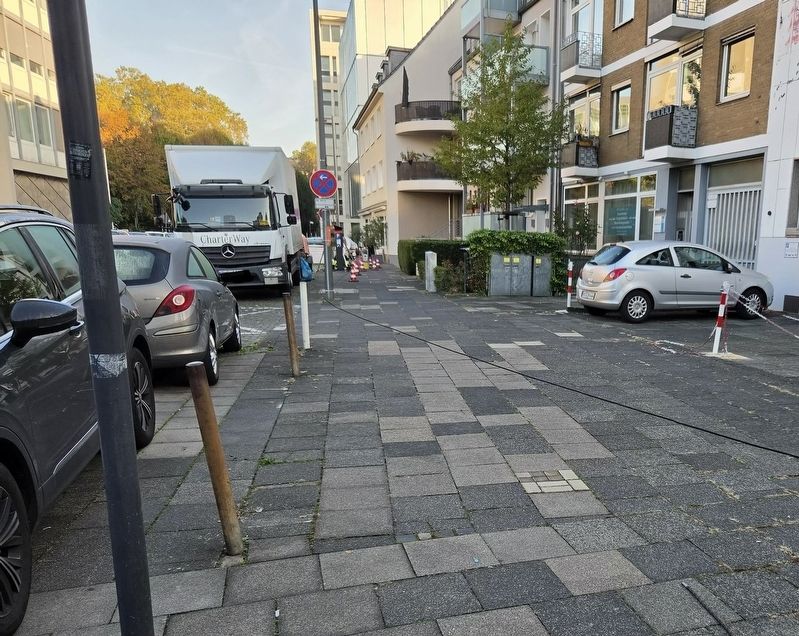
3. Ester Ettel Oszkowski Marker
The view of the Stolpersteine (Stumbling Stones) along the street in front of the building.
Credits. This page was last revised on October 16, 2026. It was originally submitted on October 15, 2026, by James Hulse of Medina, Texas. This page has been viewed 5 times since then. Photos: 1, 2, 3. submitted on October 16, 2026, by James Hulse of Medina, Texas.
