Liverpool in Merseyside, England, United Kingdom — Northwestern Europe (the British Isles)
Saint Nicholas's Church Yard
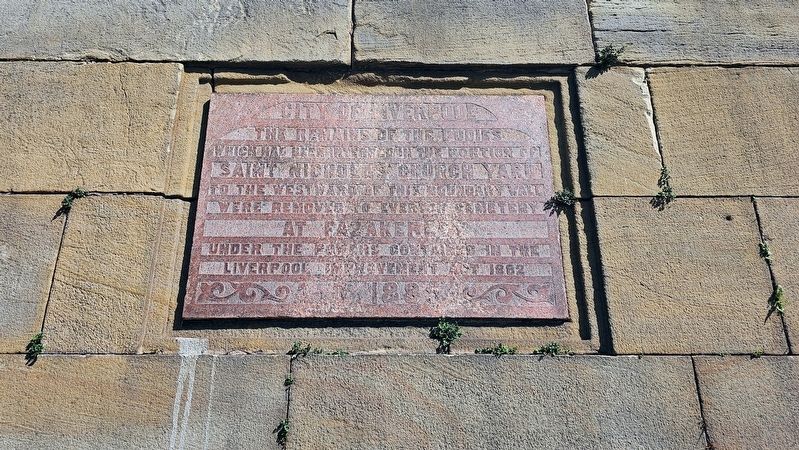
Photographed by Ian Lefkowitz, September 13, 2026
1. Saint Nicholas's Church Yard Marker
The remains of the bodies which had been interred in the portion of
Saint Nicholas’s Church Yard
to the westward of the boundary wall were removed to Everton Cemetery
at Fazakerley
under the powers contained in the Liverpool Improvement Act 1862
A.D. 1885
Erected 1885 by City of Liverpool.
Topics. This historical marker is listed in these topic lists: Cemeteries & Burial Sites • Religion & Religious Structures. A significant historical year for this entry is 1862.
Location. 53° 24.407′ N, 2° 59.706′ W. Marker is in Liverpool, England, in Merseyside. It is on George's Dock Gates south of Chapel Street, on the left when traveling south. Touch for map. Marker is at or near this postal address: 5 Old Churchyard, Liverpool, England L2 8TZ, United Kingdom. Touch for directions.

Regionally, this marker is in North West England. Globally, it is on the Atlantic Ocean, in the North Atlantic Region, in Europe, in Atlantic Europe, on one of the British Isles, in the Western World, and in the Anglosphere. Historically, it finds itself in what was once the Roman Empire.
Other nearby markers. At least
this page online
Also see . . . Gardens (Liverpool Parish Church).
Although some graves were later moved to Walton Park Cemetery (which still forms part of the benefice of Liverpool Parish), many graves still lie under the gardens. Some of the paving stones in the Gardens were once tombstones, but fixed to the wall is the elaborate headstone of John Roscoe (d. 1773) and his wife Mary as a reminder that this is still a graveyard. The burial registers also reveal the first written record of a black resident of the City: Abell, who was enslaved(Submitted on October 17, 2026, by Ian Lefkowitz of New York, New York.)to a Mr Rock, was buried on 1 October 1717 and was commemorated by a memorial stone laid in 2020.Photographed by Ian Lefkowitz, September 13, 20262. Saint Nicholas's Church Yard MarkerThe stone is embedded in the wall towards the southern entrance of Our Lady and St Nicholas Church Garden.
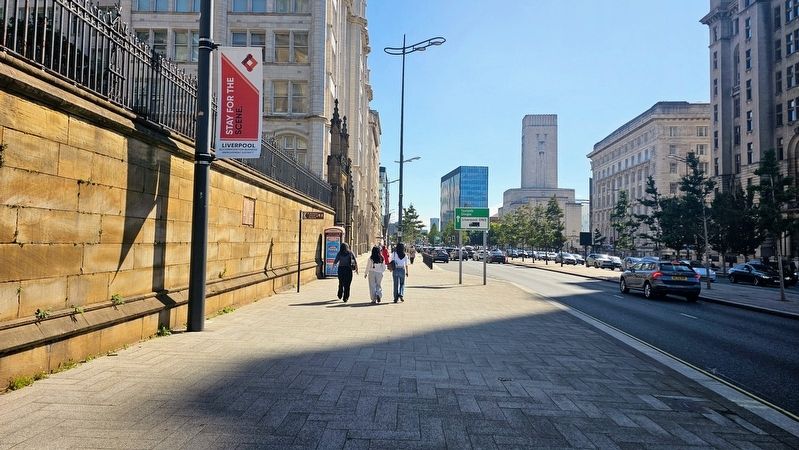
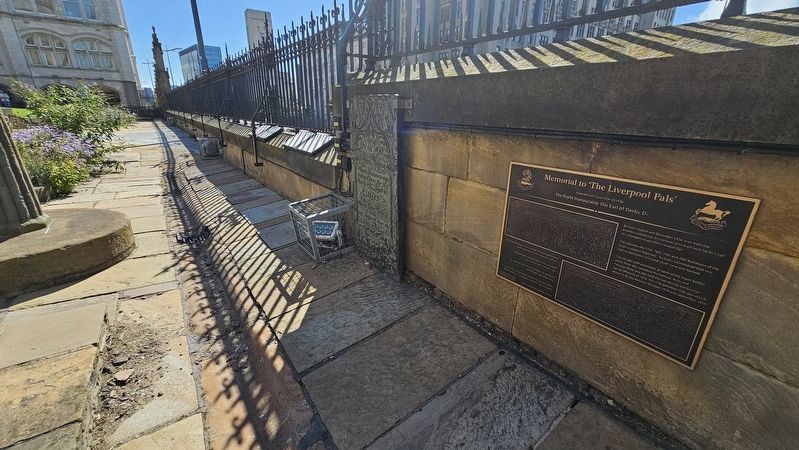
Photographed by Ian Lefkowitz, September 13, 2026
3. Our Lady and St Nicholas Church Garden
The headstone of John and Mary Roscoe stand as a reminder of the garden's history as a burial site.
Credits. This page was last revised on November 1, 2026. It was originally submitted on October 17, 2026, by Ian Lefkowitz of New York, New York. This page has been viewed 10 times since then. Photos: 1, 2, 3. submitted on October 17, 2026, by Ian Lefkowitz of New York, New York. • Andrew Ruppenstein was the editor who published this page.
