Colchester in Essex, England, United Kingdom — Northwestern Europe (the British Isles)
Essex Witch Hunts
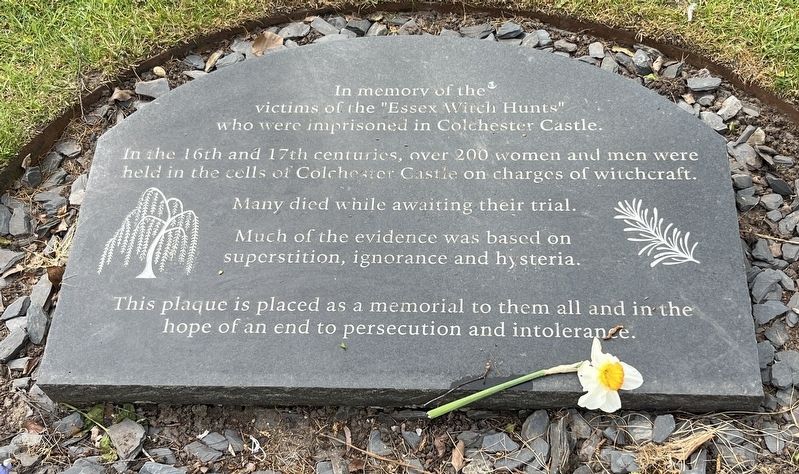
Photographed by Ray Gurganus, April 17, 2026
1. Essex Witch Hunts Marker
In the 16th and 17th centuries, over 200 women and men were held in the cells of Colchester Castle on charges of witchcraft.
Many died while awaiting their trial.
Much of the evidence was based on superstition, ignorance and hysteria.
This plaque is placed as a memorial to them all and in the hope of an end to persecution and intolerance.
Topics. This historical marker is listed in these topic lists: Forts and Castles • Notable Events.
Location. 51° 53.41′ N, 0° 54.206′ E. Marker is in Colchester, England, in Essex. It can be reached from High Street, on the left when traveling east. On the grounds of Colchester Upper Castle Park. Touch for map. Marker is in this post office area: Colchester, England CO1 1TN, United Kingdom. Touch for directions.

Regionally, this marker is in the Greater South East. Globally, it is on the Atlantic Ocean, in the North Atlantic Region, in Europe, in Atlantic Europe, on one of the British Isles, in the Western World,
this page online
Other nearby markers. At least 8 other markers are within walking distance of this marker: Forebuilding and Chapel (here, next to this marker); Main Entrance (within shouting distance of this marker); Castle - East Wall (within shouting distance of this marker); Castle - North Side (about 90 meters away, measured in a direct line); Priory Street Bastion 5 (approx. 0.3 kilometers away); East Gate (approx. 0.3 kilometers away); St Botolph's Churchyard (approx. 0.3 kilometers away); St Botolph's Priory (approx. 0.3 kilometers away). Touch for a list and map of all markers in Colchester.
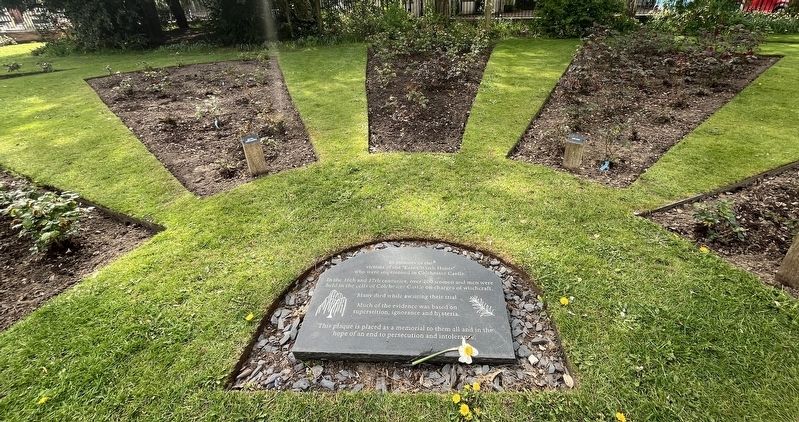
Photographed by Ray Gurganus, April 17, 2026
2. Essex Witch Hunts Marker
Credits. This page was last revised on November 1, 2026. It was originally submitted on October 17, 2026, by Ray Gurganus of Washington, District of Columbia. This page has been viewed 10 times since then. Photos: 1, 2. submitted on October 17, 2026, by Ray Gurganus of Washington, District of Columbia. • Andrew Ruppenstein was the editor who published this page.
