Hyde Park in Chicago in Cook County, Illinois — The American Midwest (Great Lakes)
Washington Park
Photographed by Sean P. Flynn, October 17, 2026
1. Washington Park Marker
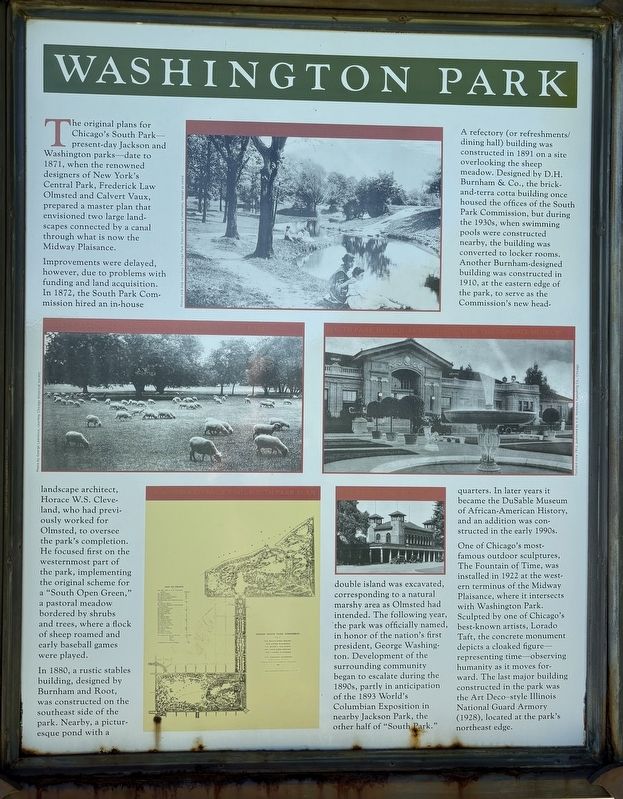
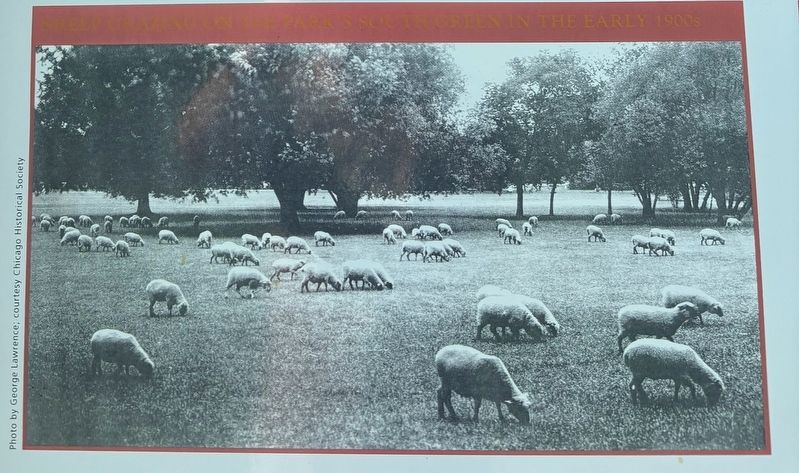
Improvements were delayed, however, due to problems with funding and land acquisition. In 1872, the South Park Commission hired an in-house landscape architect, Horace W.S. Cleveland, who had previously worked for Olmsted, to oversee the park's completion. He focused first on the westernmost part of the park, implementing the original scheme for a "South Open Green," a pastoral meadow bordered by shrubs and trees, where a flock of sheep roamed and early baseball games were played.
In 1880, a rustic stables building, designed by Burnham and Root, was constructed on the southeast side of the park. Nearby, a picturesque pond with a double island was excavated, corresponding to a natural marshy area as Olmsted had intended. The following year, the park was officially named, in honor of the nation's first president,
this page online
A refectory (or refreshments/dining hall) building was constructed in 1891 on a site overlooking the sheep meadow. Designed by D.H. Burnham & Co., the brick-and-terra cotta building once housed the offices of the South Park Commission, but during the 1930s, when swimming pools were constructed nearby, the building was converted to locker rooms. Another Burnham-designed building was constructed in 1910, at the eastern edge of the park, to serve as the Commission's new headquarters. In later years it became the DuSable Museum of African-American History, and an addition was con-structed in the early 1990s.
One of Chicago's most-famous outdoor sculptures, The Fountain of Time, was installed in 1922 at the west-ern terminus of the Midway Plaisance, where it intersects with Washington Park. Sculpted by one of Chicago's best-known artists, Lorado Taft, the concrete monument depicts a cloaked figure-representing time-observing
Photographed by Sean P. Flynn, October 17, 2026
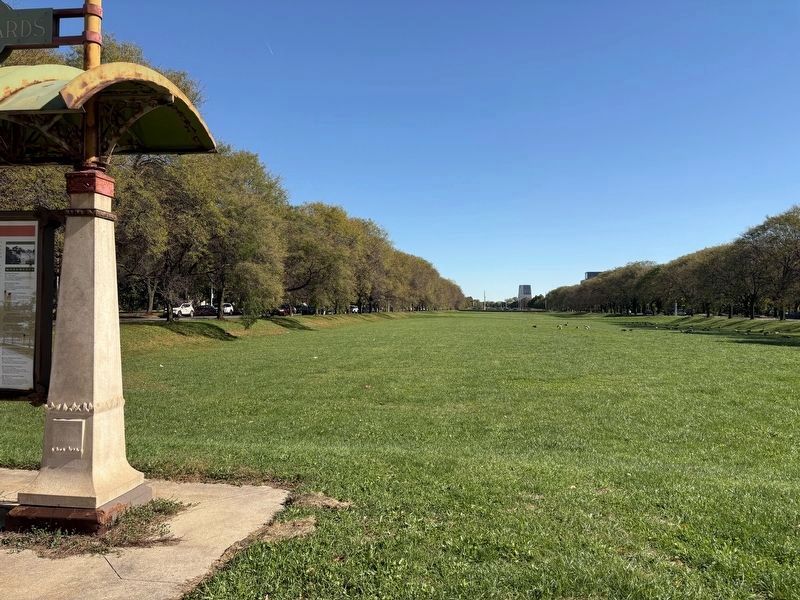
2. Washington Park Marker at the Midway
The rear side of the marker that is partially visible is a separate marker titled "The Boulevard System," about Chicago's grand boulevards that connect its parks.
Erected 1995 by City of Chicago.
Topics and series. This historical marker is listed in these topic lists: Animals • Architecture • Arts, Letters, Music • Parks & Recreational Areas. In addition, it is included in the Art Deco, and the Former U.S. Presidents: #01 George Washington series lists. A significant historical year for this entry is 1871.
Location. 41° 47.213′ N, 87° 36.352′ W. Marker is in Chicago, Illinois, in Cook County. It is in Hyde Park. It is at the intersection of Midway Plaisance and South Cottage Grove Avenue, in the median on Midway Plaisance. Touch for map. Marker is in this post office area: Chicago IL 60637, United States of America. Touch for directions.

Regionally, this marker is on Chicago’s South Side. It is also in the American Midwest. Globally, it is in North America, on the Great Lakes, in the Western Hemisphere, in the Western World, and in the Anglosphere. Historically, it finds itself in what was
Photographed by Sean P. Flynn, October 17, 2026
3. Inset photo of the sheep meadow
Other nearby markers. At least 8 other markers are within walking distance of this marker: The Boulevard System (here, next to this marker); Dr. Allison Davis (within shouting distance of this marker); Fountain of Time (about 400 feet away, measured in a direct line); Lorado Taft (approx. ¼ mile away); Site of the First Self-sustaining Controlled Nuclear Chain Reaction (approx. half a mile away); Charles E. Merriam Center for Public Administration (approx. 0.7 miles away); Enrico and Laura Fermi (approx. 0.7 miles away); Masaryk Memorial Monument (approx. 0.8 miles away). Touch for a list and map of all markers in Chicago.
More about this marker. The front (Cottage Grove Ave.-facing) side of the canopy has a marker about Chicago's Boulevard System. This marker and the one on its rear are part of a series of markers erected across Chicago in 1995, typically at locations where the city's grand boulevards enter into Chicago parks. As is also typical for these more than 30-year-old markers, the signs show some rusting and
Photographed by Sean P. Flynn, October 17, 2026
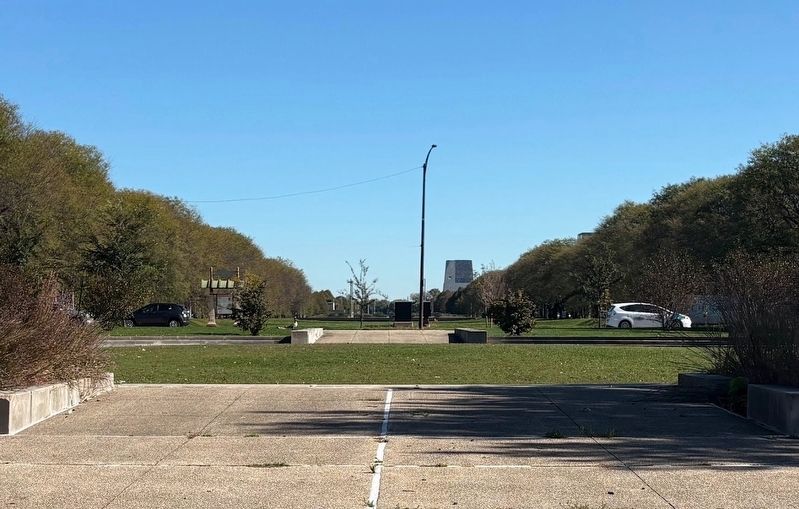
4. Long, east-facing view of the Midway
The kiosk with The Boulevard System and Washington Park markers is on the left. In the far distance on the right is the Obama Presidential Center, which opened in 2026 in Jackson Park.
Also see . . .
1. Washington Park. A history of the park, by the Chicago Park District.
Excerpt: "By the mid-1930s, the growing African-American community around Washington Park was in dire need of additional recreational facilities. The Park District responded by building two competition-size swimming pools near the refectory. In 1991, the Park District transferred a parcel of land within the park to the Board of Education for a new school, Walther H. Dyett High School. In the early 1990s, the Park District rehabilitated the refectory and transformed the swimming area into a major aquatic center. Recent projects include lagoon improvements, the construction of a $700 thousand playground, the creation of an arboretum, and a $2 million restoration of the Fountain of Time. Lagoon improvements were made in the early 2000s."(Submitted on October 18, 2026, by Sean P. Flynn of Oak Park, Illinois.)
2. Horace William Shaler Cleveland (1814-1900). From the Minnesota Historical Society, a biography of Horace W.S. Cleveland, the landscape architect who completed Washington Park.
Excerpt: "Cleveland became a landscape architect at a relatively late age. He was forty years old when he went into business as a landscape gardener in Boston, not far from his boyhood home of Lancaster, Massachusetts. Following the Civil War, he moved to New York City, where he worked for America's most famous landscape architect, Frederick Law Olmsted. Cleveland and Olmsted, who became lifelong friends, both believed that parks are essential to the life of cities."(Submitted on October 18, 2026, by Sean P. Flynn of Oak Park, Illinois.)
Credits. This page was last revised on October 18, 2026. It was originally submitted on October 18, 2026, by Sean P. Flynn of Oak Park, Illinois. This page has been viewed 6 times since then. Photos: 1, 2, 3, 4. submitted on October 18, 2026, by Sean P. Flynn of Oak Park, Illinois.
