Charleston in Franklin County, Arkansas — The American South (West South Central)
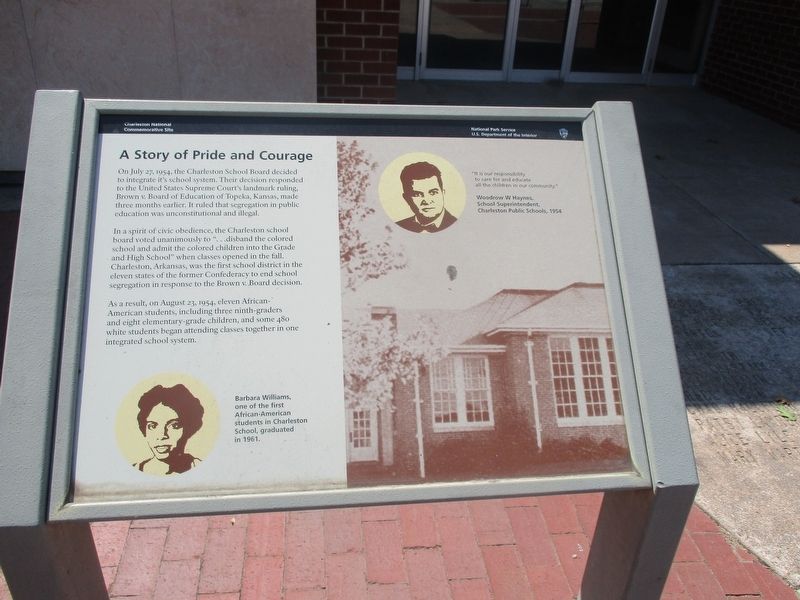
A Story of Pride and Courage
Photographed by Marc Hayot, August 29, 2026
1. A Story of Pride and Courage Marker
On July 27, 1954, the Charleston School Board decided to integrate it's school system. Their decision responded to the United States Supreme Court's landmark ruling, Brown v. Board of Education of Topeka, Kansas, made three months earlier. It ruled that segregation in public education was unconstitutional and illegal.
In a spirit of civic obedience, the Charleston school board voted unanimously to "...disband the colored school and admit the colored children into the Grade and High School" when classes opened in the fall. Charleston, Arkansas, was the first school district in the eleven states of the former Confederacy to end school segregation in response to the Brown v. Board decision.
As a result, on August 23, 1954, eleven African-American students, including three ninth-graders and eight elementary-grade children, and some 480 white students began attending classes together in one integrated school system.
"It is our responsibility to care for and educate all the children in our community." — Woodrow W Haynes, School Superintendent, Charleston Public Schools, 1954
Barbara Williams, one of the first African-American
this page online
Erected 1998 by National Park Service.
Topics. This historical marker is listed in these topic lists: African Americans • Civil Rights • Education. A significant historical date for this entry is July 27, 1954.
Location. 35° 17.666′ N, 94° 2.75′ W. Marker is in Charleston, Arkansas, in Franklin County. It can be reached from Dale Bumpers Drive. Marker is located at the entrance to the high school on the eastern side of the property. The front of the high school does not face Dale Bumpers Drive so the marker cannot be seen from the road. Touch for map. Marker is at or near this postal address: 305 Dale Bumpers Drive, Charleston AR 72933, United States of America. Touch for directions.

Regionally, this marker is in the Arkansas River Valley and in the Cherokee Heritage Region. It is also in the American South, specifically in the Upper South, and in the Ozarks. Globally, it is in North America, the Western Hemisphere, the Western World, and the Anglosphere. Historically, it finds itself in what was once the territory of the Mississippian Culture, the Louisiana Purchase,
Photographed by Marc Hayot, August 29, 2026
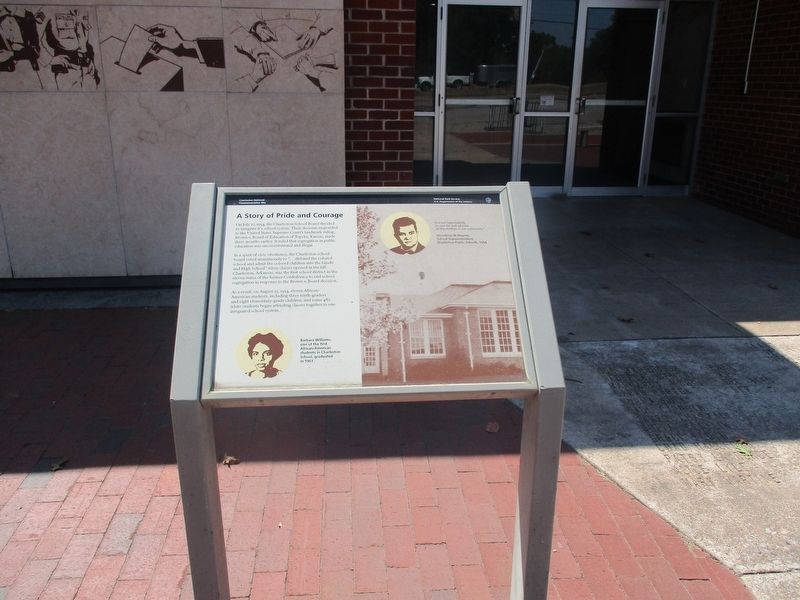
2. A Story of Pride and Courage Marker and surrounding area
This marker shows the surrounding area where the marker is located.
Other nearby markers. At least 3 other markers are within 13 miles of this marker, measured as the crow flies: Charleston High School Integration (approx. 2.7 miles away); Logan County Vietnam Memorial (approx. 12.7 miles away); Choctaw Oklahoma and Gulf Railorad (approx. 12.7 miles away).
Regarding A Story of Pride and Courage. The marker commemorates the desegregation of the Charleston School District in 1954. Charleston was the first school system in Arkansas to desegregate. On August 23, 1954, eleven black students began attending the high school.
Also see . . . Desegregation of Charleston Schools. This link provides the history of the desegregation of Charleston Schools.
Following the May 17, 1954, U.S. Supreme Court decision in Brown v. Board of Education of Topeka, Kansas that deemed state laws mandating public school segregation unconstitutional under the equal protection clause of the Fourteenth Amendment, the Charleston School Board made a historic decision.(Submitted on October 18, 2026, by Marc Hayot of Siloam Springs, Arkansas.)
Photographed by Marc Hayot, August 29, 2026
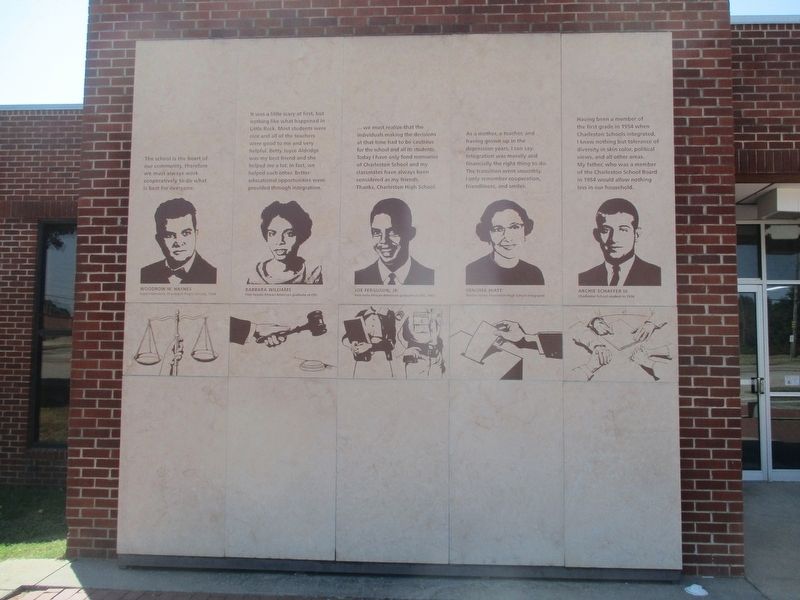
3. The first black students
This is a marker on the wall of the high school that shows the five of the first eleven black students who attended Charleston High School.
Credits. This page was last revised on November 1, 2026. It was originally submitted on October 18, 2026, by Marc Hayot of Siloam Springs, Arkansas. This page has been viewed 10 times since then. Photos: 1, 2, 3. submitted on October 18, 2026, by Marc Hayot of Siloam Springs, Arkansas. • Andrew Ruppenstein was the editor who published this page.
