Chelmsford in Essex, England, United Kingdom — Northwestern Europe (the British Isles)
Nicolas Conyngham Tindal
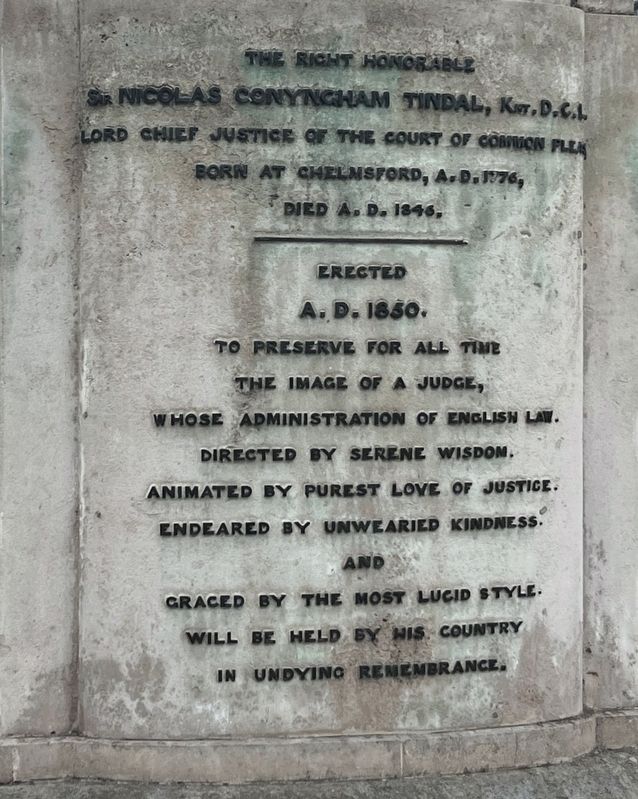
Photographed by Ray Gurganus, April 16, 2026
1. Nicholas Conyngham Tindal Marker
The Right Honorable
Sir Nicolas Conyngham Tindal, Knt., D.C.L
Lord Chief Justice of the Court of Common Pleas
Born at Chelmsford, A.D. 1776,
Died A.D. 1846,
Erected A.D. 1850.
To preserve for all time the image of a judge, whose
administration of English law.
Directed by serene wisdom.
Animated by purest love of justice.
Endeared by unwearied kindness.
And
graced by the most lucid style.
Will be held by his country in undying remembrance.
Erected 1850.
Topics. This historical marker is listed in this topic list: Law Enforcement. A significant historical year for this entry is 1776.
Location. 51° 44.069′ N, 0° 28.359′ E. Marker is in Chelmsford, England, in Essex. It is at the intersection of Tindal Street and High Street, on the right when traveling north on Tindal Street. Touch for map. Marker is at or near this postal address: 99 High Street, Chelmsford, England CM1 1EQ, United Kingdom. Touch for directions.

Regionally, this marker is in the Greater South East. Globally, it is on the Atlantic Ocean, in the North Atlantic Region, in Europe, in Atlantic Europe, on one of the British Isles,
this page online
Other nearby markers. At least 8 other markers are within walking distance of this marker: John Johnson (a few steps from this marker); Guglielmo Marconi 1874-1937 (within shouting distance of this marker); Frank Whitmore (about 150 meters away, measured in a direct line); Dr Benjamin Pugh (1715-1798) (about 180 meters away); Frederic Chancellor (approx. 0.2 kilometers away); Joanna Constantinidis (approx. 0.3 kilometers away); Frederick Herbert Hunt (approx. 0.4 kilometers away); The Old County Gaol in Moulsham (approx. 0.4 kilometers away). Touch for a list and map of all markers in Chelmsford.
Also see . . . Nicholas Conyngham Tindal (Wikipedia). Overview:
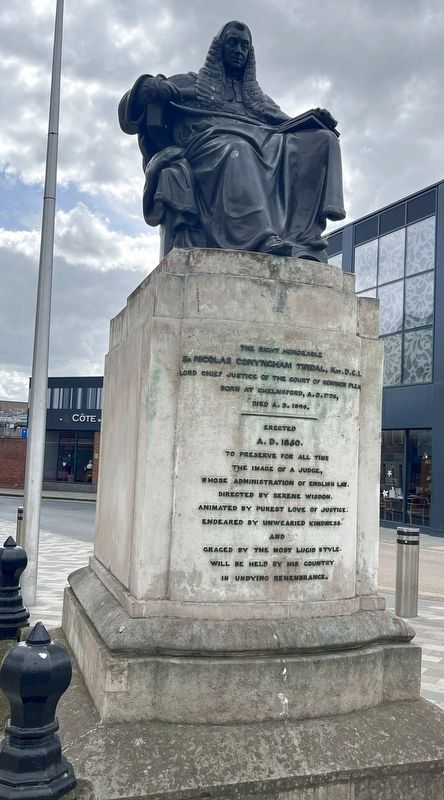
Sir Nicolas Conyngham Tindal, PC (12 December 1776 – 6 July 1846) was an English lawyer who successfully defended the then Queen of the United Kingdom, Caroline of Brunswick, at her trial for adultery in 1820. As Chief Justice of Common Pleas, an office he held with distinction from 1829 to 1846, he was responsible for the inception of the special verdict(Submitted on November 5, 2026.)"Not Guilty by reason of insanity" at the trial of Daniel M'Naghten.Photographed by Ray Gurganus, April 16, 20262. Nicolas Conyngham Tindal Statue
Credits. This page was last revised on November 5, 2026. It was originally submitted on October 19, 2026, by Ray Gurganus of Washington, District of Columbia. This page has been viewed 6 times since then. Photos: 1, 2. submitted on October 19, 2026, by Ray Gurganus of Washington, District of Columbia. • Andrew Ruppenstein was the editor who published this page.
