Wymondham in Norfolk, England, United Kingdom — Northwestern Europe (the British Isles)
Medicinal Herbs
'... and the leaf thereof for medicine' - Ezekiel 47.12
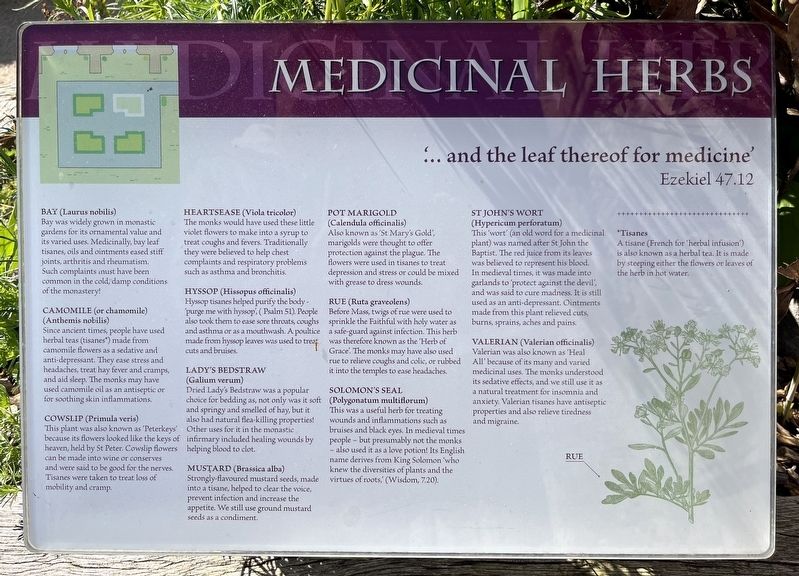
Photographed by Ray Gurganus, April 22, 2026
1. Medicinal Herbs Marker
Bay (Laurus nobilis)
Bay was widely grown in monastic gardens for its ornamental value and its varied uses. Medicinally, bay leaf tisanes, oils and ointments eased stiff joints, arthritis and rheumatism. Such complaints must have been common in the cold, damp conditions of the monastery!
Camomile (or chamomile) (Anthemis nobilis)
Since ancient times, people have used herbal teas (tisanes") made from camomile flowers as a sedative and anti-depressant. They ease stress and headaches, treat hay fever and cramps, and aid sleep. The monks may have used camomile oil as an antiseptic or for soothing skin inflammations.
Cowslip (Primula veris)
This plant was also known as 'Peterkeys' because its flowers looked like the keys of heaven, held by St Peter. Cowslip flowers can be made into wine or conserves and were said to be good for the nerves. Tisanes were taken to treat loss of mobility and cramp.
Heartsease (Viola tricolor)
The monks would have used these little violet flowers to make into a syrup to treat coughs and fevers. Traditionally they were believed to help chest complaints and respiratory problems such as
this page online
Hyssop (Hissopus officinalis)
Hyssop tisanes helped purify the body - 'purge me with hyssop' (Psalm 51). People also took them to ease sore throats, coughs and asthma or as a mouthwash. A poultice made from hyssop leaves was used to treat cuts and bruises.
Lady's Bedstraw (Galium verum)
Dried Lady's Bedstraw was a popular choice for bedding as, not only was it soft and springy and smelled of hay, but it also had natural flea-killing properties! Other uses for it in the monastic infirmary included healing wounds by helping blood to clot.
Mustard (Brassica alba)
Strongly-flavoured mustard seeds, made into a tisane, helped to clear the voice, prevent infection and increase the appetite. We still use ground mustard seeds as a condiment.
Pot Marigold (Calendula officinalis)
Also known as 'St Mary's Gold marigolds were thought to offer protection against the plague. The flowers were used in tisanes to treat depression and stress or could be mixed with grease to dress wounds.
Rue (Ruta graveolens)
Before Mass, twigs of rue were used to sprinkle the Faithful with holy water as a safe-guard against infection. This herb was therefore known as the 'Herb of Grace. The monks may have also used rue to relieve coughs and colic, or rubbed it into the temples to ease headaches.
Solomon's Seal (Polygonatum multiflorum)
This was a useful herb for treating wounds and inflammations such as bruises and black eyes. In medieval times people - but presumably not the monks - also used it as a love potion! Its English name derives from King Solomon 'who knew the diversities of plants and the virtues of roots, (Wisdom, 7.20).
St John's Wort (Hypericum perforatum)
This 'wort (an old word for a medicinal plant) was named after St John the Baptist. The red juice from its leaves was believed to represent his blood. In medieval times, it was made into garlands to protect against the devil'.. and was said to cure madness. It is still used as an anti-depressant. Ointments made from this plant relieved cuts, burns, sprains, aches and pains.
Valerian (Valerian officinalis)
Valerian was also known as 'Heal All' because of its many and varied medicinal uses. The monks understood its sedative effects, and we still use it as a natural treatment for insomnia and anxiety Valerian tisanes have antiseptic properties and also relieve tiredness and migraine.
'Tisanes
A tisane (French for 'herbal infusion) is also known as a herbal tea. It is made by steeping either the flowers or leaves of the herb in hot water.
Topics. This historical marker is listed in these topic lists: Horticulture & Forestry • Science & Medicine.
Location. 52° 34.223′ N, 1° 6.453′ E. Marker is in Wymondham, England, in Norfolk. It can be reached from Church Street. On the grounds of Wymondham Abbey. Touch for map. Marker is at or near this postal address: 21 Church Street, Wymondham, England NR18 9PH, United Kingdom. Touch for directions.

Regionally, this marker is in East Anglia. Globally, it is on the Atlantic Ocean, in the North Atlantic Region, in Europe, in Atlantic Europe, on one of the British Isles, in the Western World, and in the Anglosphere. Historically, it finds itself in what was once the Roman Empire.
Other nearby markers. At least 8 other markers are within walking distance of this marker: Aromatic Herbs (here, next to this marker); Wymondham Abbey, North Side (within shouting distance of this marker); Wymondham Abbey, South Side (within shouting distance of this marker); Wymondham Abbey, West End (within shouting distance of this marker); a different marker also named Wymondham Abbey (within shouting distance of this marker); The Green Dragon Inn (about 180 meters away, measured in a direct line); Robert and William Kett (about 180 meters away); Market Cross (approx. 0.4 kilometers away). Touch for a list and map of all markers in Wymondham.
Credits. This page was last revised on November 1, 2026. It was originally submitted on October 20, 2026, by Ray Gurganus of Washington, District of Columbia. This page has been viewed 8 times since then. Photo 1. submitted on October 20, 2026, by Ray Gurganus of Washington, District of Columbia. • Andrew Ruppenstein was the editor who published this page.
Editor’s want-list for this marker. photo of the marker within its surroundings • Can you help?
