Wymondham in Norfolk, England, United Kingdom — Northwestern Europe (the British Isles)
Aromatic Herbs
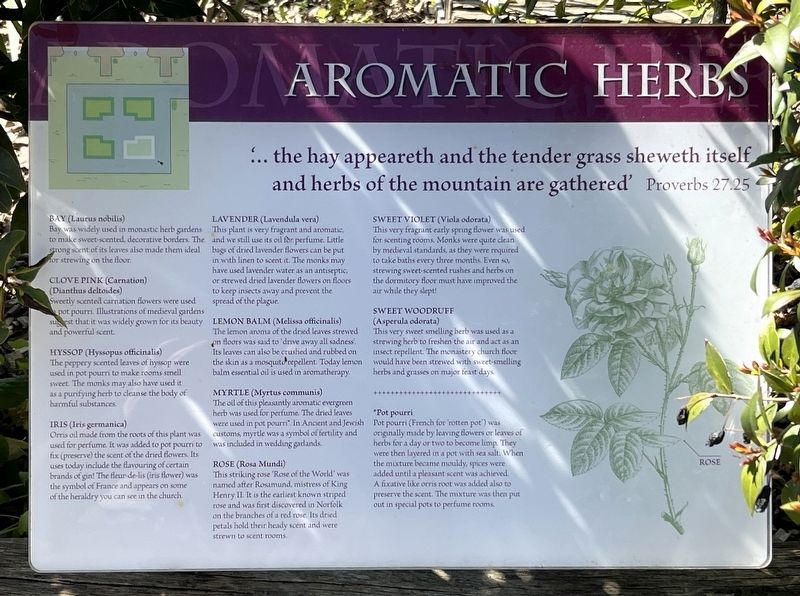
Photographed by Ray Gurganus, April 22, 2026
1. Aromatic Herbs Marker
Bay (Laurus nobilis)
Bay was widely used in monastic herb gardens to make sweet-scented, decorative borders. The Strong scent of its leaves also made them ideal or strewing on the floor.
Clove Pink (Carnation) (Dianthus deltoides)
Sweetly scented carnation flowers were used pot pourri. Illustrations of medieval gardens suggest that it was widely grown for its beauty and powerful scent.
Hyssop (Hyssopus officinalis)
The peppery scented leaves of hyssop were used in pot pourri to make rooms smell sweet. The monks may also have used it as a purifying herb to cleanse the body of harmful substances.
Iris (Iris germanica)
Orris oil made from the roots of this plant was used for perfume. It was added to pot pourri to fix (preserve) the scent of the dried flowers. Its uses today include the flavouring of certain brands of gin! The fleur-de-lis (iris flower) was the symbol of France and appears on some of the heraldry you can see in the church.
Lavender (Lavendula vera)
This plant is very fragrant
this page online
Lemon Balm (Melissa officinalis)
The lemon aroma of the dried leaves strewed en floors was said to 'drive away all sadness'. Its leaves can also be crushed and rubbed on the skin as a mosquito repellent. Today lemon balm essential oil is used in aromatherapy.
Myrtle (Myrtus communis)
The oil of this pleasantly aromatic evergreen herb was used for perfume. The dried leaves were used in pot pourri*. In Ancient and Jewish customs, myrtle was a symbol of fertility and was included in wedding garlands.
Rose (Rosa Mundi)
This striking rose 'Rose of the World' was named after Rosamund, mistress of King Henry II. It is the earliest known striped rose and was first discovered in Norfolk on the branches of a red rose. Its dried petals hold their heady scent and were strewn to scent rooms.
Sweet Violet (Viola odorata)
This very fragrant early spring flower was used for scenting rooms Monks were quite clean by medieval standards, as they were required to take baths every three months. Even so, strewing sweet scented rushes and herbs on the dormitory floor must have improved the air while they slept!
Sweet Woodruff (Asperula odorata)
This very sweet smelling herb was used as a strewing herb to freshen the air and act as an insect repellent. The monastery church floor would have been strewed with sweet-smelling herbs and grasses on major feast days.
*Potpourri
Pot pourri (French for rotten pot) was originally made by leaving flowers or leaves of herbs for a day or two to become limp. They were then layered in a pot with sea salt. When the mixture became mouldy, spices were added until a pleasant scent was achieved. A fixative like orris root was added also to preserve the scent. The mixture was then put out in special pots to perfume rooms.
Topics. This historical marker is listed in these topic lists: Horticulture & Forestry • Science & Medicine.
Location. 52° 34.22′ N, 1° 6.454′ E. Marker is in Wymondham, England, in Norfolk. It can be reached from Church Street. On the grounds of Wymondham Abbey. Touch for map. Marker is at or near this postal address: 21 Church St, Wymondham, England NR18 9PH, United Kingdom. Touch for directions.

Regionally, this marker is in East Anglia. Globally, it is on the Atlantic Ocean, in the North Atlantic Region, in Europe, in Atlantic Europe, on one of the British Isles, in the Western World, and in the Anglosphere. Historically, it finds itself in what was once the Roman Empire.
Other nearby markers. At least 8 other markers are within walking distance of this marker: Medicinal Herbs (here, next to this marker); Wymondham Abbey, North Side (within shouting distance of this marker); Wymondham Abbey, South Side (within shouting distance of this marker); Wymondham Abbey, West End (within shouting distance of this marker); a different marker also named Wymondham Abbey (within shouting distance of this marker); The Green Dragon Inn (about 180 meters away, measured in a direct line); Robert and William Kett (about 180 meters away); Market Cross (approx. 0.4 kilometers away). Touch for a list and map of all markers in Wymondham.
Credits. This page was last revised on November 1, 2026. It was originally submitted on October 20, 2026, by Ray Gurganus of Washington, District of Columbia. This page has been viewed 6 times since then. Photo 1. submitted on October 20, 2026, by Ray Gurganus of Washington, District of Columbia. • Andrew Ruppenstein was the editor who published this page.
Editor’s want-list for this marker. photo of the marker within its surroundings • Can you help?
