Leechburg in Armstrong County, Pennsylvania — The American Northeast (Mid-Atlantic)
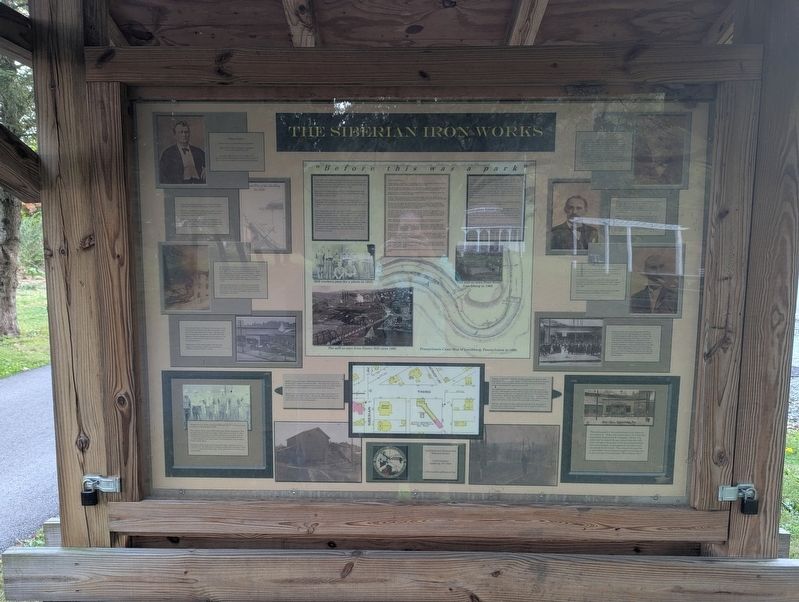
The Siberian Iron Works
"Before this was a park"
Photographed by Kelly Smith, October 13, 2026
1. The Siberian Iron Works Marker
Father of the tin plate industry in America.
Born 1827 in Wolverhampton, England Died 1901 in Wheeling, WV
Founder of the Siberian Iron Works 1871. First to produce Russia Iron & Tin Plate in the U.S. First to use natural gas for metallurgical purposes.
A map showing the location of Beale’s well taken from the Pennsylvania Geological Survey of 1887.
The well was drilled in 1869 and reached a depth of 1250 feet in the search of oil. Natural gas was struck at a depth of 1200 feet.
With no use for the natural gas venting from the well the crew installed a 60 foot vertical pipe and set the gas aflame. The well burned continuously until Rogers re-purposed the gas in 1874.
Kirkpatrick & Company’s “Sunnyside Mill” at the Westmoreland end of the Leechburg Bridge shown circa 1885. The mill was constructed to supply ingots made from scrap to the operation in Leechburg. The mill used a ten and a fifteen ton furnace, all equipment was hand operated. Ingots were carted across the Leechburg bridge by horse and wagon to be rolled into sheets.
Approximately sixty feet in height at the rear of
this page online
This postcard from 1915 shows the entrance to the “The American Sheet & Tin Plate Company” then owned and operated by U.S. Steel. The new owners had expanded the mill by this time. With the addition of new buildings and new machinery the mill now featured eleven sheet mills and eleven annealing furnaces.
Employment at the mill reached 700 men and women running three shifts and payroll had swelled to over $100,000 a month.
(Right) An excerpt from a 1909 Sanborn Insurance map shows the location of U.S. Steel’s Leechburg Mine. The mine was constructed as part of U.S. Steel’s expansion of the works as the available natural gas supply was not sufficient to run the additional equipment.
(Below) A mine worker poses in front of the tipple at the corner of Third Street and Penn Avenue. The gravity railroad and the mine would stay in operation until the mill was closed in 1931 being unable to survive the “Great Depression”.
Workers at U.S.
Photographed by Kelly Smith, October 13, 2026
2. The Siberian Iron Works Marker
The majority of the mills skilled labor were Welsh immigrants. Rogers knew that he would be unable to find laborers in the U.S. who understood the process of tin plate manufacture as it had never before been manufactured in this country. England dominated U.S. tin plate imports so he went home to Wolverhampton and recruited workers from there.
Having no other skills these immigrants took a substantial risk in coming here. The Siberian Iron Works would be the only place in the U.S. they could apply their trade. If the mill failed they would have no fall-back.
From 1828 until 1865 Leechburg’s Riverfront Park was on the route of the Pennsylvania Canal. The canal was the heart of Leechburg’s economy until its demise at the hands of the railroads but the site did not sit vacant for long.
Here in 1871 William Rogers and T.J. Burchfield began construction on a pioneering new mill that Rogers would name “The Siberian Iron Works”.
Rogers, a Welsh immigrant, had been involved in iron at Pittsburgh and Apollo before arriving here. His ambition was to begin mass production of tin plate in America for the first time. The rolling mill went into operation in 1872 and the tin plate mill was in operation by 1874. The mills featured 6 puddling furnaces, 2 knobbling fires, 1 refiners fire, 6 heating furnaces, 3 annealing furnaces, 2 pairs of muck rollers, 2 pairs of cold rollers, 1 pair of muck shears, 2 pairs of sheet shears, one blast furnace complete with an Allen engine producing 350hp which was powered by 5 boilers. The mill employed 150 men, most of who had been recruited by Rogers in England and Wales. The output of was 250 tons of finished iron and 90 boxes of tin a day.
Interesting Facts...
William Rogers had been experimenting with natural gas since 1869 and had to design and build most of the components from scratch.
John Cole, the superintendent in 1874, was first to ignite the gas under the boilers. He used a long pole as he was certain there would be an explosion.
Mill employees William B. Jack and James Saulters were the first to adapt the puddling furnaces to use natural gas.
William Rogers stole the process for making Russia Iron while in Russia performing a mineralogical survey for the state of Pennsylvania. He named the mill as tribute to the place he had stolen the process from.
The natural gas supply for the mill came from a well that Joseph Beale had drilled in search of oil. No oil was found and the venting gas halted his search. The gas was sent up a pipe sixty feet high and ignited. It had burned over the town for five years before Rogers re-purposed it.
The 1875 reduction of tariff on tinplate was the result W.P. Fessenden’s (U.S. Secretary of the Treasury) lack of understanding of what tinplate was. Fessenden did not know that tinplate was made of iron coated with tin and placed it in the wrong category. His mistake stifled U.S. tinplate manufacture until the it was corrected by the McKinley Tariff Act of 1890.
Beale, Wallace and Kirkpatrick all have streets named for them in Leechburg while William Rogers is responsible for giving Siberian Avenue its name.
William Rogers had a 6000 square foot home built by his company Rogers and Burchfield at the top of First Street in 1872. His company sold the home to his wife Mary Ann Rogers for the sum of $10.00 shortly before they filed for bankruptcy. The trustee filed suit to retrieve the property but lost. Rogers remained in the home through the late 1800’s.
William Rogers attempted to buy back the mill at the Sheriff’s sale in 1876. He sent an agent named Criswell who won the auction with $70,000.00. Rogers couldn’t raise the money in time and the mill went back up for auction again that year. Kirkpatrick, Wallace and Beale paid $77,000 for the mill and 250 acres of land.
Major Joseph Beale was struck with a minie ball and laid injured on the battlefield at Charles City Cross Roads for seven days before being taken prisoner in 1862. Doctors were unable to remove the minie ball from his side and he carried it with him until his death.
Joseph Beale served as this districts State Representative in the 60th U.S. Congress.
The new mill a success from the start. Rogers and Burchfield built the mill from scratch, it was capitalized at $225,000. One year after going into production the nation would be caught in the panic of 1873. The mill however continued to be successful until 1875 when the U.S. Congress reduced the tin tariff to 1.1 cents per pound. As a result imports increased 140%. Coupled with failures Rogers and Burchfield experienced in outside investments the pair filed for bankruptcy in November of 1875.
However, between 1872 and 1875 Rogers was able to achieve several firsts in American iron manufacture.
The Siberian Iron Works would become the first mill to use natural gas as a fuel in iron manufacture (1874). It was also the first mill in the U.S. to mass produce tin plate (1874) and was the first mill outside of Russia to produce Russia Iron, a noncorrosive sheet iron used in the manufacture of boilers (1872).
The mill was purchased in 1876 by partners Joseph Beale, J.C. Kirkpatrick and John C. Wallace to form Kirkpatrick, Beale & Co. When Beale went into business for himself in the 1880’s the mill became Kirkpatrick & Co. In 1900 it was purchased by U.S. Steel and renamed The American Sheet and Tinplate Company before its closing in 1931 as a result of the Great Depression.
John C. Kirkpatrick was born at Turtle Creek, Westmoreland County in 1833. At the age of 22 he opened his first store in Pittsburgh, PA selling lamps and lamp oil. He later became involved in several refineries near the Lawrenceville section of Pittsburgh. He was not active in the manufacture of iron until he purchased the Siberian Iron Works in 1876 with partners Beale and Wallace. Kirkpatrick was also a partner in the Mansfield Iron Company at Carnegie, PA before his death from “the grip” in October of 1895. His interests in the mills passed from him to his two sons J.L. Kirkpatrick and J.W. Kirkpatrick.
Major Joseph Grant Beale was born in Natrona, PA in 1859. He served in the Civil War and was promoted to Major but was wounded June 30th, 1862 in the seven days fight at Charles City Cross Roads. Unable to fully recover from his injury he returned to civilian life.
Beale practiced law and had coal mining interests in Squirrel Hill prior to coming to Leechburg. He was largely responsible for the industrialization of Leechburg after the closure of the Pennsylvania Canal. Beale was active in oil, natural gas, coal, iron, banking and real estate and was responsible for convincing Rogers and Burchfield to locate their mill at this site.
J.C. Wallace was an Irish immigrant who worked in the iron industry in Pittsburgh, PA. He moved to Leechburg in 1877 after partnering with Kirkpatrick and Beale and remained here until 1890.
In 1885 Wallace partnered with William Banfield, an English immigrant employed at his mill, to found Wallace, Banfield & Co to manufacture tin in Irondale, OH.
Wallace remained a partner in both mills until 1900 when they were purchased by U.S. Steel.
Workers at the American Sheet and Tin Plate Company pose for a photograph in celebration of Americanization Day on May 3rd, 1919. The Americanization movement began as a nationwide effort to assimilate new immigrants into American culture in 1910. Immigrants unfamiliar with American culture typically settled in the same neighborhoods as others from their home lands. During World War One the nation felt an increased need to bring new arrivals into our system and assure that their allegiance lay with the United States.
This photograph of the mill entrance was taken in the winter of 1905, a few years after U.S. Steel had purchased Kirkpatrick & Company. As the mill continued to expand the gas supply was not sufficient enough to keep pace with the continued addition of equipment so management switched some equipment back to coal. This created the need for a convenient and continuous supply of coal that led to the creation of Leechburg’s “Third Street Mine”.
(Below) A coal miner walks the tracks towards U.S. Steel’s Leechburg Mine located at the corner of Third Street and Penn Avenue. U.S. Steel’s American Sheet & Tin Plate can be seen in the background running at full capacity (circa 1910).
The tracks (built around 1900) were a direct link from the mine to the mill. Cars loaded with coal left the mine under the power of gravity. A brakeman rode the car down the hill using a hand brake to control its speed. Mules were employed to pull the empty cars back to the mine to be reloaded. The mules were later replaced with a steam engine and cable system to haul the cars back to the mine.
With the mill being less than 1000 feet from the mine this gravity railroad was a simple and cost effective way to keep the boilers and furnaces of the mill powered.
Erected by Leechburg Area Museum and Historical Society.
Topics. This historical marker is listed in these topic lists: Immigration • Industry & Commerce. A significant historical year for this entry is 1872.
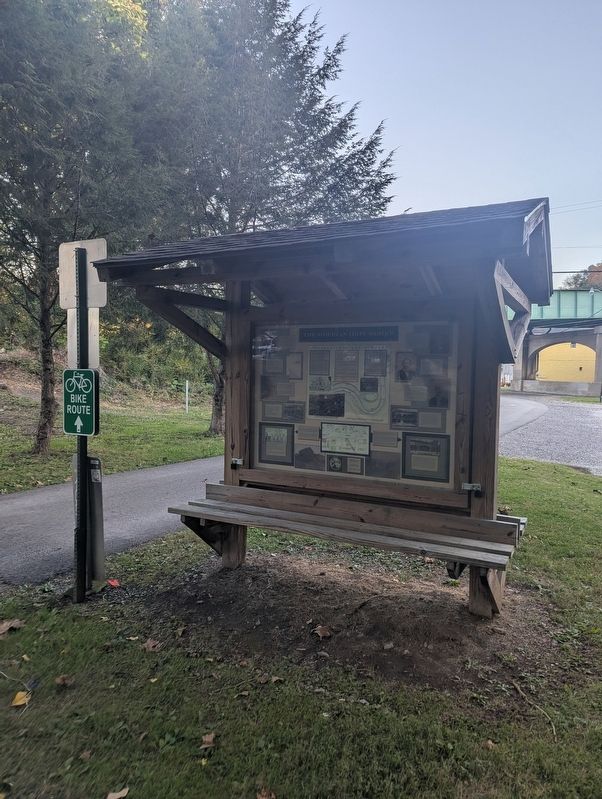
Location. 40° 37.617′ N, 79° 36.512′ W. Marker is in Leechburg, Pennsylvania, in Armstrong County. It can be reached from River Avenue. In a wooden case just near the terminus of the Armstrong Trail system, within Leechburg's Riverfront Park. Touch for map. Marker is in this post office area: Leechburg PA 15656, United States of America. Touch for directions.

Regionally, this marker is in Greater Pittsburgh. It is also in the American Northeast, in the Mid-Atlantic, in Appalachia, and specifically in Northern Appalachia. Globally, it is in North America, the Western Hemisphere, the Western World, and the Anglosphere. Historically, it finds itself in what was once the Haudenosaunee (Iroquois) Confederacy and also one of the original Thirteen Colonies.
Other nearby markers. At least 8 other markers are within walking distance of this marker: Leechburg (within shouting distance of this marker); a different marker also named The Siberian Iron Works (within shouting distance of this marker); Dr. H. W. Fraley Park (within shouting distance of this marker); D. Leech & Company / Western Transportation Company (about 300 feet away, measured in a direct line); Leechburg Veterans Mural and Sitting Park (about 400 feet away); Leechburg Veterans Memorial (about 500 feet away); David Leech (approx. ¼ mile away); Leechburg High School Building (approx. 0.3 miles away). Touch for a list and map of all markers in Leechburg.
Credits. This page was last revised on October 20, 2026. It was originally submitted on October 20, 2026, by Kelly Smith of Leechburg, Pennsylvania. This page has been viewed 7 times since then. Photos: 1, 2. submitted on October 20, 2026, by Kelly Smith of Leechburg, Pennsylvania. • Bill Pfingsten was the editor who published this page.
