Leechburg in Armstrong County, Pennsylvania — The American Northeast (Mid-Atlantic)
The Hyde Park Walking Bridge
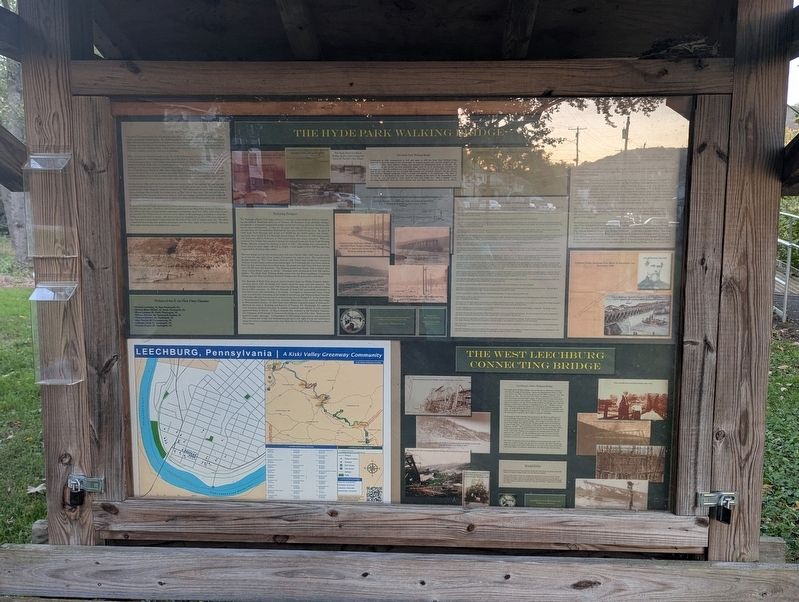
Photographed by Kelly Smith, October 13, 2026
1. The Hyde Park Walking Bridge Marker
The State of Pennsylvania has over 86,000 miles of rivers and streams, the most of any state in the continental United States. The Kiskiminetas River to your right is part of the Allegheny River Watershed and contributes 27 miles to the total system. Crossing the “Kiski” has been a challenge since the days of the Lenape and Delaware Indians. For the residents of Leechburg and Hyde Park the trouble began in late 1800’s when both boroughs began to grow as industrial centers based in steel, tin, coal and natural gas.
Early crossings by foot were made at the site of the Pennsylvania Canal’s Dam #1 where David Leech established a foot bridge across the top of the dam in 1846. Leech’s bridge was washed away four times before a new bridge was constructed in 1875 at the foot of Third Street. The residents of Hyde Park relied on Leechburg for many of their daily needs (doctors, grocers, banking, etc.) and the residents of Leechburg relied on Hyde Park as prohibition went into effect in Leechburg in March of 1866. More importantly residents of both boroughs often needed to cross the river for work as factories
this page online
At this site in 1886-1887 the West Penn Railroad erected one of two railroad bridges into and out of Leechburg to serve the boroughs growing freight and passenger needs. Travelers began crossing this bridge (illegally) before its completion. The Johnstown Flood of 1889 put a stop to these crossings when it swept the bridge away on May 31st of that year. The railroad rebuilt the bridge in 1901 but just three years later in 1904 an ice-gorge carried the second bridge off of its piers. Having just regraded and doubled the tracks on the Westmoreland side of the river the railroad abandoned the site permanently.
To serve the needs of both communities a ferry was put into service at the foot of Main Street in Hyde Park in 1904. The Hyde Park Ferry connected to the West Penn Railways Trolley on this side of the river and served the community successfully until June 28th, 1913 when 65 people boarded
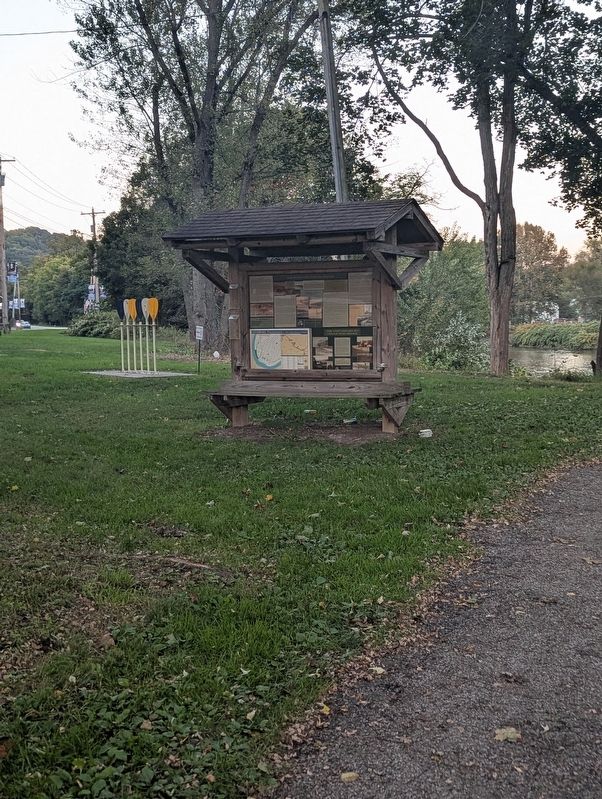
Photographed by Kelly Smith, October 13, 2026
2. The Hyde Park Walking Bridge Marker
Victims of the Hyde Park Ferry Disaster
-Michael Iconondos, 40, East Vandergrift, PA
-Michael Milno (Miller), 40, North Vandergrift, PA
-Elmer Larimer, 55, North Washington, PA
-William Eckman, 39, Vandergrift Heights, PA
-Clarence Stewart, 22, Vandergrift, PA
-Merl Weaver, 26, Punxsutawney, PA
-Jefferson Davis, 61, Vandergrift, PA
-Charles Chonco, 26, Vandergrift, PA
Building Bridges
The Borough of Hyde Park began efforts to construct a foot bridge in 1920 by contracting the John A. Roebling’s Sons Co. of Trenton, NJ (builders of the Brooklyn Bridge) to engineer a wire cable suspension bridge across the existing piers (see Roebling side bar for more information). A lease for the piers and right-of-way across the river was secured from the Pennsylvania Railroad for the sum of $100.00 per year. By April of 1920 Hyde Park Borough had raised over $7200 for the $8500 project, the remaining funds were raised by the Borough of Leechburg. By October of 1920 construction was underway and by February of 1921 construction was nearly complete. When an overhead foot bridge was completed across the railroad tracks the Hyde Park Walking Bridge officially opened for crossing in April of 1921. The bridge was constructed of wood, featured three spans 156 feet in length, a total length of over 550 feet and was suspended by Roebling wire cables.
The new bridge served both communities well until March 16th, 1936 when two inches of rain fell atop sixty-three inches of accumulated winter snow. The result would become known as “The Great Saint Patrick’s Day Flood” and would leave countless Western Pennsylvania communities submerged. In Pittsburgh the river level reached forty-six feet, twenty feet above flood stage. 62 people lost their lives, 500 were injured and 135,000 were left homeless. The flooding lasted from March 17th to March 20th when waters finally began to recede. Damages were estimated at over 300 million dollars. The Hyde Park Walking Bridge along with the West Leechburg Connecting Bridge and the West Leechburg Railroad Bridge were all destroyed by the flood.
The Borough of Hyde Park secured partial funding from the Works Progress Administration and in 1937 the bridge was rebuilt using the same plan and material. The second bridge would serve until 1948 when the Borough of Hyde Park ordered it closed due to safety concerns. In 1949 the Borough of Hyde Park successfully petitioned to have the county take ownership of the bridge. In August an Armstrong County Grand Jury awarded joint ownership of the bridge to Armstrong and Westmoreland Counties. The bridge officially became known as Armstrong County Bridge #13. At the same time a Westmoreland County Grand Jury awarded ownership of the overhead foot bridge to Westmoreland County. In 1950 Hyde Park officials requested copies of drawing #3-368 from the John A. Roebling and Sons Co. of Trenton, NJ. Pittsburgh, PA engineer Carl Jacobsen updated the plans to modern standards and officials in both counties approved them in March. In May a contract was awarded to the Freeland Construction Company of Pittsburgh to construct the bridge at a cost of $17,642. Work was delayed by supply shortages. In September of 1950 bridge construction was completed. The overhead foot bridge was decommissioned and a new right-of-way was established along the river to a railroad crossing near Main Street, Hyde Park, PA similar to what’s there today.
The Hyde Park Walking Bridge
Constructed in 1920, reconstructed in 1937 and again in 1950 the Hyde Park Walking Bridge was built to serve the needs of two communities in separate counties who are both divided and connected by a river. Since 1886 five bridges have spanned the Kiskiminetas River at this site. The present bridge has served the local population longer than all of its predecessors combined and in more ways than its builders may have intended. Spanning the river since 1950 it has become part of the local culture and has provided safe crossing and cherished memories for generations.
This Roebling designed suspension bridge is honest and graceful in its appearance. The views of the bridge from the banks of the river are just as pleasing as the views of the surrounding country you see when you cross it. Cross slowly as many have before you. Take a moment to enjoy being “suspended” above the river, between here and there, between our past and our future.
A Timeline of the Hyde Park Walking Bridge
1827 David Leech builds a dam 500 feet down river from this location for the Pennsylvania Canal. The dam forms a 7 mile slack water to Apollo, PA. The canal prism from Leechburg to Pittsburgh begins approximately at this location.
1855 The Pennsylvania Railroad buys the Pennsylvania Canal closing much of the mainline but the canal here continues to operate from Blairsville to Pittsburgh for another decade.
1865 The Canal in Leechburg closes. The Pennsylvania Railroad sells the right of way to the West Penn Railroad.
1866 The West Penn Railroad opens the railroad from Pittsburgh to Blairsville on the opposite side of the Kiskiminetas; passengers must cross the river at the Leechburg Bridge for service. The railroad avoids Hyde Park, PA through a tunnel cut just outside the borough limits where South Gosser Hill Road becomes Railroad Street.
1887 The West Penn Railroad lowers the grade of the Conemaugh Line and constructs a bridge at this location. Trains enter and exit Leechburg near Banfield Road and at this location. Freight and passenger service is received inside Borough limits for the first time.
1889 (May 31st) The South Fork dam near Johnstown, PA, constructed as part of the Pennsylvania Canal and now in the hands of the South Fork Fishing and Hunting Club fails after several days of heavy rainfall. 20 million tons of water surge down the Conemaugh and Kiskiminetas rivers at 40mph. 2,209 lives are lost along with countless buildings, roads and bridges, including the West Penn Railroad Bridge at this location.
1889 to 1901 Thru traffic on the railroad returns to the Westmoreland County side of the Kiskiminetas River. Freight is brought to Leechburg on the West Leechburg Railroad Bridge and passengers return to crossing the river for service.
1901 The West Penn Railroad rebuilds the East Leechburg Bridge (also known as the Hyde Park Freight Bridge). To reduce congestion in Leechburg the Westmoreland County tracks are regraded and doubled for thru freight. The Hyde Park tunnel is abandoned when work is completed in 1903.
1904 (March 1st) An ice jam that had been building along the river began to move at 1:05pm. In preparation the West Penn Railroad had moved 13 cars loaded with coal onto the bridge in an effort to weigh it down. The efforts were in vain; at 1:25pm the bridge, the cars and their contents were lost. The railroad abandons the site and returns passenger service to the newly graded Westmoreland side once again.
1904 to 1920 The Hyde Park Ferry operates from the foot of Main Street, Hyde Park, PA ½ mile up river from this location. Ferry crossings, being dependent on river conditions, are not always possible and were sometimes dangerous. On June 13th, 1913 passengers rushing to the end of the ferry in an attempt to catch an approaching trolley caused it to capsize. The passengers were spilt into the river; eight people died as a result. Hyde Park begins its efforts for a safer, more reliable way across the river.
1920 (February) Hyde Park resident Elmer Baker, age 17, is struck and killed by a train as he walks along the railroad tracks to cross the river at the Leechburg bridge. Efforts to construct a pedestrian crossing are intensified. The borough obtains a blue-print for a 650 foot suspension bridge from the John A. Roebling’s Sons Company of Trenton, NJ (drawing number 3-368 dated 5-14-1920).
1921 Hyde Park Borough secures a lease from the Pennsylvania Railroad to erect a bridge at this site. A Roebling designed suspension bridge constructed from wood and steel cable is completed by the end of the year.
1934 The Pennsylvania Railroad sells the piers and right-of-way to Hyde Park Borough for the sum of $150.00.
1936 (March 17th) Melting snow and heavy rain flow down the valley and the resulting flood takes a third bridge from this site. The borough of Hyde Park secures aid from the Works Progress Administration to rebuild the bridge.
1937 The new bridge is completed using the original Roebling design. It is again constructed from wood.
1948 With the bridge in a state of disrepair it is closed to foot traffic. Hyde Park Borough requests an updated drawing of the original plan from John A. Roebling’s Sons Company.
1949 Hyde Park Borough requests that Armstrong and Westmoreland counties take responsibility for the bridge. On August 27th a Grand Jury decision awards joint custody of the bridge and property to Westmoreland County and Armstrong County.
1950 Now officially known as Armstrong County Bridge #13 the current version of the Hyde Park Foot Bridge is completed. The design remains virtually unchanged but is now constructed from steel.
1951 Hyde Park Borough unsuccessfully lobbies Westmoreland County to place lights on the bridge. By year’s end Hyde Park and Leechburg Borough enter an agreement with West Penn Power installs lights on the bridge for the first time.
2005 Hyde Park Borough begins a project to rehabilitate the bridge and install additional lighting. Norfolk Southern Railroad expresses concerns over illegal crossings of the tracks by pedestrians using the bridge as was evident by a footpath worn into the ground.
2007 Kiski Valley Enterprises donates Hyde Park Lot #4 to the borough to create a safe path to the next approved railroad crossing for pedestrians using the bridge.
2008 The rehabilitation project is completed. New approaches to the bridge and new lighting is included in the project at a cost of $263,684.00. The work was completed by Brayman Construction using designs provided by Widmer Engineering.
Roebling Connections
Western Pennsylvanians have a greater familiarity with bridges than most of their fellow countrymen. They also have a greater connection to famed suspension bridge engineer John A. Roebling than most are aware of. He was the inventor of wire-rope cable, founder of the John A Roebling’s Sons Company and the engineer behind the Brooklyn Bridge in New York and the John A. Roebling Suspension Bridge in Cincinnati along with many others. The story of Roebling’s success in America as an inventor and engineer began here in Western Pennsylvania.
Born Johann August Roebling in 1806 he studied engineering in his native Prussia before immigrating to the United States with his brother Carl. In 1832, 14 miles northwest of here, the pair purchased 1,525 acres of land in Butler County on which they founded the German settlement now known as Saxonburg, Pennsylvania.
John Roebling practiced agriculture during his early years in America but found the work unsatisfying and returned to engineering. In 1841 he began producing iron wire-rope cables in Saxonburg.
Looking to prove the worth of his invention he convinced the Pennsylvania Canal Board to allow him to demonstrate his invention on the Allegheny Portage Railroad. Part of the Pennsylvania Canal System which had passed through this location, the Allegheny Portage Railroad hauled canal boats over the Allegheny Mountains from Hollidaysburg to Johnstown and back using stationary steam engines and inclined planes. A total of ten inclined planes traversed the mountain. Expensive and short lived hemp rope was employed to pull the boats up and down the planes. Roebling gained permission to test his wire-rope on incline three (the shortest of the ten) at his own expense. His experiment proved successful and soon the hemp ropes were replaced with Roebling cables.
In 1844 he won a contract to replace the failed Allegheny Aqueduct which was also part of the Pennsylvania Canal and spanned the Allegheny River just above Freeport, PA. When the project was completed in 1845 it was suspended with Roebling’s cable that kept the spans from sagging.
Roebling went on to engineer several bridges in Pittsburgh. The first was at the current site of the Smithfield Street Bridge in 1846, another at the site of the Clemente Bridge in 1859. His most notable achievements were the Niagara Falls Suspension Bridge (1854), The John A. Roebling Suspension Bridge (1866) and the Brooklyn Bridge (1883). The John A. Roebling’s Sons Company went on to design many suspension bridges after his death in 1869. Roebling cables would be used in notable structures such as the George Washington Bridge (1931) and the Golden Gate Bridge (1937). A lesser known John A. Roebling’s Sons Company designed suspension bridge, the Hyde Park Walking Bridge, stands to your right.
The West Leechburg Connecting Bridge
Leechburg’s Other Walking Bridge
The Hyde Park Walking Bridge was not the first pedestrian crossing to serve the Borough of Leechburg. Across the Kiskiminetas River to the west of town the West Leechburg Steel and Tin Plate Company went into operation in 1897. The location (now West Leechburg) was chosen to take advantage of Leechburg’s supply of experienced tin and steel workers and its access to the railroad. However the only crossing on the west side of Leechburg was the West Leechburg Railroad Bridge and it did not feature a pedestrian walkway or planking of any sort. Workers crossed the bridge with regularity against the warning of railroad and mill officials. In 1909 William McGreary was struck and killed by a freight train while crossing the bridge on his way to work. In response to the accident the mill posted a guard at the bridge to stop the crossings.
In January of 1910 a charter was granted to the West Leechburg Connecting Bridge Company for the construction of a foot bridge 400 feet downstream from the railroad bridge. The company had purchased a steel truss bridge from Blairsville, PA that would arrive in Leechburg in July of that year. Construction of the bridge would be completed by February of 1911. The completed structure was a two span Pratt Thru Truss approximately 400 feet in length. On the West Leechburg side stood a toll booth. Tokens were required for crossing and cost 2 cents each or 3 for a nickel. On the Leechburg side were two sets of stairs joined by a platform. On occasion the platform played host to boxing matches and the stairs served as bleachers.
The West Leechburg Connecting Bridge served pedestrians until 1927 when the railroad bridge was planked for crossing. The West Leechburg Railroad bridge stood until 1936 when it was lost to the Great Saint Patrick’s Day Flood. It would be replaced by the Mill Bridge shortly after.
WARNING!
When crossing the Hyde Park Walking Bridge into Hyde Park, PA please respect the Railroad Company’s Right-Of-Way and stay off of the tracks!!!
Tracks are for trains. If you are reading this sign then you are not a train. Trains can take more than a mile to stop and cannot swerve to avoid you. An average of 450 people are killed each year trespassing on railroad property and dozens of people have been killed in accidents on this line in the past 100 years. Please do not become one of them.
Erected by Leechburg Area Museum and Historical Society.
Topics. This historical marker is listed in these topic lists: Architecture • Bridges & Viaducts • Industry & Commerce • Waterways & Vessels.
Location. 40° 37.666′ N, 79° 35.877′ W. Marker is in Leechburg, Pennsylvania, in Armstrong County. It is on Market Street, on the right when traveling north. Within a wooden case placed at the beginning of the footpath that takes you across the Historic Hyde Park Suspension Bridge. Part of the Leechburg Towpath Trail. Touch for map. Marker is at or near this postal address: 481 Market Street, Leechburg PA 15656, United States of America. Touch for directions.

Regionally, this marker is in Greater Pittsburgh. It is also in the American Northeast, in the Mid-Atlantic, in Appalachia, and specifically in Northern Appalachia. Globally, it is in North America, the Western Hemisphere, the Western World, and the Anglosphere. Historically, it finds itself in what was once the Haudenosaunee (Iroquois) Confederacy and also one of the original Thirteen Colonies.
Other nearby markers. At least 8 other markers are within walking distance of this marker: Pennsylvania Canal (a few steps from this marker); The Hyde Park Foot Bridge (within shouting distance of this marker); Leechburg High School Building (approx. ¼ mile away); David Leech (approx. 0.3 miles away); Leechburg Veterans Memorial (approx. half a mile away); Leechburg Veterans Mural and Sitting Park (approx. half a mile away); Jackie Wilson (approx. half a mile away); Leechburg (approx. half a mile away). Touch for a list and map of all markers in Leechburg.
Credits. This page was last revised on October 20, 2026. It was originally submitted on October 20, 2026, by Kelly Smith of Leechburg, Pennsylvania. This page has been viewed 8 times since then. Photos: 1, 2. submitted on October 20, 2026, by Kelly Smith of Leechburg, Pennsylvania. • Bill Pfingsten was the editor who published this page.
