Hot Springs in Fall River County, South Dakota — The American Midwest (Upper Plains)
Hot Springs National Cemetery
Photographed by William Fischer, Jr., September 25, 2026
1. Hot Springs National Cemetery Marker
Battle Mountain Sanitarium
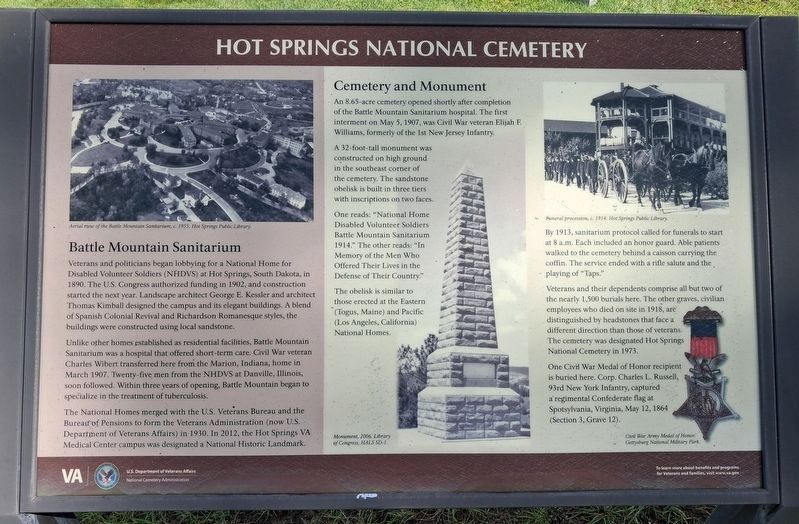
Veterans and politicians began lobbying for a National Home for Disabled Volunteer Soldiers (NHDVS) at Hot Springs, South Dakota, in 1890. The U.S. Congress authorized funding in 1902, and construction started the next year. Landscape architect George E. Kessler and architect Thomas Kimball designed the campus and its elegant buildings. A blend of Spanish Colonial Revival and Richardson Romanesque styles, the buildings were constructed using local sandstone.
Unlike other homes established as residential facilities, Battle Mountain Sanitarium was a hospital that offered short-term care. Civil War veteran Charles Wibert transferred here from the Marion, Indiana, home in March 1907. Twenty-five men from the NHDVS at Danville, Illinois, soon followed. Within three years of opening, Battle Mountain began to specialize in the treatment of tuberculosis.
The National Homes merged with the U.S. Veterans Bureau and the Bureau of Pensions to form the Veterans Administration (now U.S. Department of Veterans Affairs) in 1930. In 2012, the Hot Springs VA Medical Center campus was designated
this page online
[Photo caption] Aerial view of the Battle Mountain Sanitarium, c.1955
Cemetery and Monument
An 8.65-acre cemetery opened shortly after completion of the Battle Mountain Sanitarium hospital. The first interment on May 5, 1907, was Civil War veteran Elijah F. Williams, formerly of the 1st New Jersey Infantry.
A 32-foot-tall monument was constructed on high ground in the southeast corner of the cemetery. The sandstone obelisk is built in three tiers with inscriptions on two faces.
One reads: "National Home Disabled Volunteer Soldiers Battle Mountain Sanitarium 1914. The other reads: "In Memory of the Men Who Offered Their Lives in the Defense of Their Country."
The obelisk is similar to those erected at the Eastern (Togus, Maine) and Pacific (Los Angeles, California) National Homes.
[Photo caption] Monument, 2006.
By 1913, sanitarium protocol called for funerals to start at 8 am. Each included an honor guard. Able patients walked to the cemetery behind a caisson carrying the coffin. The service ended with a rifle salute and the playing of "Taps."
[Photo caption] Funeral procession, c.1914
Veterans
Photographed by William Fischer, Jr., September 25, 2026
2. Hot Springs National Cemetery NRHP Marker
Marker is adjacent to the Gettysburg Address marker
One Civil War Medal of Honor recipient is buried here. Corp. Charles L. Russell, 93rd New York Infantry, captured a regimental Confederate flag at Spotsylvania, Virginia, May 12, 1864 (Section 3, Grave 12).
[Photo caption] Civil War Army Medal of Honor
—————————————
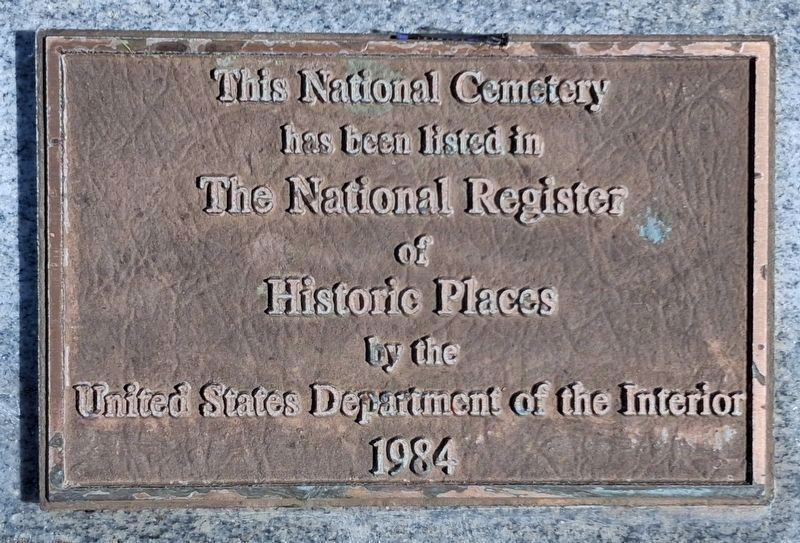
This National Cemetery
has been listed in
The National Register
of Historic Places
by the United States
Department of the Interior
1984
Erected by National Cemetery Association.
Topics. This historical marker is listed in these topic lists: Cemeteries & Burial Sites • Patriots & Patriotism. A significant historical date for this entry is May 5, 1907.
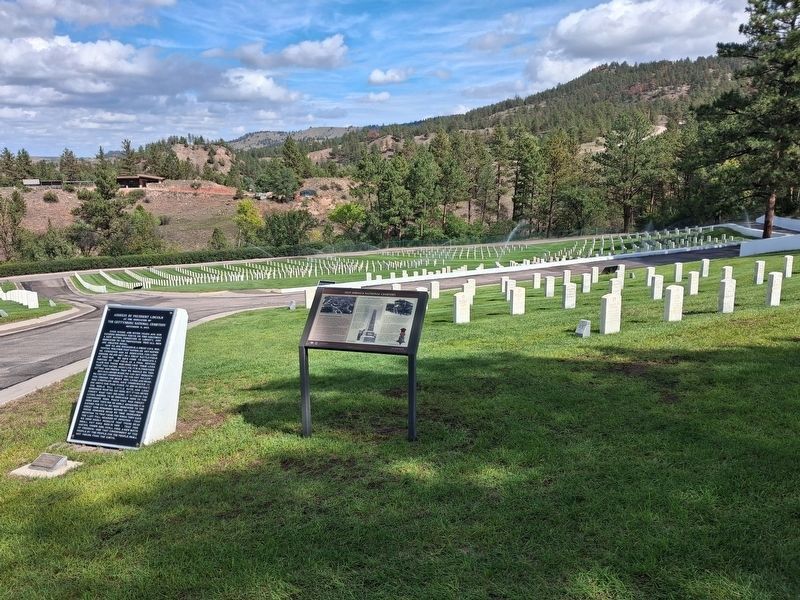
Location. 43° 26.373′ N, 103° 28.343′ W. Marker is in Hot Springs, South Dakota, in Fall River County. Markers are in Section 2 of the Hot Springs National Cemetery, accessed from the VA Medical Center campus. Touch for map.
Photographed by William Fischer, Jr., September 25, 2026
3. Hot Springs National Cemetery and Marker

Regionally, this marker is in West River. It is also in the American Black Hills, in the Lewis & Clark Corridor, on the prairies, and on the Northern Plains. Globally, it is in North America, the Western Hemisphere, the Western World, and the Anglosphere. Historically, it finds itself in what was once Rupert’s Land and also the Louisiana Purchase.
Other nearby markers. At least 8 other markers are within walking distance of this marker: Address by President Lincoln (here, next to this marker); Lieut.-Col. Guy P. Squire (a few steps from this marker); War Memorial (within shouting distance of this marker); A National Cemetery System (within shouting distance of this marker); a different marker also named War Memorial (within shouting distance of this marker); Battle Mountain (about 800 feet away, measured in a direct line); Hot Springs Centennial (approx. 0.3 miles away); Battle Mountain Sanitarium (approx. 0.4 miles away). Touch for a list and map of all markers in Hot Springs.
Photographed by William Fischer, Jr., September 25, 2026
4. Hot Springs National Cemetery
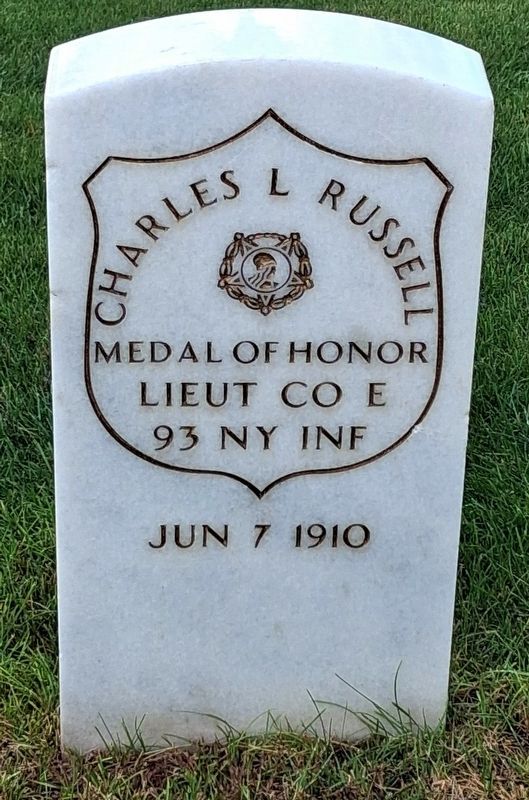
Photographed by William Fischer, Jr., September 25, 2026
5. Charles L. Russell Gravesite
In Hot Springs National Cemetery
Credits. This page was last revised on October 20, 2026. It was originally submitted on October 20, 2026, by William Fischer, Jr. of Reynoldsburg, Ohio. This page has been viewed 9 times since then. Photos: 1, 2, 3, 4, 5. submitted on October 20, 2026, by William Fischer, Jr. of Reynoldsburg, Ohio.
