Cromer in Norfolk, England, United Kingdom — Northwestern Europe (the British Isles)
Prospect and Promenade
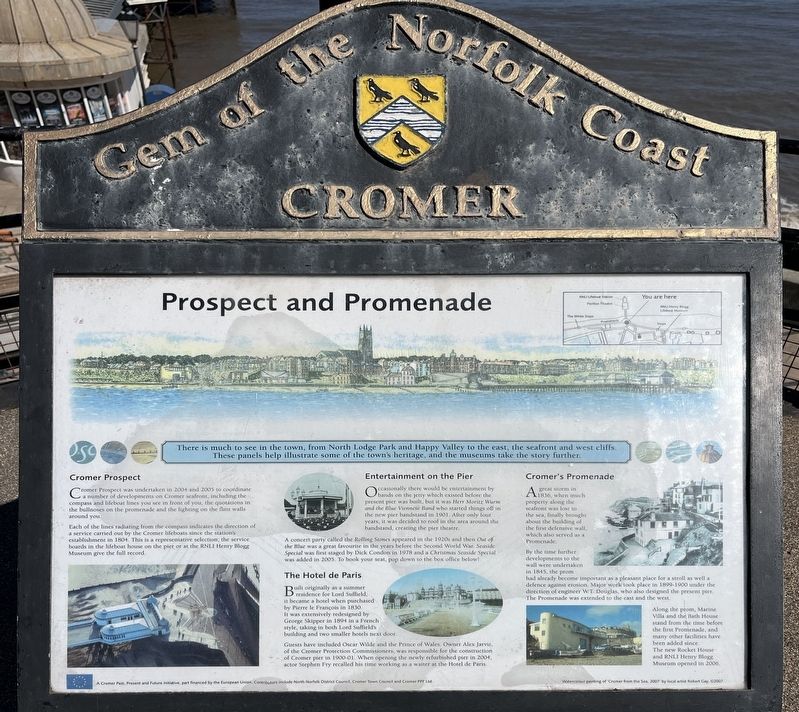
| — | Gem of the Norfolk Coast | — |
Photographed by Ray Gurganus, April 25, 2026
1. Prospect and Promenade Marker
Cromer Prospect
Cromer Prospect was undertaken in 2004 and 2005 to coordinate a number of developments on Cromer seafront, including the compass and lifeboat lines you see in front of you, the quotations in the bullnoses on the promenade and the lighting on the flint walls around you.
Each of the lines radiating from the compass indicates the direction of a service carried out by the Cromer lifeboats since the station's establishment in 1804. This is a representative selection; the service boards in the lifeboat house on the pier or at the RNLI Henry Blogg Museum give the full record.
Entertainment on the Pier
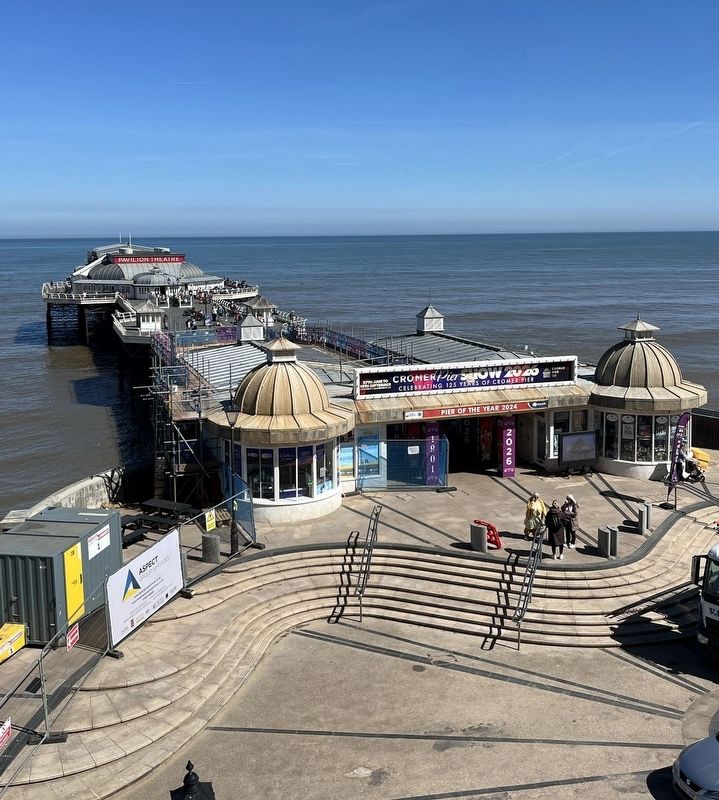
Occasionally there would be entertainment by bands on the jetty which existed before the present pier was built, but it was Herr Moritz Wurm and the Blue Viennese Band who started things off in the new pier bandstand in 1901. After only four years, it was decided to roof in the area around the
this page online
A concert party called the Rolling Stones appeared in the 1920s and then Out of the Blue was a great favourite in the years before the Second World War. Seaside Special was first staged by Dick Condon in 1978 and a Christmas Seaside Special was added in 2005. To book your seat, pop down to the box office below!
The Hotel de Paris
Built originally as a summer residence for Lord Suffield, it became a hotel when purchased by Pierre le François in 1830. It was extensively redesigned by George Skipper in 1894 in a French style, taking in both Lord Suffield's building and two smaller hotels next door.
Guests have included Oscar Wilde and the Prince of Wales. Owner Alex Jarvis, of the Cromer Protection Commissioners, was responsible for the construction of Cromer pier in 1900-01. When opening the newly refurbished pier in 2004, actor Stephen Fry recalled his time working as a waiter at the Hotel de Paris.
Cromer's Promenade
A great storm in 1836, when much property along the seafront was lost to the sea, finally brought about the building of the first defensive wall, which also served as
Photographed by Ray Gurganus, April 25, 2026
2. Cromer Pier
By the time further developments to the wall were undertaken in 1845, the prom had already become important as a pleasant place for a stroll as well a defence against erosion. Major work took place in 1899-1900 under the direction of engineer W.T. Douglas, who also designed the present pier. The Promenade was extended to the east and the west.
Along the prom, Marine Villa and the Bath House stand from the time before the first Promenade, and many other facilities have been added since.
The new Rocket House and RNLI Henry Blogg Museum opened in 2006.
Topics. This historical marker is listed in these topic lists: Entertainment • Parks & Recreational Areas.
Location. 52° 55.95′ N, 1° 18.054′ E. Marker is in Cromer, England, in Norfolk. It is on Hans Place. The marker is on the walkway leading from the street down to pier level. Touch for map. Marker is in this post office area: Cromer, England NR27 9HE, United Kingdom. Touch for directions.

Regionally, this marker is in East Anglia. Globally, it is on the Atlantic Ocean, in the North Atlantic Region, in Europe, in Atlantic Europe, on one of the British Isles, in the Western World, and in the Anglosphere. Historically, it finds itself in what was once the Roman Empire.
Other nearby markers. At least 6 other markers are within 14 kilometers of this marker, measured as the crow flies: Cromer Pier (within shouting distance of this marker); Bronze Ballet, 1940 (about 90 meters away, measured in a direct line); The Gangway (approx. 0.2 kilometers away); Steamer, 1934 (approx. 0.3 kilometers away); The Pastons in North Walsham (approx. 13.6 kilometers away); The town with two stations (approx. 13.9 kilometers away).
Credits. This page was last revised on October 21, 2026. It was originally submitted on October 20, 2026, by Ray Gurganus of Washington, District of Columbia. This page has been viewed 4 times since then. Photos: 1, 2. submitted on October 20, 2026, by Ray Gurganus of Washington, District of Columbia. • Andrew Ruppenstein was the editor who published this page.
