Woodend in Macedon Ranges Shire, Victoria, Australia — Oceania
Traditional Owners
Photographed by Dean Barton-Ancliffe, September 8, 2026
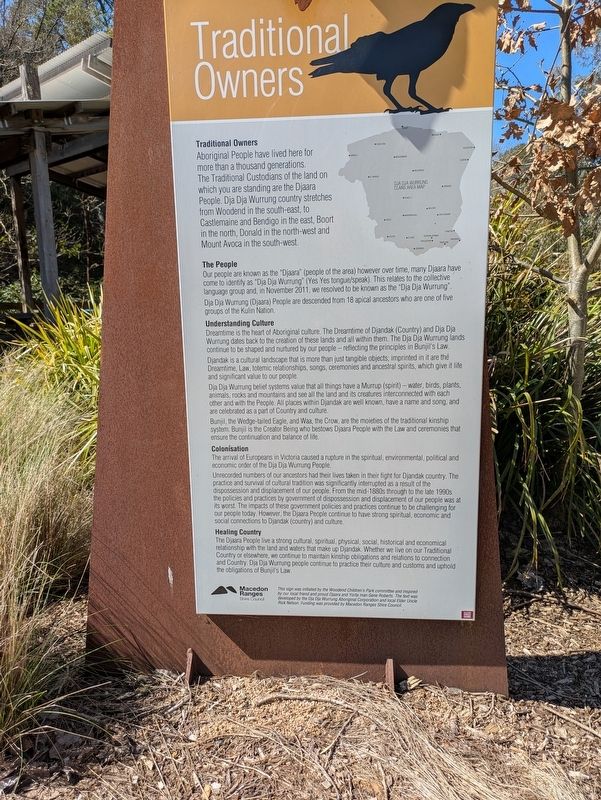
1. Traditional Owners Marker
Aboriginal People have lived here for more than a thousand generations. The Traditional Custodians of the land on which you are standing are the Djaara People. Dja Dja Wurrung country stretches from Woodend in the south-east, to Castlemaine and Bendigo in the east, Boort in the north, Donald in the north-west and Mount Avoca in the south-west.
The People
Our people are known as the "Djaara" (people of the area) however over time, many Djaara have come to identity as "Dja Dja Wurrung" (Yes Yes tongue/speak). This relates to the collective language group and, in November 2011, we resolved to be known as the "Dja Dja Wurrung". Dja Dja Wurrung (Djaara) People are descended from 18 apical ancestors who are one of five groups of the Kulin Nation.
Understanding Culture
Dreamtime is the heart of Aboriginal culture. The Dreamtime of Djandak (Country) and Dja Dja Wurrung dates back to the creation of these lands and all within them. The Dja Dja Wurrung lands continue to be shaped and nurtured by our people -reflecting the principles in Bunjil's Law.
Djandak is a cultural landscape that is more than
this page online
Dja Dja Wurrung belief systems value that all things have a Murrup (spirit) - water, birds, plants, animals, rocks and mountains and see all the land and its creatures interconnected with each other and with the People. All places within Djandak are well known, have a name and song, and are celebrated as a part of Country and culture.
Bunjil, the Wedge-tailed Eagle, and Waa, the Crow, are the moieties of the traditional kinship system. Bunjil is the Creator Being who bestows Djaara People with the Law and ceremonies that nsure the continuation and balance of life.
Colonisation
The arrival of Europeans in Victoria caused a rupture in the spiritual, environmental, political and economic order of the Dja Dja Wurrung People.
Unrecorded numbers of our ancestors had their lives taken in their fight for Djandak country. The practice and survival of cultural tradition was significantly interrupted as a result of the dispossession and displacement of
Photographed by Dean Barton-Ancliffe, September 8, 2026
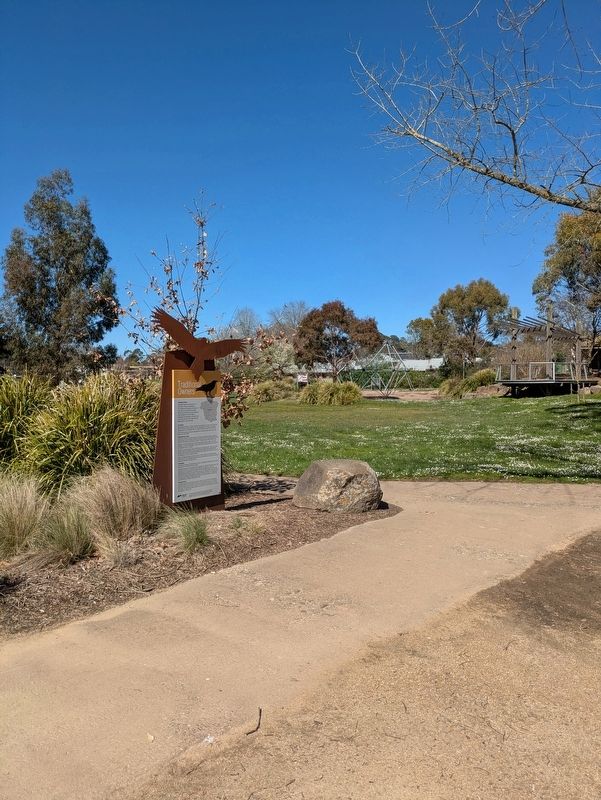
2. Traditional Owners Marker at the entrance to Campaspe Park Recreation Reserve
Healing Country
The Djaara People live a strong cultural, spiritual, physical, social, historical and economical relationship with the land and waters that make up Djandak. Whether we live on our Traditional Country or elsewhere, we continue to maintain kinship obligations and relations to connection and Country. Dja Dja Wurrung people continue to practice their culture and customs and uphold the obligations of Bunjil's Law.
Topics. This historical marker is listed in this topic list: Indigenous Peoples and Communities. A significant historical year for this entry is 1880.
Location. 37° 21.315′ S, 144° 31.856′ E. Marker is in Woodend, Victoria, in Macedon Ranges Shire. It can be reached from High Street (Route C792) 0.1 kilometers east of Forest Street. Touch for map. Marker is at or near this postal address: 144 High Street, Woodend VIC 3442, Australia. Touch for directions.

Regionally, it is in Oceania, in Australasia, in the Pacific Ocean, in South Pacific, on the Pacific Rim, in the Western World, and in the Anglosphere. Historically, it finds itself in what was once a British colony.
Other nearby markers. At least 8 other markers are within walking distance of this marker: Robbie's Walk (a few steps from this marker); Mechanics Institute & State Library (approx. 0.3 kilometers away); Woodend Court House (approx. 0.3 kilometers away); Woodend Memorial Clock Tower (approx. 0.4 kilometers away); Woodend Memorial Clock Tower - World War II (approx. 0.4 kilometers away); Woodend Memorial Clock Tower - World War I (approx. 0.4 kilometers away); Woodend War Memorial Plaque (approx. 0.4 kilometers away); Woodend RSL War Memorial (approx. half a kilometer away). Touch for a list and map of all markers in Woodend.
Also see . . . Djadjawurrung. Wikipedia
The Djadjawurrung or Dja Dja Wurrung, also known as the Djaara or Jajowrong people and Loddon River tribe, are an Aboriginal Australian people who are the traditional owners of lands including the water catchment areas of the Loddon and Avoca rivers in the Bendigo region of central Victoria, Australia. They are part of the Kulin alliance of Aboriginal Victorian peoples. There are 16 clans, which adhere to a patrilineal system. Like other Kulin peoples, there are two moieties: Bunjil the eagle and Waa the crow. The Dja Dja Wurrung experienced dispossession, conflict, and massacres during European settlement in the 1830s and 1840s, though the impact of disease was far greater.(Submitted on October 21, 2026, by Dean Barton-Ancliffe of Rowville, Victoria.)
Credits. This page was last revised on October 23, 2026. It was originally submitted on October 21, 2026, by Dean Barton-Ancliffe of Rowville, Victoria. This page has been viewed 14 times since then. Photos: 1, 2. submitted on October 21, 2026, by Dean Barton-Ancliffe of Rowville, Victoria. • Andrew Ruppenstein was the editor who published this page.
