Riddells Creek in Macedon Ranges Shire, Victoria, Australia — Oceania
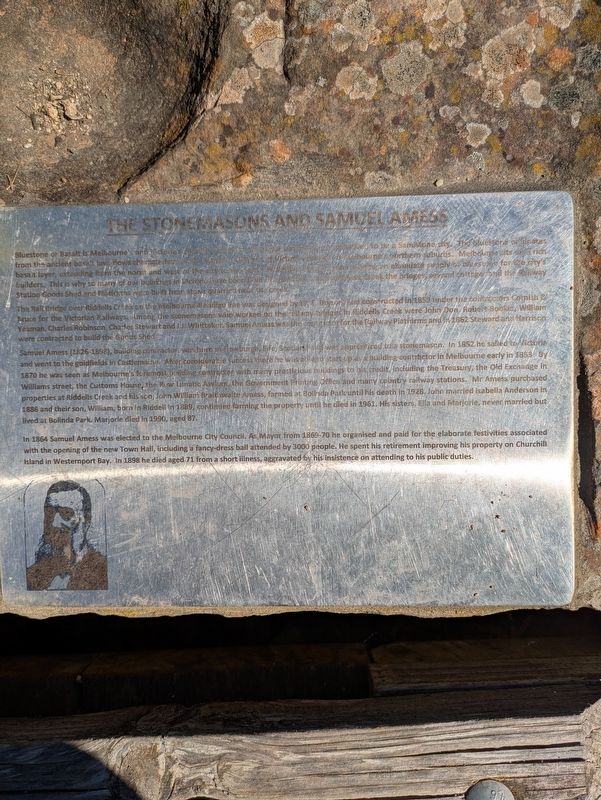
The Stonemasons and Samuel Amess
Photographed by Dean Barton-Ancliffe, September 8, 2026
1. The Stonemasons and Samuel Amess Marker
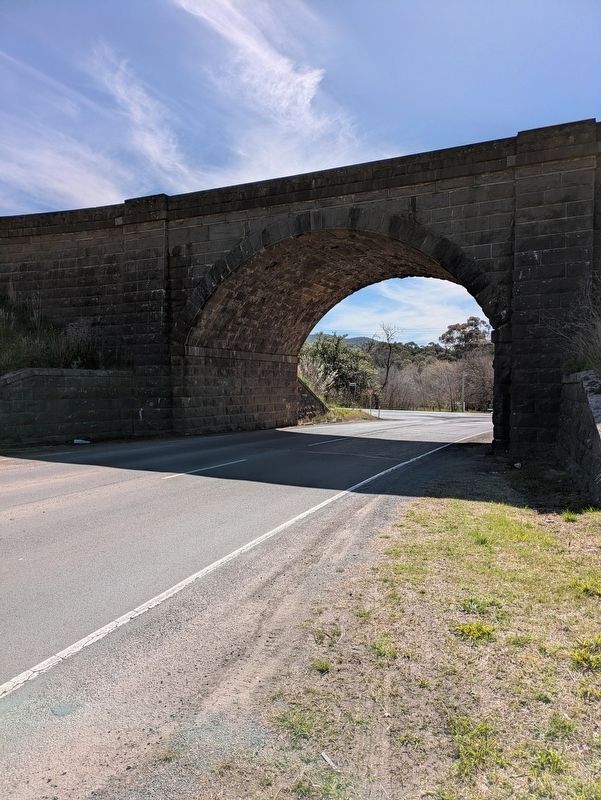
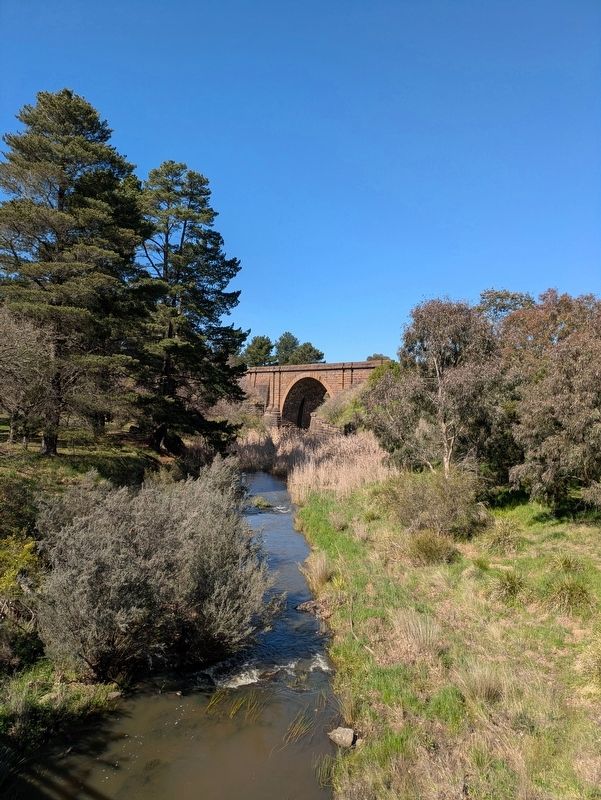
The Rail Bridge over Riddells Creek on the Melbourne Bendigo line was designed by W. E. Bryson and constructed in 1859 under the contractors Cornish & Bruce for the Victorian Railways. Among the stonemasons who worked of the railway bridges in Riddells Creek were John Don, Robert Bodkin, William Yeaman, Charles Robinson, Charles Stewart and J. J. Whittaker. Samuel Amess was the contractor for the Railway Platforms and in 1862 Steward and Harrison
this page online
Samuel Amess (1826-1898), building contractor, was born at Newburgh, Fife, Scotland and was apprenticed to a stonemason. In 1852 he sailed to Victoria and went to the goldfields in Castlemaine. After considerable success there he was able to start up as a building contractor in Melbourne early in 1853. By 1870 he was seen as Melbourne's foremost building contractor with many prestigious buildings to his credit, including the Treasury, the Old Exchange in Williams street, the Customs House, the Kew Lunatic Asylum, the Government Printing office and many country railway stations. Mr Amess purchased properties at Riddells Creek and his son, John William Braithwaite Amess, farmed at Bolinda Park until his death in 1928. John married Isabella Anderson in 1886 and their son, William, born in Riddell in 1889, continued farming the property until he died in 1961. His sisters, Ella and Marjorie, never married but lived at Bolinda Park. Marjorie died in 1990, aged 87.
In 1864 Samuel Amess was elected to the Melbourne City Council. As Mayor from 1869-70 he organised and paid for the elaborate festivities
Photographed by Dean Barton-Ancliffe, September 8, 2026
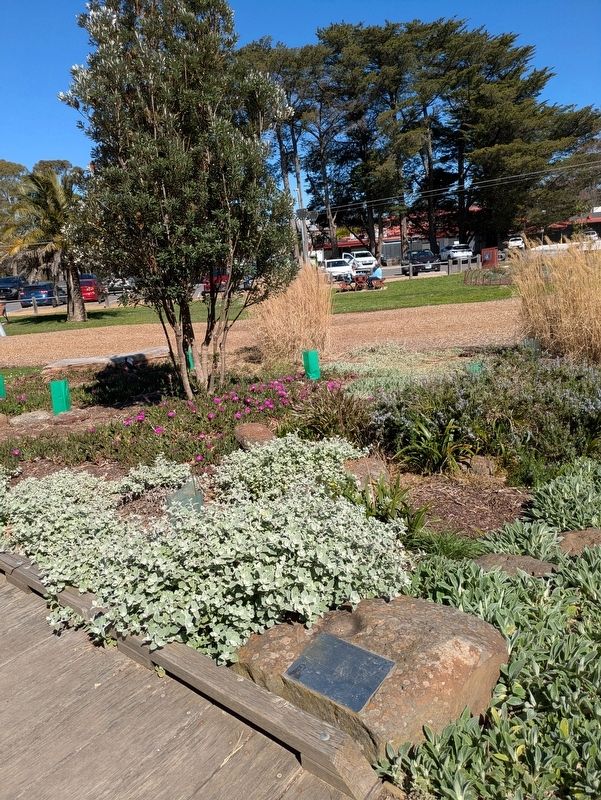
2. The Stonemasons and Samuel Amess Marker in the Lions Park
Topics. This historical marker is listed in these topic lists: Architecture • Charity & Public Work • Colonial Era • Railroads & Streetcars. A significant historical year for this entry is 1859.
Location. 37° 27.748′ S, 144° 40.689′ E. Marker is in Riddells Creek, Victoria, in Macedon Ranges Shire. It is on Main Road (Victoria Route C708) 0.1 kilometers north of Station Street, on the left when traveling south. Touch for map. Marker is at or near this postal address: 63A Main Road, Riddells Creek VIC 3431, Australia. Touch for directions.

Regionally, it is in Oceania, in Australasia, in the Pacific Ocean, in South Pacific, on the Pacific Rim, in the Western World, and in the Anglosphere. Historically, it finds itself in what was once a British colony.
Other nearby markers. At least 8 other markers are within 18 kilometers
Photographed by Dean Barton-Ancliffe, September 8, 2026
3. Bluestone Rail Bridge near Riddells Creek
Also see . . . Samuel Amess (1826–1898). Australian Dictionary of Biography
Samuel Amess (1826-1898), building contractor, was born at Newburgh, Fife, Scotland, son of Samuel Amess, miller, and his wife Elizabeth, née Fotheringham. On leaving private school he was apprenticed to a stonemason. In 1852 he sailed to Victoria and after some success at the goldfields was able to start as a building contractor early in 1853 in Melbourne. He bought land in William Street and the house he(Submitted on October 23, 2026, by Dean Barton-Ancliffe of Rowville, Victoria.)built there remained his home until his death. Amess built the Treasury, the 'Old Exchange', the Customs House, the Kew Lunatic Asylum (a contract of about £120,000), the Government Printing Office and many country railway stations. He was the contractor for the west facade of Parliament House but in 1883 was involved in a dispute over the facing stone and lost the contract. In the 1870s he was regarded as Melbourne's foremost building contractor and in 1873 was the first president of the Builders and Contractors Association.Photographed by Dean Barton-Ancliffe, September 8, 20264. A second Bluestone Rail Bridge over Riddells Creek
In 1864 Amess was elected to the Melbourne City Council. As mayor in 1869-70 he organized and paid for the ceremonies and festivities associated with the opening of the new town hall in August 1870. Amess commissioned Henry Kendall and Charles Horsley to write a cantata for the concert which 4500 people attended, and he gave a magnificent fancy dress ball at which 3000 guests dined on boars' heads, sucking pigs, jellies and champagne. Amess described his 'sparing the corporable funds' as 'a simple act of duty … The contrary course would have left room for cavilling and question, alike humiliating and vexatious to the members of the City Council'.
Credits. This page was last revised on October 24, 2026. It was originally submitted on October 23, 2026, by Dean Barton-Ancliffe of Rowville, Victoria. This page has been viewed 15 times since then. Photos: 1, 2, 3, 4. submitted on October 23, 2026, by Dean Barton-Ancliffe of Rowville, Victoria. • Andrew Ruppenstein was the editor who published this page.
