Lake of the Woods in Orange County, Virginia — The American South (Mid-Atlantic)
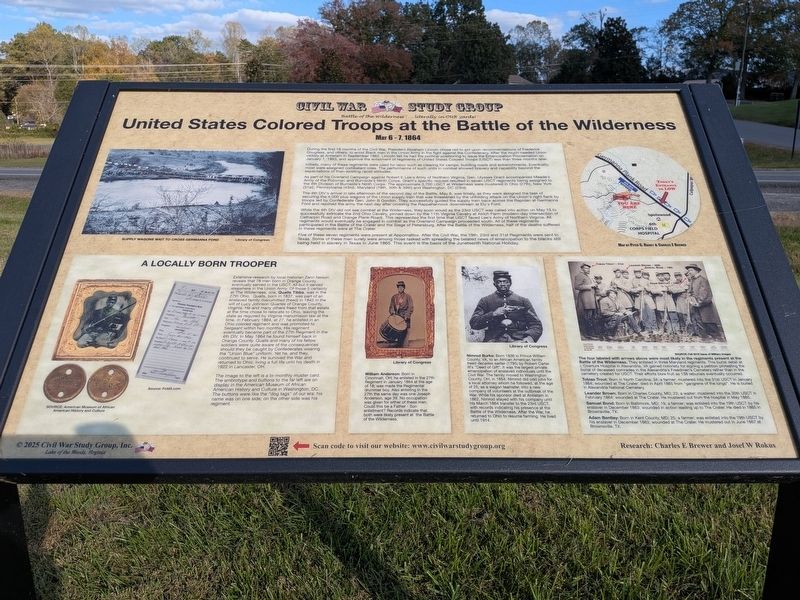
United States Colored Troops at the Battle of the Wilderness
May 6-7, 1865
| — | Civil War Study Group | Battle of the Wilderness... literally in OUR yards! | — |
Photographed by Evan Dwyer, October 23, 2026
1. United States Colored Troops at the Battle of the Wilderness Marker
Initially, many of these regiments were used for labor such as clearing for camps, building roads and entrenchments. Eventually, most were assigned combatant roles. The performance of such units in combat showed bravery and capability beyond the expectations of then-existing racist attitudes.
As part of his Overland Campaign against Robert E. Lee's Army of Northern Virginia, Gen. Ulysses Grant accompanied Meade's Army of the Potomac and Burnside's Ninth Corps. Grant's specific request resulted in seven USCT regiments being assigned to the 4th Division of Burnside's Ninth Corps. The approximate 3,700 USCT at Wilderness were mustered
this page online
The 4th DIV's arrival in late afternoon of the second day of the Battle, May 6, was timely, as they were assigned the task of securing the 4,000 plus wagons of the Union supply train that was threatened by the unfolding attack on the Union's right flank by troops led by Confederate Gen. John B. Gordon. They successfully guided the supply train back across the Rapidan at Germanna Ford and rejoined the army the next day after crossing the Rappahannock downstream at Ely's Ford.
While the 4th DIV did not see combat at the Wilderness, they soon would as the 23rd USCT was called into action on May 15 to successfully extricate the 2nd Ohio Cavalry, pinned down by the 11th Virginia Cavalry at Alrich Farm (modern-day intersection of Catharpin Road and Orange Plank Road). This represented the first time that USCT faced Lee's Army of Northern Virginia. All regiments would eventually be engaged in combat as the Overland Campaign proceeded south. All of these regiments participated in the Battle of the Crater and the Siege of Petersburg.
Photographed by Evan Dwyer, October 23, 2026
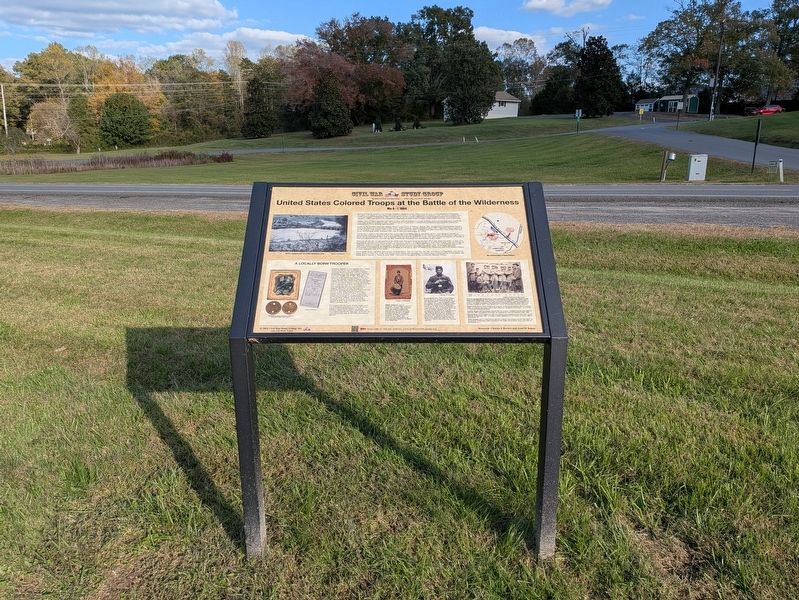
2. United States Colored Troops at the Battle of the Wilderness Marker
Five of these seven regiments were present at Appomattox. After the Civil War, the 19th, 23rd and 31st Regiments were sent to Texas. Some of these men surely were among those tasked with spreading the belated news of emancipation to the blacks still being held in slavery in Texas in June 1865. This event is the basis of the Juneteenth National Holiday.
Photo Caption: Supply wagons wait to cross Germanna Ford - Library of Congress
A Locally Born Trooper
Extensive research by local historian Zann Nelson reveals that 78 men born in Orange County eventually served in the USCT. All but 5 served elsewhere in the Union Army. Of those 5 certainly at The Wilderness, one, Qualls Tibbs, was in the 27th Ohio. Qualls, born in 1837, was part of an enslaved family manumitted (freed) in 1842 in the will of Lucy Johnson Quarles of Orange County, Virginia. He and many others freed from that estate at the time chose to relocate to Ohio, leaving the state as required by Virginia manumision law at the time. In February 1864, at 27, he enlisted in an
Photographed by Evan Dwyer, October 23, 2026
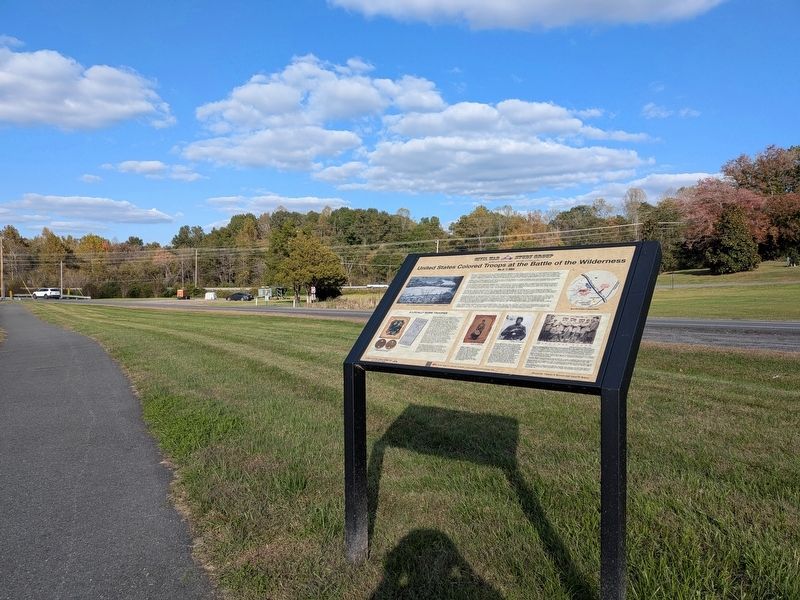
3. United States Colored Troops at the Battle of the Wilderness Marker
The image to the left is a bi-monthly muster card. The ambrotype and buttons to the far left are on display in the American Museum of African American History and Culture in Washington, DC. The buttons were like the "dog tags" of our era: his name was on one side; on the other side was his regiment.
William Anderson: Born in Cincinnati, OH; he enlisted in the 27th Regiment in January 1864 at the age of 18; he was made the Regimental drummer boy. Also enlisting in the 27th the same day was one Joseph Anderson, age 39. No occupation was given for either of these men. Could this be a Father - Son enlistment? Records indicate that both were likely present at the Battle of the Wilderness.
Nimrod Burke: Born 1836 in Prince William County, VA, to an African American family freed decades earlier (1795) by Robert Carter III's "Deed of Gift". It was the largest private emancipation of enslaved individuals until the Civil War. The family moved to Washington County, OH, in 1854. Nimrod did odd jobs for a local attorney whom he followed, at the age of 25, as a wagon teamster, into a new company of volunteers at the outbreak of the War. Wile his sponsor died at Antietam in 1862, Nimrod stayed with his company until his March 1864 transfer to the 23rd USCT, with records indicating his presence at the Battle of the Wilderness. After the War, he returned to Ohio to resume farming. He lived until 1914.
Tobias Trout: Born in North Carolina; 34; a farmer; mustered into the 31st USCT in January 1864; wounded at The Creater; died in April 1865 from "gangrene of the lungs". He is buried in Alexandria National Cemetery.
Leander Brown: Born in Charles County, MD; 23; a waiter; mustered into the 30th USCT in February 1864; wounded at The Crater. He mustered out from the hospital in May 1865.
Samuel Bond: Born in Baltimore, MD; 19; a farmer; was enlisted into the 19th USCT by his enslaver in December 1863; wounded in action leading up to The Crater. He died in 1865 in Brownsville, TX.
Adam Bentley: Born in Kent County, MD; 25; a farmer; was enlisted into the 19th USCT by his enslaver in December 1863; wounded at The Crater. He mustered out in June 1867 at Brownsville, TX.
Photo Captions:
SOURCE: American Museum of African American History and Culture
Source: Fold3.com
Library of Congress
Library of Congress
SOURCE: Fall 2016 Issue of Military Images
Map by Peter G. Rainey & Charles E Brewer
Research: Charles E Brewer and Josef W Rokus
Scan code to visit our website: www.civilwarstudygroup.org
Erected 2025 by Civil War Study Group, Inc., and Lake of the Woods, Virginia.
Topics. This historical marker is listed in these topic lists: African Americans • War, US Civil. A significant historical date for this entry is May 6, 1864.
Location. 38° 21.087′ N, 77° 45.221′ W. Marker is in Lake of the Woods, Virginia, in Orange County. It is on Lakeview Parkway near Shoosmith Road, on the left when traveling north. Located at a park in Lake of the Woods gated community. All visitors must be registered guests of a resident. No entry is permitted to the general public.. Touch for map. Marker is at or near this postal address: 90 Shoosmith Road, Locust Grove VA 22508, United States of America. Touch for directions.

Regionally, this marker is in Northern Virginia and in the Piedmont. It is also in the American South and specifically in the Upper South. Globally, it is in North America, the Western Hemisphere, the Western World, and the Anglosphere. Historically, it finds itself in what was once the territory of the Mississippian Culture, one of the original Thirteen Colonies, one of the Confederate States of America, and the Antebellum South.
Other nearby markers. At least 8 other markers are within 2 miles of this marker, measured as the crow flies: Spotswood Family Cemetery (approx. 0.6 miles away); Captain John Spotswood (approx. 0.7 miles away); Orange Grove 1728 - 1864 (approx. 0.7 miles away); Orange Grove 1865 - 1967 (approx. 0.7 miles away); Battle of the Wilderness (approx. 0.7 miles away); a different marker also named Battle of the Wilderness (approx. one mile away); Gordon's Flank Attack (approx. 1.3 miles away); Historic Orange County, Virginia (approx. 1.6 miles away). Touch for a list and map of all markers in Lake of the Woods.
Credits. This page was last revised on October 23, 2026. It was originally submitted on October 23, 2026, by Evan Dwyer of Richmond, Virginia. This page has been viewed 11 times since then. Photos: 1, 2, 3. submitted on October 23, 2026, by Evan Dwyer of Richmond, Virginia.
