Near Atlantic Beach in Carteret County, North Carolina — The American South (South Atlantic)
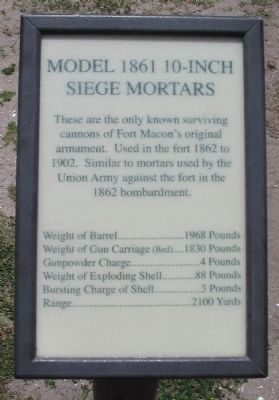
Model 1861 10-inch Siege Mortars
Photographed by Craig Swain, May 2, 2010
1. Model 1861 10-inch Siege Mortars Marker
Weight of Barrel .......................... 1968 Pounds
Weight of Gun Carriage (Bed) .... 1830 Pounds
Gunpowder Charge ................... 4 Pounds
Weight of Exploding shell ......... 88 Pounds
Bursting Charge of Shell ........... 3 Pounds
Range ............................ 2100 Yards
Topics. This historical marker is listed in this topic list: War, US Civil. A significant historical year for this entry is 1862.
Location. 34° 41.781′ N, 76° 40.725′ W. Marker is near Atlantic Beach, North Carolina, in Carteret County. It can be reached from Fort Macon Road, on the right when traveling east. Located on the Parade Field of Fort Macon, Fort Macon State Park. Touch for map. Marker is in this post office area: Atlantic Beach NC 28512, United States of America. Touch for directions.

Regionally, this marker is in the Coastal Plain and on the Crystal Coast. It is also in the American South, specifically in the Upper South, in the Tidewater,
this page online
Other nearby markers. At least 8 other markers are within walking distance of this marker: Welcome to Fort Macon (a few steps from this marker); Model 1841 6-pounder Field Cannon (a few steps from this marker); Model 1841 Navy 32-pounder (within shouting distance of this marker); Hot Shot Furnace (within shouting distance of this marker); Carronade Battery (within shouting distance of this marker); Rifled 32-pounder (within shouting distance of this marker); Cistern (within shouting distance of this marker); Mortar Battery (within shouting distance of this marker). Touch for a list and map of all markers in Atlantic Beach.
Photographed by Craig Swain, May 2, 2010
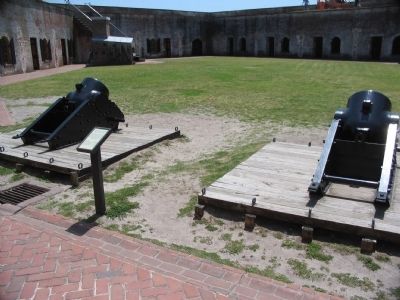
2. Model 1861 10-inch Siege Mortars and Marker
Photographed by Craig Swain, May 2, 2010
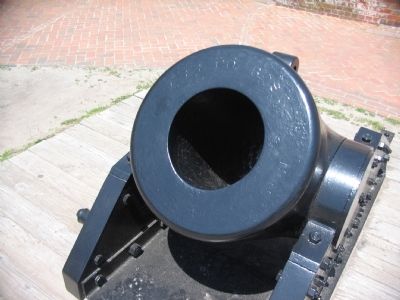
3. Model 1861 10-inch Siege Mortar
Both mortars at Fort Macon were cast by Cyrus Alger & Company, Boston, Massachusetts in 1862. This mortar weighed 1,968 pounds when inspected by Thomas J. Rodman (initials T.J.R.). It is registry number 7.
Photographed by Craig Swain, May 2, 2010
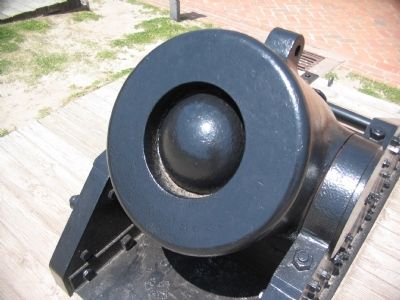
4. Model 1861 10-inch Siege Mortars
The other mortar at Fort Macon is registry number 8, also from Cyrus Alger. It weighed 1,966 pounds.
Photographed by Craig Swain, May 2, 2010
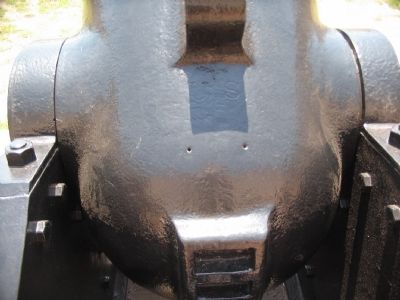
5. Double Vents
Siege mortars usually featured two vents for placing the friction primer. These appear as small holes in the center of this view. Only one of the vents was clear to the powder chamber. The other, serving as a backup in the event of jamming or malfunction, was filled with zinc. In this view is the "U.S." acceptance mark, just above the vents.
Photographed by Craig Swain, May 2, 2010
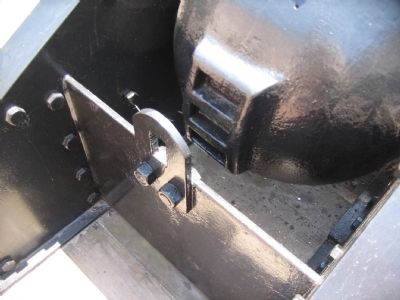
6. Elevating Sockets
The mortar was elevated by use of a metal leaver. The leaver was seated in the square hole in a bracket on the bed, then pushed into the sockets on the breech face of the mortar.
Photographed by Craig Swain, May 2, 2010
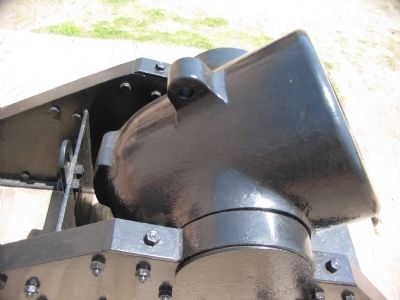
7. Mortar and Bed
The mortar had an "ear" at the top, which was used to maneuver the weapon onto the bed or cart for transportation. The bed is made of wrought iron.
Credits. This page was last revised on June 16, 2016. It was originally submitted on June 3, 2010, by Craig Swain of Leesburg, Virginia. This page has been viewed 2,518 times since then and 89 times this year. Photos: 1, 2, 3, 4, 5, 6, 7. submitted on June 3, 2010, by Craig Swain of Leesburg, Virginia.
