Chorlton-on-Medlock in Manchester in Greater Manchester, England, United Kingdom — Northwestern Europe (the British Isles)
Coupland Building 1
The Birthplace of Modern Computing
Photographed by Ian Lefkowitz, September 14, 2026
1. Coupland Building 1 Marker
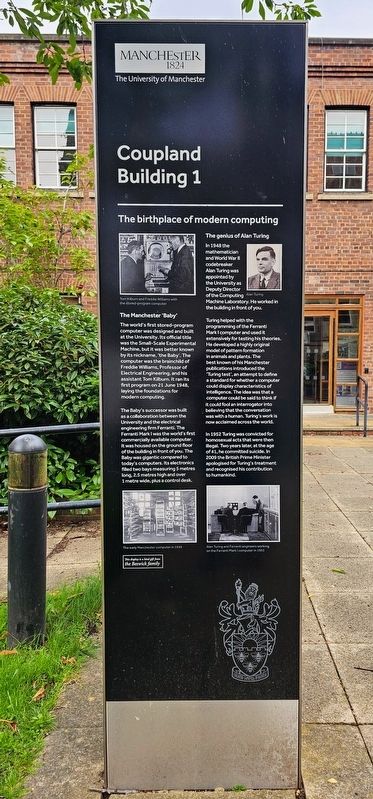
The world’s first stored-program computer was designed and built at the University. Its official title was the Small-Scale Experimental Machine, but it was better known by its nickname, ‘the Baby’. The computer was the brainchild of Freddie Williams, Professor of Electrical Engineering, and his assistant Tom Kilburn. It ran its first program on 21 June 1948, laying the foundations for modern computing.
The Baby’s successor was built as a collaboration between the University and the electrical engineering firm Ferranti. The Ferranti Mark I was the world’s first commercially available computer. It was housed on the ground floor of the building in front of you. The Baby was gigantic compared to today’s computers. Its electronics filled two bays measuring 5 metres long, 2.5 metres high and over 1 metre wide, plus a control desk.
The Genius of Alan Turing
In 1948 the mathematician and World War II codebreaker Alan Turing was appointed by the University as Deputy Director of the Computing Machine Laboratory. He worked in the building in front of you.
Turing helped with the programming of the Ferranti Mark I computer and used it extensively for testing his theories. He developed a highly original model of pattern formation in animals and plants. The best known of his Manchester publications introduced the ‘Turing test’, an attempt to define a standard for whether a computer could display characteristics of intelligence. The idea was that a computer could be said to think if it could fool an interrogator into believing that the conversation was with a human. Turing’s work is now acclaimed across the world.
In 1952 Turing was convicted for homosexual acts that were then illegal. Two years later, at the age of 41, he committed suicide. In 2009 the British Prime Minister apologised for Turing’s treatment
this page online
This display is a kind gift from the Beswick family
(Captions)
Tom Kilburn and Freddie Williams with the stored-program computer
Alan Turing
The early Manchester computer in 1949
Alan Turing and Ferranti engineers working on the Ferranti Mark I computer in 1951
Erected by The University of Manchester.
Topics. This historical marker is listed in this topic list: Science & Medicine. A significant historical date for this entry is June 21, 1948.
Location. 53° 27.954′ N, 2° 14.115′ W. Marker is in Manchester, England, in Greater Manchester. It is in Chorlton-on-Medlock. It is on Coupland Street west of Oxford Road, on the right when traveling east. Touch for map. Marker is at or near this postal address: 186 Oxford Road, Manchester, England M13 9GP, United Kingdom. Touch for directions.

Regionally, this marker is in North West England. Globally, it is on the Atlantic Ocean, in the North Atlantic Region, in Europe, in Atlantic Europe, on one of the British Isles, in the Western World, and in the Anglosphere. Historically, it finds itself in what was once the Roman Empire.
Other nearby markers. At
Photographed by Ian Lefkowitz, September 14, 2026
2. Coupland Building 1
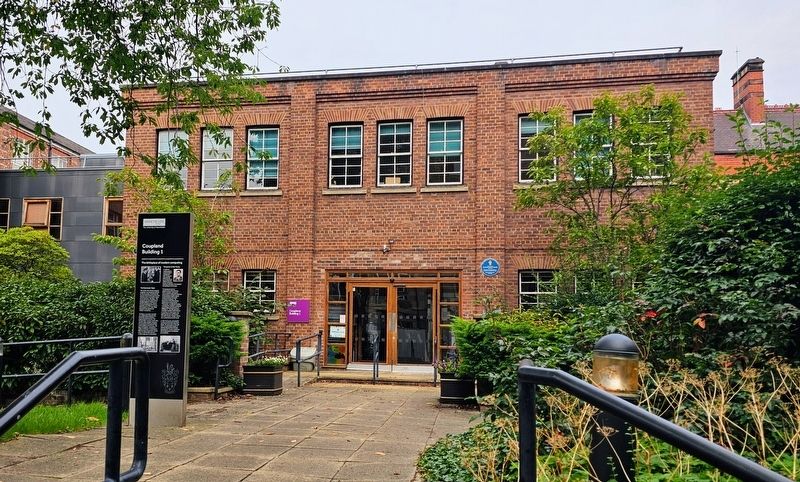
The interpretive marker is located in front of the building.
Also see . . . How a 70-year-old ‘Baby’ changed the face of modern computing (University of Manchester).
At 11am on 21 June, 1948 the Small Scale Experimental Machine (SSEM), nicked named ‘The Baby’, started running its first program. It took 52 minutes, running through 3.5 million calculations before it got to the correct answer. But, in that process, the Baby became the first computer in the world to run a program electronically stored in its memory, rather than on paper tape or hardwired in.(Submitted on October 26, 2026, by Ian Lefkowitz of New York, New York.)
Additional keywords. LGBT; LGBTQ; 🏳️🌈
Credits. This page was last revised on October 26, 2026. It was originally submitted on October 26, 2026, by Ian Lefkowitz of New York, New York. This page has been viewed 7 times since then. Photos: 1, 2. submitted on October 26, 2026, by Ian Lefkowitz of New York, New York. • Andrew Ruppenstein was the editor who published this page.
