Chorlton-on-Medlock in Manchester in Greater Manchester, England, United Kingdom — Northwestern Europe (the British Isles)
Sir Lawrence Bragg
Photographed by Ian Lefkowitz, September 14, 2026
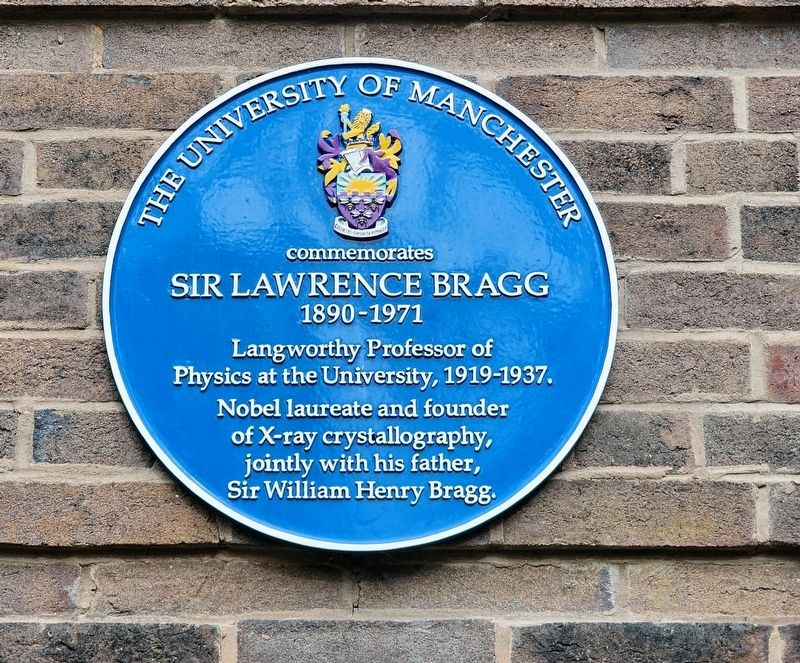
1. Sir Lawrence Bragg Marker
commemorates
Sir Lawrence Bragg
1890–1971
Langworthy Professor of Physics at the University, 1919–1937.
Nobel laureate and founder of X-ray crystallography, jointly with his father, Sir William Henry Bragg.
Erected 2015 by The University of Manchester.
Topics. This historical marker is listed in these topic lists: Education • Science & Medicine. A significant historical year for this entry is 1915.
Location. 53° 27.944′ N, 2° 14.124′ W. Marker is in Manchester, England, in Greater Manchester. It is in Chorlton-on-Medlock. It is on Coupland Street east of Higher Chatham Street, on the right when traveling west. Touch for map. Marker is at or near this postal address: 9 Higher Chatham Street, Manchester, England M13 9NR, United Kingdom. Touch for directions.

Regionally, this marker is in North West England. Globally, it is on the Atlantic Ocean, in the North Atlantic Region, in Europe, in Atlantic Europe, on one of the British Isles, in the Western World, and in the Anglosphere. Historically, it finds itself in what was once the Roman Empire.
Other nearby markers. At least
this page online
Also see . . . Plaque unveiled for Nobel laureate Sir Lawrence Bragg (University of Manchester, 11 December 2015).
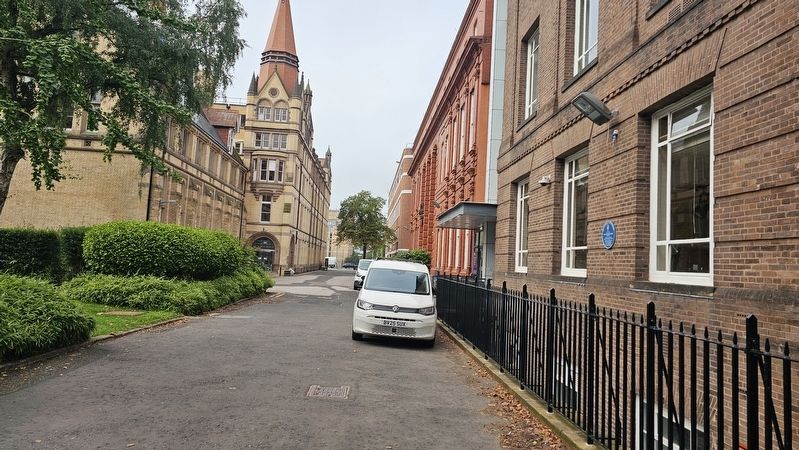
It wasn’t until September 1922 that Bragg was officially awarded the prize, due to World War I. Sir Lawrence and his father, Sir William Bragg, were jointly awarded the Nobel Prize in Physics for their analysis of crystal structure by means of X-rays. Aged 25 at the time, Bragg remains the youngest ever Nobel Laureate in physics. They showed first that the phenomenon can be simply understood in terms of the reflection of X-ray(Submitted on October 26, 2026, by Ian Lefkowitz of New York, New York.)waves by planes of atoms in the crystals (according to Bragg's law) and, second, that the observed effects are capable of revealing the detailed arrangements of the atoms in the crystals.Photographed by Ian Lefkowitz, September 14, 20262. Sir Lawrence Bragg MarkerThe plaque faces the side of the building, on Coupland Street.
Additional keywords. blue plaque
Credits. This page was last revised on October 26, 2026. It was originally submitted on October 26, 2026, by Ian Lefkowitz of New York, New York. This page has been viewed 11 times since then. Photos: 1, 2. submitted on October 26, 2026, by Ian Lefkowitz of New York, New York. • Andrew Ruppenstein was the editor who published this page.
