Washington in Hempstead County, Arkansas — The American South (West South Central)
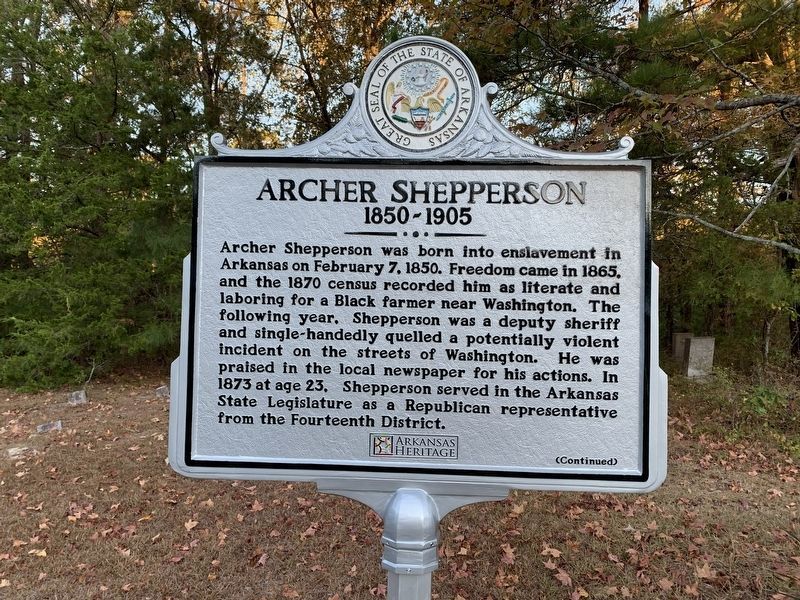
Archer Shepperson
1850-1905
Josh Williams, Historic Washington State Park, October 17, 2026
1. Archer Shepperson, 1850-1905 Marker, Side One
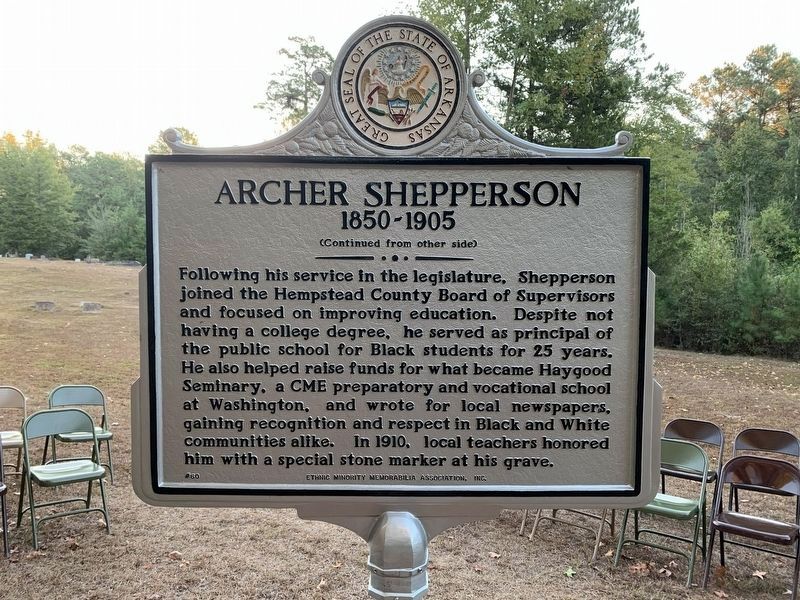
Following his service in the legislature, Shepperson joined the Hempstead County Board of Supervisors and focused on improving education. Despite not having a college degree, he served as principal of the public school for Black students for 25 years. He also helped raise funds for what became Haygood Seminary, a CME preparatory and vocational school at Washington, and wrote for local newspapers, gaining recognition and respect in Black and White communities alike. In 1910, local teachers honored him with a special stone marker at his grave.
Erected 2026 by Ethnic Minority Memorabilia Association, Inc.;
this page online
Topics and series. This historical marker is listed in these topic lists: African Americans • Education • Government & Politics • Law Enforcement. In addition, it is included in the Arkansas Heritage series list. A significant historical date for this entry is February 7, 1850.
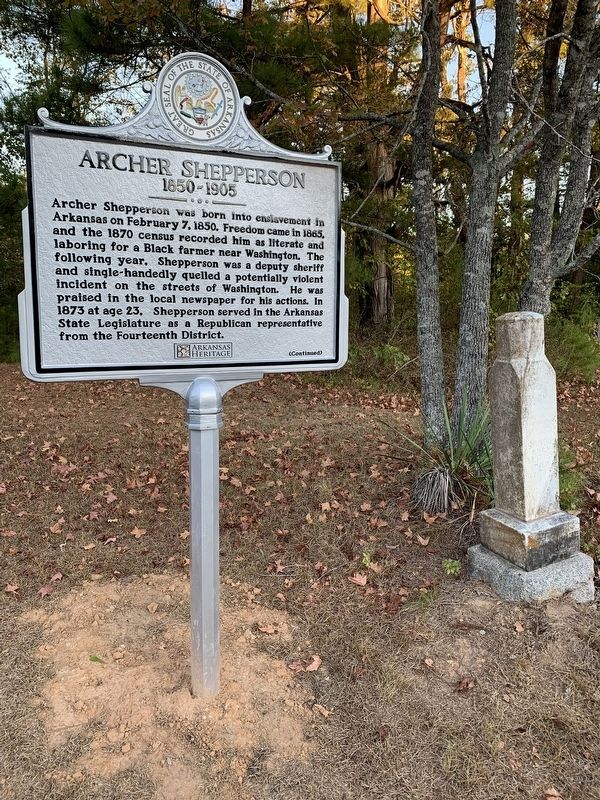
Location. 33° 46.518′ N, 93° 41.464′ W. Marker is in Washington, Arkansas, in Hempstead County. It can be reached from Carrigan Street 0.2 miles south of U.S. 278. Marker is in the historic African American section of the Old Washington Cemetery, adjacent to Archer Shepperson's gravestone. Touch for map. Marker is at or near this postal address: 124 Carrigan Street, Washington AR 71862, United States of America. Touch for directions.

Regionally, this marker is in the Gulf Coastal Plain and in Caddo Territory. It is also in the American South, specifically in the Upper South, and in the Piney Woods. Globally, it is in North America, the Western Hemisphere, the Western World, and the Anglosphere. Historically, it finds itself in what was once New Spain, the territory of the Mississippian Culture, the Louisiana
Josh Williams, Historic Washington State Park
2. Archer Shepperson, 1850-1905 Marker, Side Two
Other nearby markers. At least 8 other markers are within walking distance of this marker: Confederate Dead 1861-1865 (about 600 feet away, measured in a direct line); Battle of Prairie De Ann (about 600 feet away); Hempstead County In The Civil War (approx. 0.2 miles away); The Washington Post Office (approx. half a mile away); Homesite of Dr. Isaac Newton Jones and Elizabeth Littlejohn Jones (approx. 0.6 miles away); Confederate Capital (approx. 0.6 miles away); Masonic Civil War Memorial (approx. 0.6 miles away); James Black's Shop (approx. 0.7 miles away). Touch for a list and map of all markers in Washington.
Also see . . . Archer Shepperson (Encyclopedia of Arkansas). Excerpt, a notable event:
On December 16, 1871, an event in Washington became a turning point in Shepperson’s life. Serving as a deputy sheriff when the sheriff, one Captain Vance, was out of town, Shepperson stepped in and quelled a potential violent outburst between a Black militia group and local citizens. The situation developed when “some misunderstanding or difficulty(Submitted on October 28, 2026.)arose” between the two groups while the militia was performing a weekly drill on the streets of Washington. Shepperson “promptly interfered, locked up one of the hostile parties, disarmed another and quieted things generally in quick time.” The Washington Telegraph praised his actions and brought him to the attention of his community. That community elected him to the Arkansas House of Representatives, and he served in 1873–1874.Josh Williams, Historic Washington State Park3. Archer Shepperson Historical Marker Next to Archer Shepperson's Grave Marker
Credits. This page was last revised on October 28, 2026. It was originally submitted on October 27, 2026, by Ashley Sides of Little Rock, Arkansas. This page has been viewed 8 times since then. Photos: 1, 2, 3. submitted on October 27, 2026, by Ashley Sides of Little Rock, Arkansas. • Andrew Ruppenstein was the editor who published this page.
