Dunham in Brome-Missisquoi, Québec — Central Canada (French-Canadian)
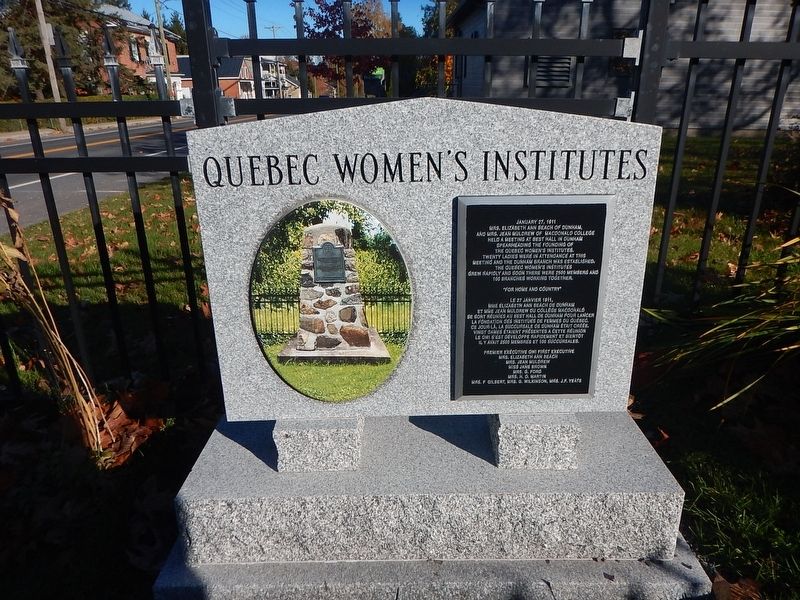
Quebec Women's Institutes
January 27, 1911
Photographed by Kevin Craft, October 20, 2026
1. Quebec Women's Institutes Marker
{English text}
and Mrs. Jean Muldrew of Macdonald College
held a meeting at Best Hall in Dunham
spearheading the founding of
the Quebec Women’s Institutes.
Twenty ladies were in attendance at this
meeting and the Dunham branch was established.
The Quebec Women’s Institutes
grew rapidly and soon there were 2500 members and
100 branches working together.
“For home and country”
{French text}
et Mme Jean Muldrew du collège Macdonald
se sont réunies au Best Hall de Dunham pour lancer
la fondation des Instituts de Femmes du Québec.
Ce jour-là, la succursale de Dunham était créée.
Vingt dames étaient présentes à cette réunion.
Le QWI s’est développé rapidement et bientôt
il y avait 2500 membres et 100 succursales.
Premier exécutive QWI First Executive
Mrs. Elizabeth Ann Beach
Mrs. Jean Muldrew
Miss Jane Brown
Mrs. G. Ford
Mrs. H. O. Martin
Mrs. F. Gilbert, Mrs. G. Wilkinson, Mrs. J.F. Yeats
Topics. This historical marker is listed in this topic list: Women. A significant historical date for this entry is January 27, 1911.
Location. 45° 7.93′ N, 72° 48.027′ W. Marker is in Dunham, Québec, in Brome-Missisquoi.
this page online

Regionally, this marker is in the Outaouais & Eastern Townships. It is also in Central Canada. Globally, it is in North America, the Western Hemisphere, and the Western World. Historically, it finds itself in what was once a British colony, the Viceroyalty of New France, the Haudenosaunee (Iroquois) Confederacy, and Rupert’s Land.
Other nearby markers. At least 8 other markers are within 16 kilometers of this marker, measured as the crow flies: First Women's Institute (a few steps from this marker); Adélard Godbout (approx. 9 kilometers away); The Pike River / La Rivière aux Brochets (approx. 9.1 kilometers away); Cornell Mill (approx. 9.1 kilometers away); a different marker also named Cornell Mill (approx. 9.1 kilometers away); In honour of Capt. Caleb Tree (approx. 9.3 kilometers away); Grange Alexander-Solomon-Walbridge (approx. 14.8 kilometers away); Sutton (approx. 14.8 kilometers
Photographed by Kevin Craft, October 20, 2026
2. Wideview of Quebec Women's Institutes Marker
More about this marker. Dedication of the Quebec Women’s Institutes Monument in Dunham, Submitted by Louise Smith (and stolen from Facebook)
On Saturday, May 25th, 2024, the skies were clear and the sun was shining. It was warm but not too hot. It was a perfect day for representatives from various Quebec Women’s Institutes across Quebec to come to the town of Dunham for the dedication of the monument honouring the establishment of the first branch of the Women’s Institutes in Quebec.
Elizabeth Ann Johnson was born in 1866 in Faddentown, not far from the villages of Clarenceville and Noyan. As a young woman she moved to Knowlton. There she met her future husband, George Mason Beach. They were married in 1888. Eventually they moved to the family farm in Dunham.
In 1911 Mrs. Beach invited several ladies to her home where they discussed forming the first Women’s Institute branch in Quebec. Elizabeth Ann Beach was a woman with a vision that inspired many women to look to the needs in the community outside of their homes.
The mayor of Dunham, Pierre Janecek, spoke at the dedication. He has been a staunch supporter of the value and history of the Quebec Women’s Institutes. Every November, when the Remembrance Day ceremony takes place at the monument, the mayor makes sure that the place is properly prepared, and he always attends or else he makes sure that someone from the town is at the ceremony.In his speech Mayor Janecek told how the first meeting of the Dunham branch was held across the street from the monument site in what was called Best Hall at that time. Now it is the Dunham Tourist Bureau.
He was happy to see the names of other charter members written permanently on the stones, each family representing early members of the village of Dunham. There is a separate stone recognizing that the land on which the monuments sit, was donated by Mary Stevens Selby. Selby Lake is named after the Selby family.
Pierre Janecek ended his speech thanking the Quebec Women’s Institutes for recognizing the legacy of the Dunham ladies, and for contributing to the history of the village.
Linda Janes, the President of the Quebec Women’s Institutes, also spoke. She gave more information on the first meeting. It was lead by Elizabeth Ann Beach with the help of Jean Muldrew of MacDonald College. The goal, in starting a W.I. branch, was to teach and inspire women, particularly those living in rural areas, with little or no access to information that was available in larger cities, how to learn through reading, writing, painting, art, languages, handicrafts, child care, nutrition, home economics, and teaching.
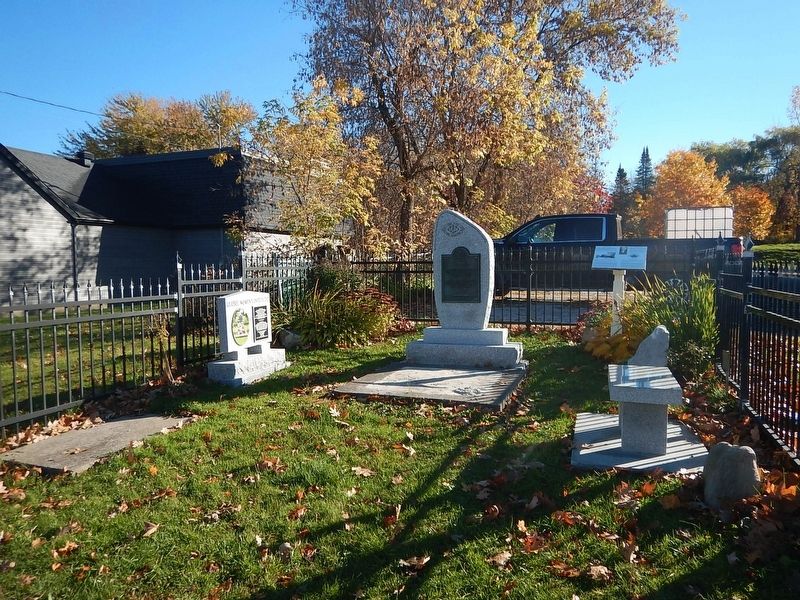
The land was dedicated in 1964 and initially a stone cairn was built on the site. Years went by and although repaired, the cement between the stones deteriorated to a point where it was not able to continue as a monument. A granite monument is now in place and two other monuments complete the site.
Credits. This page was last revised on October 27, 2026. It was originally submitted on October 27, 2026, by Kevin Craft of Bedford, Quebec. This page has been viewed 4 times since then. Photos: 1, 2. submitted on October 27, 2026, by Kevin Craft of Bedford, Quebec.
