Cheyenne in Laramie County, Wyoming — The American West (Mountains)
Sky Trail Sculpture/Today's Common Styles of Horseshoes
Photographed by William Fischer, Jr., September 28, 2026
1. Today's Common Styles of Horseshoes Marker
SKY TRAIL
Sculpture by RICK UPHAM
2002
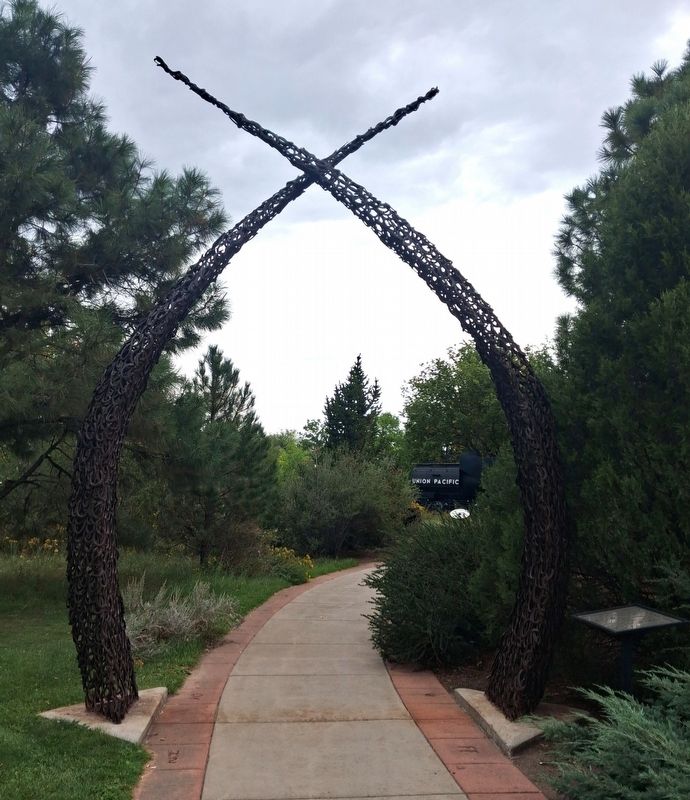
After collecting thousands of horseshoes for over five years, the Gardens selected metal artist Rick Upham to create this arbor. Assisting Upham was his son Adrian Upham
Upham said of the arch; "I wanted to create vanishing points into the sky reminiscent of long-horn cattle from the early cattle drives from Texas to Wyoming. I also wanted a smooth visual texture from the rough and rusted horseshoes Upham placed small metal whistles in the top of the sculpture, which in the right wind creates an eerie sound.
Rick Upham (along with his brother and fellow artist, Tim Upham) have created numerous public art projects across the United States.
————————————
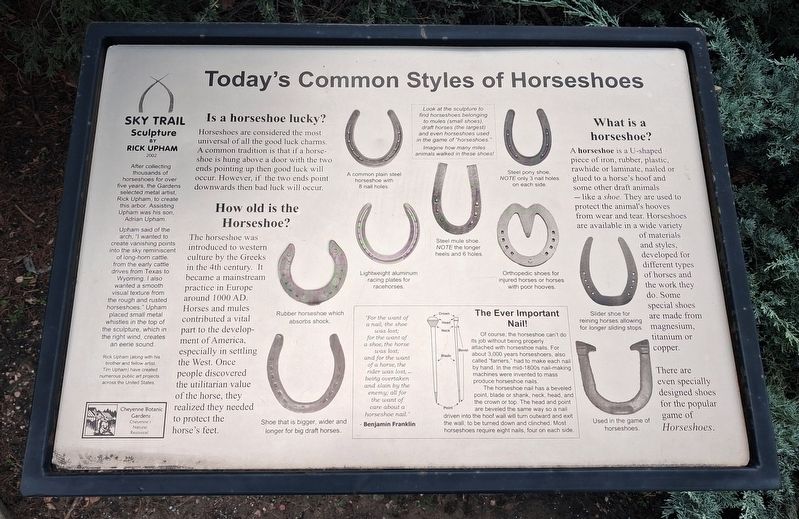
Today's Common Styles of Horseshoes
Is a horseshoe lucky?
Horseshoes are considered the most universal of all the good luck charms. A common tradition is that if a horseshoe is hung above a door with the two ends pointing up then good luck will occur. However, if the two ends point downwards then bad luck will occur.
How old is the Horseshoe?
The horseshoe was introduced to western culture by
this page online
What is a horseshoe?
A horseshoe is a U-shaped piece of iron, rubber, plastic, rawhide or laminate, nailed or glued to a horse's hoof and some other draft animals-like a shoe. They are used to protect the animal's hooves from wear and tear. Horseshoes are available in a wide variety of materials and styles, developed for different types of horses and the work they do. Some special shoes are made from magnesium, titanium or copper.
There are even specially designed shoes for the popular game of Horseshoes.
[Horseshoe variety photo captions, left to right, top to bottom]
• A common plain steel horseshoe with 8 nail holes.
• Steel pony shoe. NOTE only 3 nail holes on each side.
• Rubber horseshoe which absorbs shock.
• Lightweight aluminum racing plates for racehorses.
• Steel mule shoe. NOTE the
Photographed by William Fischer, Jr., September 28, 2026
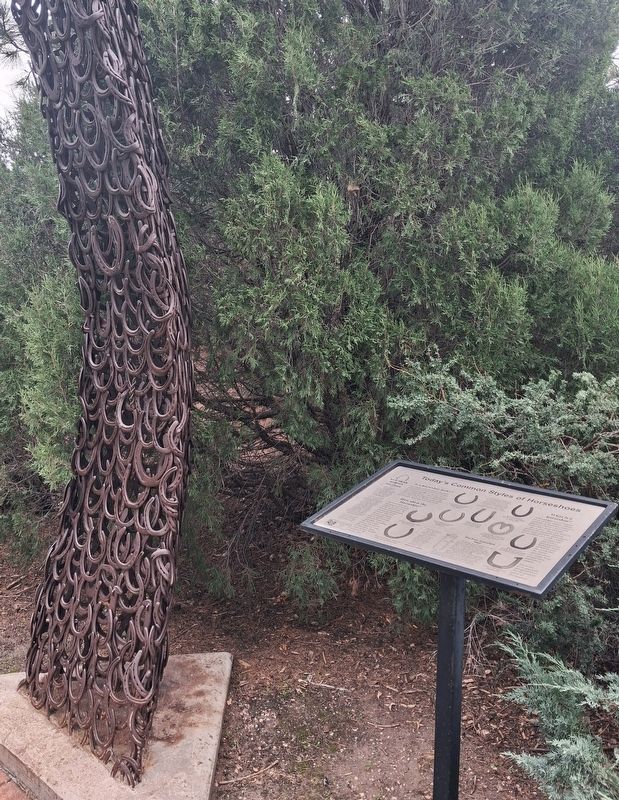
2. Sky Trail Sculpture (detail) and Today's Common Styles of Horseshoes Marker
• Orthopedic shoes for injured horses or horses with poor hooves.
• Slider shoe for reining horses allowing for longer sliding stops.
• Shoe that is bigger, wider and longer for big draft horses.
• Used in the game of horseshoes.
"For the want of a nail, the shoe was lost; for the want of a shoe, the horse was lost; and for the want of a horse, the rider was lost, being overtaken and slain by the enemy all for the want of care about a horseshoe nail."
- Benjamin Franklin
The Ever Important Nail!
Of course, the horseshoe can't do job without being properly attached with horseshoe nails. For about 3,000 years horseshoers, also called "farriers," had to make each nail by hand. In the mid-1800s nail-making machines were invented to mass produce horseshoe nails.
The horseshoe nail has a beveled point, blade or shank, neck, head, and the crown or top. The head and point are beveled the same way so a nail driven into the hoof wall will turn outward and exit the wall, to be turned down and clinched. Most horseshoes require eight nails, four on each side.
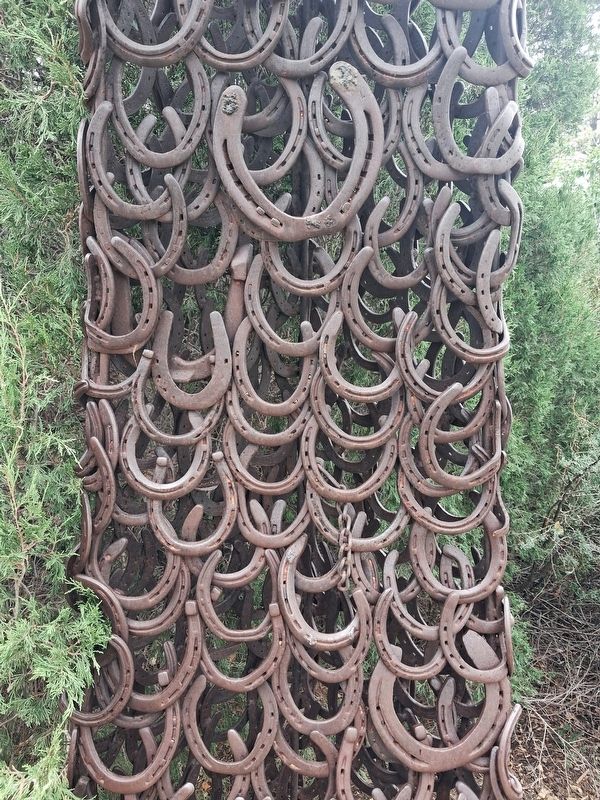
Look at the sculpture to find horseshoes belonging to mules (small shoes), draft horses (the largest) and even horseshoes used in the game of "horseshoes."
Erected by Cheyenne
Photographed by William Fischer, Jr., September 28, 2026
3. Sky Trail Sculpture and Today's Common Styles of Horseshoes Marker
Topics. This historical marker is listed in these topic lists: Agriculture • Animals • Arts, Letters, Music • Settlements & Settlers. A significant historical year for this entry is 2002.
Location. 41° 9.479′ N, 104° 49.973′ W. Marker is in Cheyenne, Wyoming, in Laramie County. It can be reached from no nearby street. Marker is in the Cheyenne Botanic Gardens. Touch for map. Marker is at or near this postal address: 4603 Lions Park Drive, Cheyenne WY 82001, United States of America. Touch for directions.

Regionally, this marker is in the Laramie Basin. It is also in the American Mountain West, on the Great Plains, and specifically on the High Plains. Globally, it is in North America, the Western Hemisphere, the Western World, and the Anglosphere. Historically, it finds itself in what was once the Louisiana Purchase.
Other nearby markers. At least 8 other markers are within walking distance of this marker: Horsetail Joint Fir (a few steps from this marker); 1700s Cheyenne Area Garden (within shouting distance of this marker); Floyd and Edna Young Folk Art Fence (within shouting distance of this
Photographed by William Fischer, Jr., September 28, 2026
4. Sky Trail Sculpture Detail
Credits. This page was last revised on October 31, 2026. It was originally submitted on October 30, 2026, by William Fischer, Jr. of Reynoldsburg, Ohio. This page has been viewed 11 times since then. Photos: 1, 2, 3, 4. submitted on October 30, 2026, by William Fischer, Jr. of Reynoldsburg, Ohio.
