Cheyenne in Laramie County, Wyoming — The American West (Mountains)
1929 Farmall "Regular Series" Tractor
Rotary Century Plaza
Photographed by William Fischer, Jr., September 28, 2026
1. 1929 Farmall "Regular Series" Tractor Marker
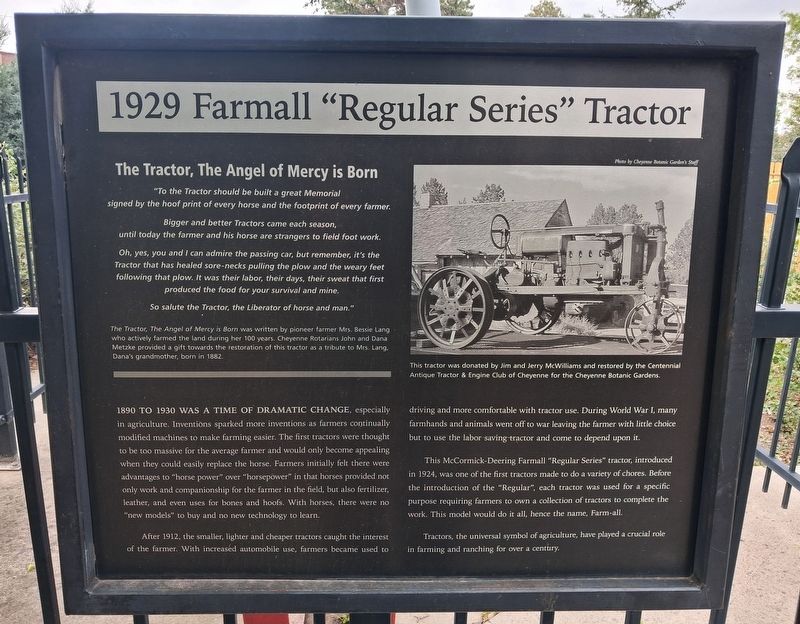
The Tractor, The Angel of Mercy is Born
"To the Tractor should be built a great Memorial signed by the hoof print of every horse and the footprint of every farmer.
Bigger and better Tractors came each season, until today the farmer and his horse are strangers to field foot work.
Oh, yes, you and I can admire the passing car, but remember, it's the Tractor that has healed sore-necks pulling the plow and the weary feet following that plow. It was their labor, their days, their sweat that first produced the food for your survival and mine.
So salute the Tractor, the Liberator of horse and man."
The Tractor, The Angel of Mercy is Born was written by pioneer farmer Mrs. Bessie Lang who actively farmed the land during her 100 years. Cheyenne Rotarians John and Dana Metzke provided a gift towards the restoration of this tractor as a tribute to Mrs. Lang, Dana's grandmother, born in 1882.
[Photo caption reads]
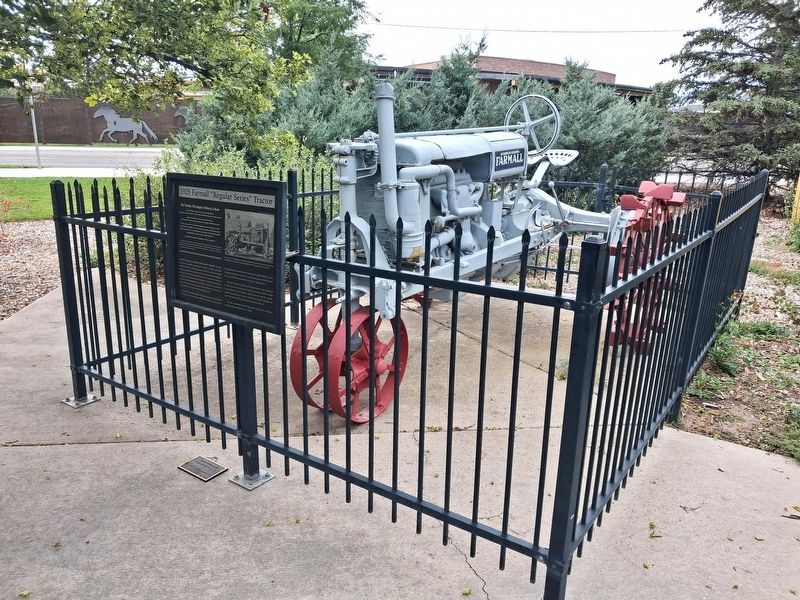
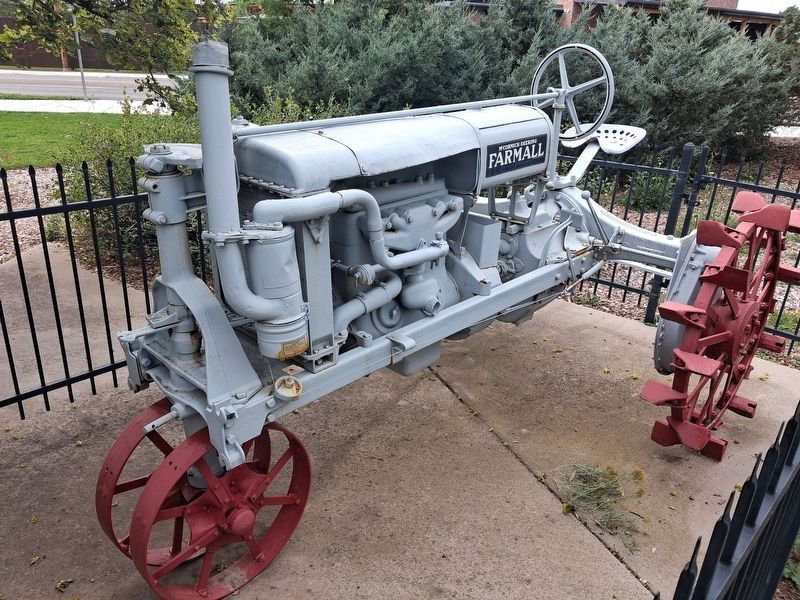
This tractor was donated by Jim and Jerry McWilliams and restored by the Centennial Antique Tractor & Engine Club of Cheyenne for the Cheyenne Botanic Gardens.
———————————————
1890 TO 1930 WAS A TIME OF DRAMATIC CHANGE,
this page online
After 1912, the smaller, lighter and cheaper tractors caught the interest of the farmer. With increased automobile use, farmers became used to driving and more comfortable with tractor use. During World War I, many farmhands and animals went off to war leaving the farmer with little choice but to use the labor saving tractor and come to depend upon it.
This McCormick-Deering Farmall "Regular Series" tractor, introduced in 1924, was one of the first tractors made to do a variety of chores. Before the introduction of the "Regular", each tractor was
Photographed by William Fischer, Jr., September 28, 2026
2. 1929 Farmall "Regular Series" Tractor and Marker
Tractors, the universal symbol of agriculture, have played a crucial role in farming and ranching for over a century.
Erected by Cheyenne Botanic Gardens and Concerned Citizens and Organizations.
Topics. This historical marker is listed in these topic lists: Agriculture • Animals • Industry & Commerce • Settlements & Settlers. A significant historical year for this entry is 1929.
Location. 41° 9.445′ N, 104° 49.949′ W. Marker is in Cheyenne, Wyoming, in Laramie County. It can be reached from Carey Avenue, on the right when traveling north. Marker and tractor are in the Rotary 1900s Century Plaza in the Cheyenne Botanic Gardens. Touch for map. Marker is at or near this postal address: 4603 Lions Park Drive, Cheyenne WY 82001, United States of America. Touch for directions.

Regionally, this marker is in the Laramie Basin. It is also in the American Mountain West, on the Great Plains, and specifically on the High Plains. Globally, it is in North America, the
Photographed by William Fischer, Jr., September 28, 2026
3. 1929 Farmall "Regular Series" Tractor
Other nearby markers. At least 8 other markers are within walking distance of this marker: Shelterbelts (here, next to this marker); 1800s Cheyenne Area Garden (a few steps from this marker); Gene Howard (a few steps from this marker); 1900s Cheyenne Area Garden (a few steps from this marker); Union Pacific Steam Engine #1242 (within shouting distance of this marker); Rotary Century Plaza (within shouting distance of this marker); Floyd and Edna Young Folk Art Fence (within shouting distance of this marker); 1700s Cheyenne Area Garden (within shouting distance of this marker). Touch for a list and map of all markers in Cheyenne.
Credits. This page was last revised on November 1, 2026. It was originally submitted on November 1, 2026, by William Fischer, Jr. of Reynoldsburg, Ohio. This page has been viewed 8 times since then. Photos: 1, 2, 3. submitted on November 1, 2026, by William Fischer, Jr. of Reynoldsburg, Ohio.
