Winterville in Athens-Clarke County, Georgia — The American South (South Atlantic)
What is Botanical Medicine?
Photographed by Darren Jefferson Clay, September 19, 2026
1. What is Botanical Medicine? Marker
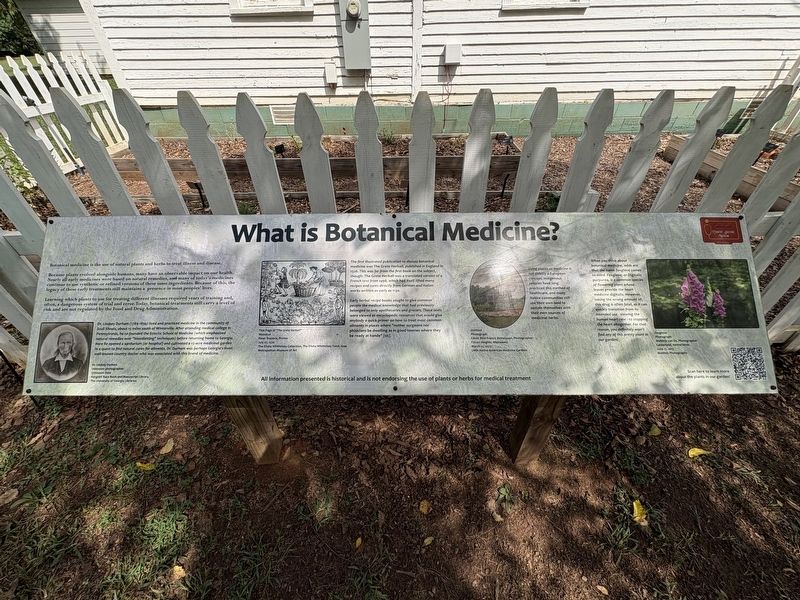
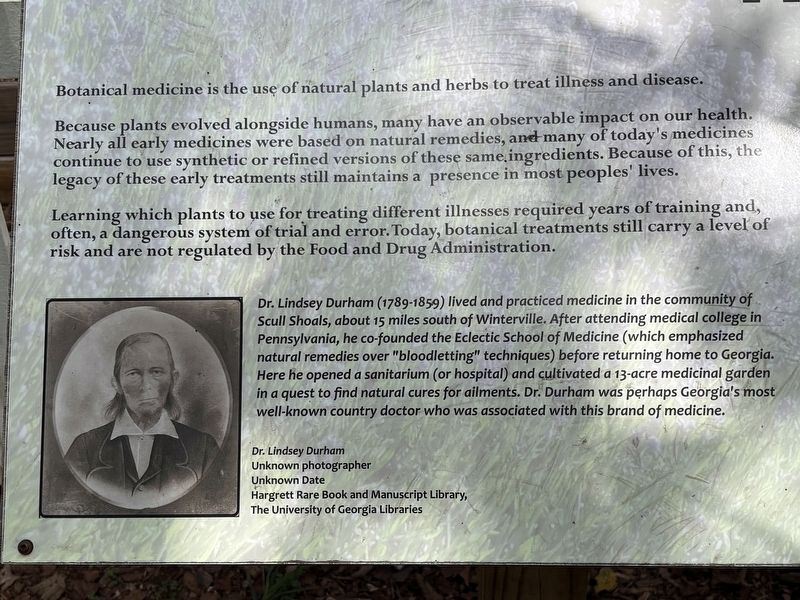
 Botanical medicine is the use of natural plants and herbs to treat illness and disease.
Because plants evolved alongside humans, many have an observable impact on our health. Nearly all early medicines were based on remedies, and many of today's medicines continue to use synthetic or refined versions of these same ingredients. Because of this, the legacy of these early treatments still maintains a presence in most peoples' lives.
Learning which plants to use for treating different illnesses required years of training and, often, a dangerous system of trial and error. Today, botanical treatments still carry a level of risk and are not regulated by the Food and Drug Administration.
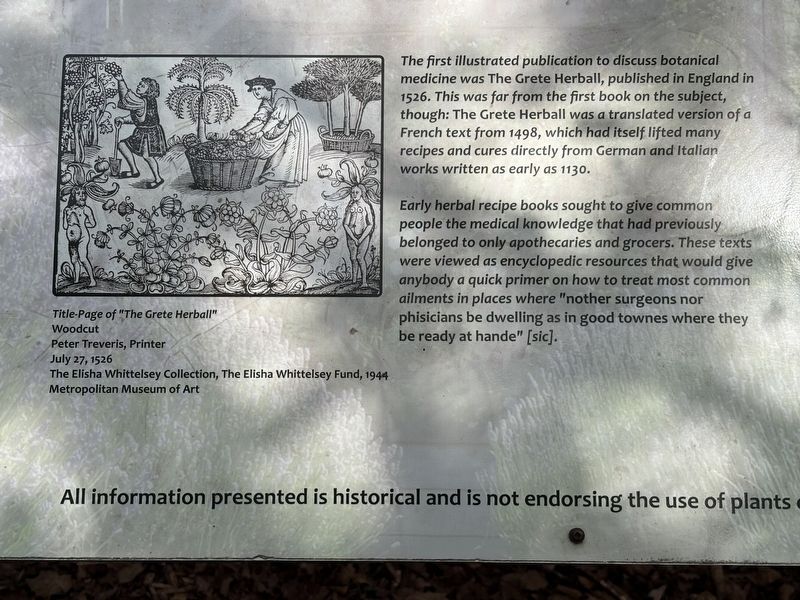
The first illustrated publication to discuss botanical medicine was The Grete Herball, published in England in 1526. This was far from the first book on the subject, though: The Grete Herball was a translated version of a French text from 1498, which had itself lifted many recipes and cures directly from German and Italian works written as early as 1130.
Early herbal recipe books sought to give common people the medical knowledge
this page online
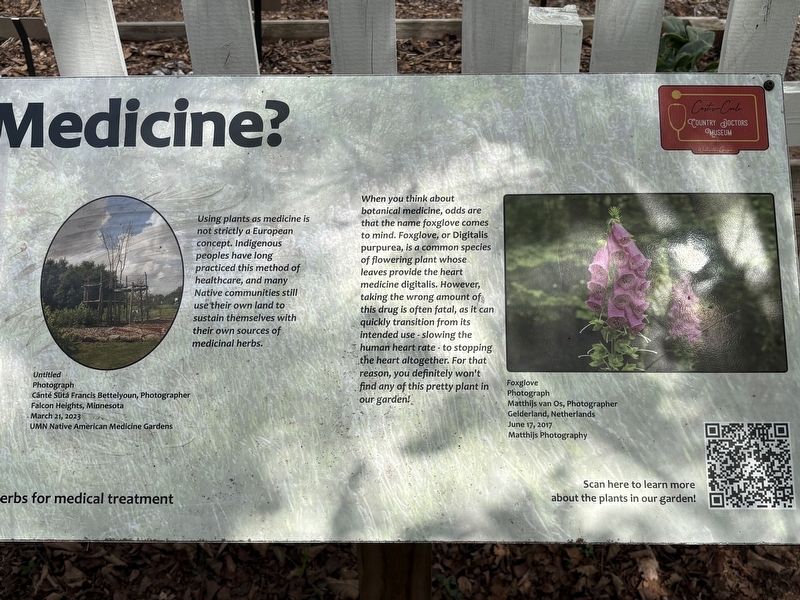
Using plants as medicine is not strictly a European concept. Indigenous peoples have long practiced this method of healthcare, and many Native communities still use their own land to sustain themselves with their own sources of medicinal herbs.
When you think about botanical medicine, odds are that the name foxglove comes to mind. Foxglove, or Digitalis purpurea, is a common species of flowering plant whose leaves provide the heart medicine digitalis. However, taking the wrong amount of this drug is often fatal, as it can quickly transition from its intended use - slowing the human heart rate - to stopping the heart altogether. For that reason, you definitely won't find any of this pretty plant in our garden.
Photo captions:
Dr. Lindsey Durham (1789 - 1858) lived and practiced medicine in the community of Scull Shoals,
Photographed by Darren Jefferson Clay, September 19, 2026
2. What is Botanical Medicine? Marker
Dr. Lindsey Durham, Unknown photographer, Unknown Date, Hargrett Rare Book and Manuscript Library. The University of Georgia Libraries
Title Page of "The Grete Herball", Woodcut, Peter Treveris, Printer, July 27, 1526, The Elisha Whittelsey Collection, The Elisha Whittelsey Fund, 1944. Metropolitan Museum of Art
Untitled Photograph, Cante Suta Francis Bettelyoun, Photographer; Falcon Heights, Minnesota, March 21, 2023. UMN Native American Medicine Gardens
Floxglove Photograph: Matthijs van Os, Photographer; Gelderland, Netherlands, June 7, 2017. Matthijs Photography
Topics. This historical marker is listed in these topic lists: Horticulture & Forestry
Photographed by Darren Jefferson Clay, September 19, 2026
3. What is Botanical Medicine? Marker
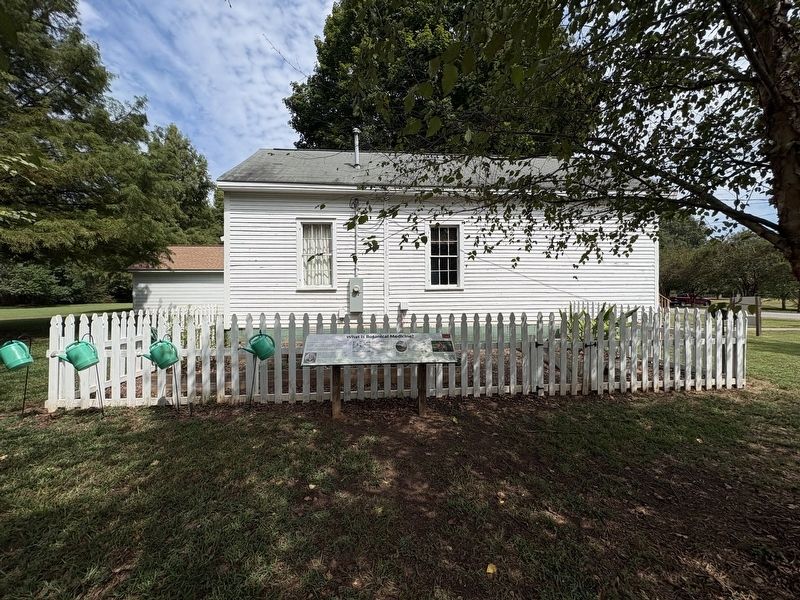
Location. 33° 58.062′ N, 83° 16.829′ W. Marker is in Winterville, Georgia, in Athens-Clarke County. It is on Marigold Lane, on the left when traveling north. On the grounds of the Carter-Coile Country Doctors Museum. Touch for map. Marker is at or near this postal address: 111 Marigold Lane, Winterville GA 30683, United States of America. Touch for directions.

Regionally, this marker is in the Classic City Area and in the Piedmont. It is also in the American South and specifically in the Deep South. Globally, it is in North America, the Western Hemisphere, the Western World, and the Anglosphere. Historically, it finds itself in what was once the territory of the Mississippian Culture, one of the original Thirteen Colonies, one of the Confederate States of America, and the Antebellum South.
Other nearby markers. At least 8 other markers are within 5 miles of this marker, measured as the crow flies: Pittard Park (about 600 feet away, measured in a direct line); Ben T. Epps (approx. 2.7 miles away); Gospel Pilgrim Cemetery (approx. 4.7 miles away);
Photographed by Darren Jefferson Clay, September 19, 2026
4. What is Botanical Medicine? Marker
Photographed by Darren Jefferson Clay, September 19, 2026
5. What is Botanical Medicine? Marker
Credits. This page was last revised on November 24, 2026. It was originally submitted on November 1, 2026, by Darren Jefferson Clay of Duluth, Georgia. This page has been viewed 11 times since then. Photos: 1, 2, 3, 4, 5. submitted on November 7, 2026, by Darren Jefferson Clay of Duluth, Georgia. • Andrew Ruppenstein was the editor who published this page.