Dahlgren in King George County, Virginia — The American South (Mid-Atlantic)
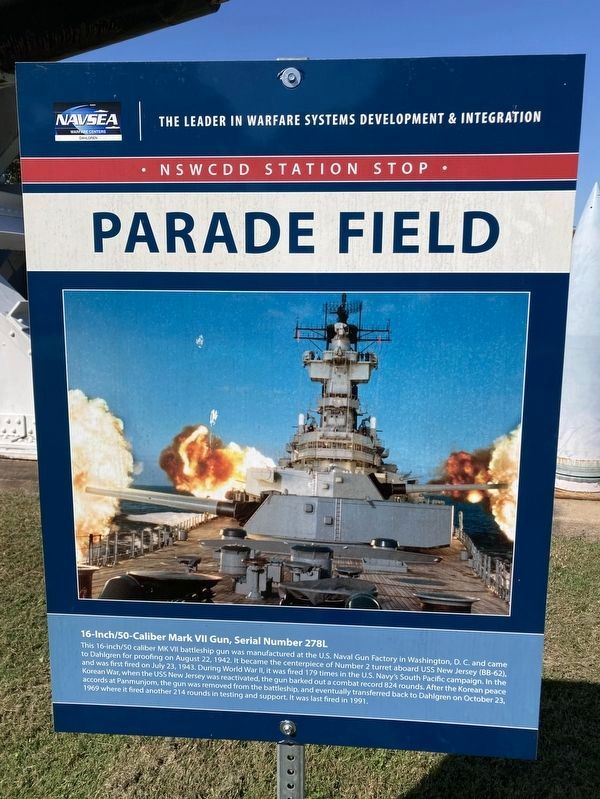
Parade Field
NSWCDD Station Stop
Photographed by Evan Dwyer, October 13, 2023
1. Parade Field Marker
Photographed with permission under the escort of Dahlgren Public Affairs Office personnel.
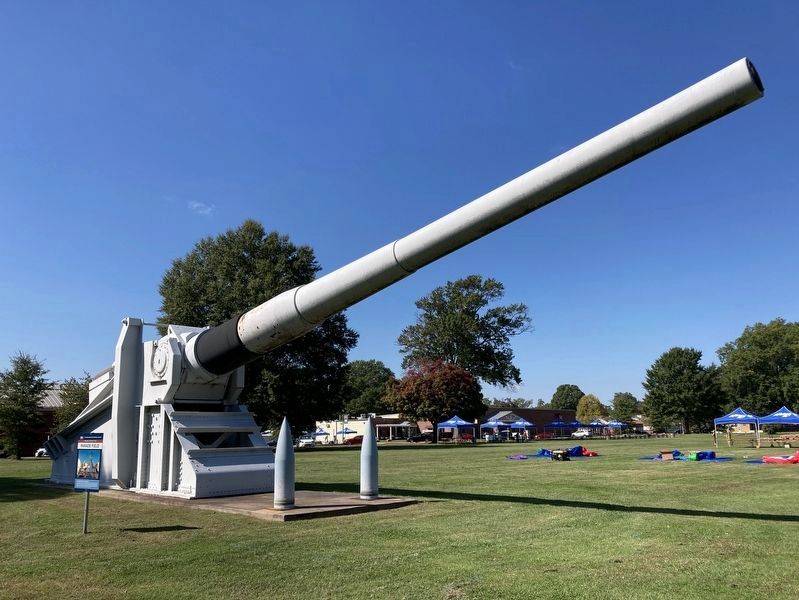
16-Inch/50-Caliber Mark VII Gun, Serial Number 278L
This 16-inch/50 caliber MK VII battleship gun was manufactured at the U.S. Naval Gun Factory in Washington, D.C. and came to Dahlgren for proofing on August 22, 1942. It became the centerpiece of Number 2 turret aboard USS New Jersey (BB-62), and was first fired on July 23, 1943. During World War II, it was fired 179 times in the U.S. Navy's South Pacific campaign. In the Korean War, when the USS New Jersey was reactivated, the gun barked out a combat record 824 rounds. After the Korean peace accords at Panmunjom, the gun was removed from the battleship, and eventually transferred back to Dahlgren on October 23, 1969 where it fired another 214 rounds in testing and support. It was last fired in 1991.
Erected by NAVSEA Warfare Centers Dahlgren.
Topics. This historical marker is listed in these topic lists: War, Korean • War, World II • Waterways & Vessels. A significant historical date for this entry is July 23, 1943.
Location. 38° 19.584′ N, 77° 2.308′ W. Marker is in Dahlgren, Virginia, in King George County. It is at the intersection of Welsh Road and Jenkins
this page online

Regionally, this marker is in the American South, specifically in the Upper South, in the Mid-Atlantic, in the Tidewater, in the Chesapeake Bay Region, and on the Eastern Seaboard. Globally, it is in the North Atlantic Region, North America, the Western Hemisphere, the Western World, and the Anglosphere. Historically, it finds itself in what was once the territory of the Mississippian Culture, one of the original Thirteen Colonies, one of the Confederate States of America, and the Antebellum South.
Other nearby markers. At least 8 other markers are within 6 miles of this marker, measured as the crow flies: Serial Number 278L (a few steps from this marker); Historic Guns (approx. half a mile away); Dahlgren's Naval Ordnance Testing (approx. half a mile away); 19 Inch Armor Plate (approx. half a mile away); Civil War Action At Mathias Point (approx. 2½ miles away); Mathias Point
Photographed by Evan Dwyer, October 13, 2023
2. Parade Field Marker
And the star of the show, the Mark VII gun from USS New Jersey, looming over it on a testing mount. The two projectiles in front of the gun mount are one of the types the gun could fire.
Photographed with permission under the escort of Dahlgren Public Affairs Office personnel.
Photographed with permission under the escort of Dahlgren Public Affairs Office personnel.
Another marker is no longer nearby. "Cliffton" (was approx. 4.4 miles away in Maryland but has been confirmed missing).
More about this marker. Marker is within a US Navy installation and restricted to individuals with base access or escorted by a credentialed individual. Photography is not permitted on base without escort and/or approval from the Dahlgren Public Affairs Office.
Photographed by Evan Dwyer, October 1, 2017
3. Battleship New Jersey
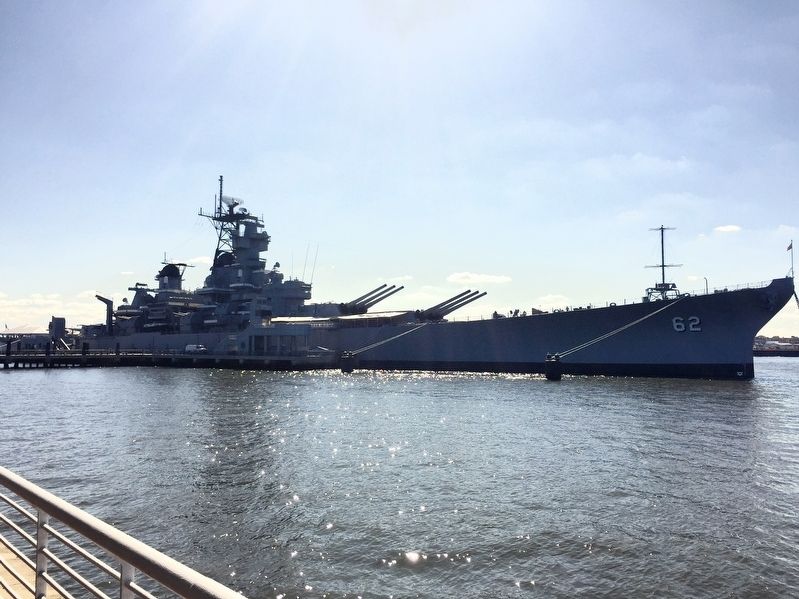
Moored at her museum berthing in Camden, New Jersey. The reader may notice that Turret 2 (second from the bow) has all three of its guns - the turrets were designed so that guns could be swapped out as the rifled liner within each barrel wore out. Another gun tube would be inserted in place of the worn out weapon and used until it was also worn out. Each shot fired through a rifle, especially of this size, removed a small amount of material from the rifling within the barrel as a result of the friction, gasses, and explosive energies produced by the shell hurtling through the tube with propellant forcing it forward (this usually included expanding a ring around the base of the projectile that would engage the rifling rings and impart spin on the projectile - for long range accuracy, like a football - while also forming a seal to ensure the pressure of gasses behind the projectile remained contained for maximum velocity). Eventually the rifling would be worn down enough that gasses would leak, velocity would decrease, and spin would be less stable - decreasing accuracy of the shot. Each shot was tracked by personnel within the gun turret, for each barrel, even in practice and training shooting. Once a gun was worn out and removed from the turret, a manufacturing facility - such as the gun factory at Washington Navy Yard - could remove the rifling and replace it, since the rifling was designed as an insertable liner rather than molded into the gun barrel's interior wall.
Credits. This page was last revised on November 1, 2026. It was originally submitted on November 1, 2026, by Evan Dwyer of Richmond, Virginia. This page has been viewed 8 times since then. Photos: 1, 2, 3. submitted on November 1, 2026, by Evan Dwyer of Richmond, Virginia.
