Dahlgren in King George County, Virginia — The American South (Mid-Atlantic)
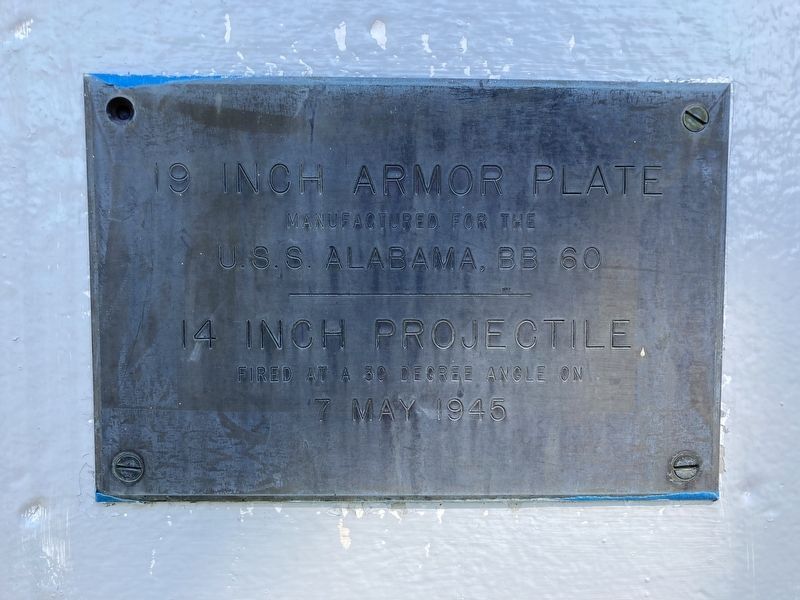
19 Inch Armor Plate
Photographed by Evan Dwyer, October 13, 2023
1. 19 Inch Armor Plate Marker
Photographed with permission under the escort of Dahlgren Public Affairs Office personnel.
Manufactured for the
U.S.S. Alabama, BB 60
-
14 Inch Projectile
Fired at a 50 Degree Angle on
7 May 1945
Topics. This historical marker is listed in these topic lists: War, World II • Waterways & Vessels. A significant historical date for this entry is May 7, 1945.
Location. 38° 19.853′ N, 77° 2.762′ W. Marker is in Dahlgren, Virginia, in King George County. It is at the intersection of Dahlgren Road and Hall Road, on the left when traveling east on Dahlgren Road. Touch for map. Marker is in this post office area: Dahlgren VA 22448, United States of America. Touch for directions.

Regionally, this marker is in the American South, specifically in the Upper South, in the Mid-Atlantic, in the Tidewater, in the Chesapeake Bay Region, and on the Eastern Seaboard. Globally, it is in the North Atlantic Region, North America, the Western Hemisphere, the Western World, and the Anglosphere. Historically, it finds itself in what was once the territory of the Mississippian Culture, one of the original Thirteen Colonies, one of the Confederate States of America, and the Antebellum South.
Other nearby markers. At least
this page online
Another marker is no longer nearby. "Cliffton" (was approx. 4½ miles away in Maryland but has been confirmed missing).
More about this marker. Marker is within a US Navy installation and restricted to individuals with base access or escorted by a credentialed individual. Photography is not permitted on base without escort and/or approval from the Dahlgren Public Affairs Office.
Additional commentary.
1. Testing & Effect Description
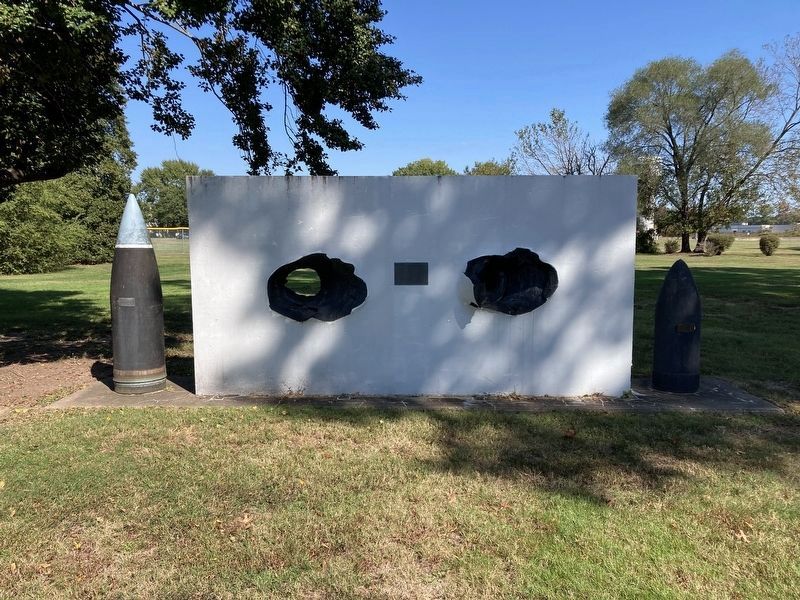
From Peter DeForest of World War Pictures - This is a 19” (Probably 18 1/2”) thick Class B Armor plate after being shot by two 14" Mk 16 MOD 8 1500 lb. Armor-Piercing Capped (APC) shells at
Photographed by Evan Dwyer, October 13, 2023
2. 19 Inch Armor Plate Marker
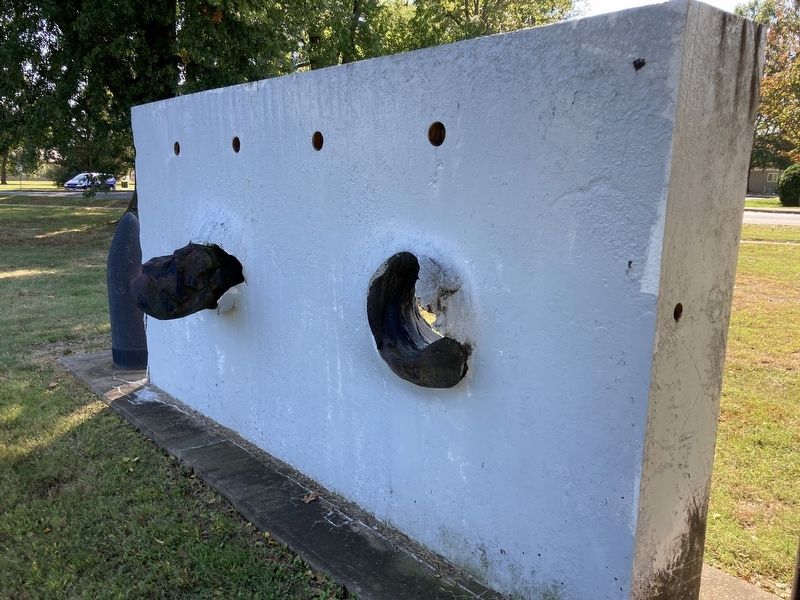
And the armor plate it is mounted on. There is a 14-inch projectile still stuck in the hole in the right. The projectile that passed through the left hole achieved a complete penetration. Intact, unfired projectiles flank the armor plating. On the left is an experimental 18-inch projectile designed in 1921 for a weapon that was never put into service. On the right is an armor-piercing 16-inch Mark 3 projectile, designed slightly earlier for the 16"/45-caliber Marks I, II, and III - the guns used to initially equip the Colorado-class battleships at the end of the 1910s, as well as the never-completed Lexington-class battlecruisers.
Photographed with permission under the escort of Dahlgren Public Affairs Office personnel.
Photographed with permission under the escort of Dahlgren Public Affairs Office personnel.
These 14” shells were fired from a 14”/45-caliber naval gun with powder charges reduced to create an impact velocity of around 2000 feet per second. Reducing velocity was a method used for evaluating performance against other projectiles - by equalizing velocity, projectile performance could be measured on the merits of the projectile design alone.
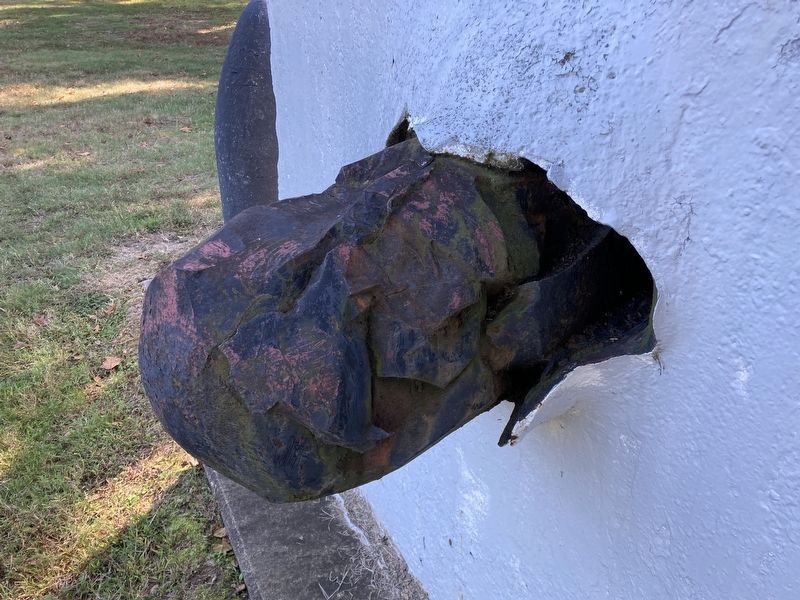
Dahlgren shell testing reports often mention shells with “Chewed Up Noses” and that is definitely the case here, although the shell remains in burstable condition (i.e., though the projectile was deformed by impacting and penetrating the steel armor, it was not impaired enough to prevent it from detonating within the target - this survivability was an element of the projectile's design). Note that the base plug of the stuck projectile has been removed to ensure it had no explosive charge for display.
Photographed by Evan Dwyer, October 13, 2023
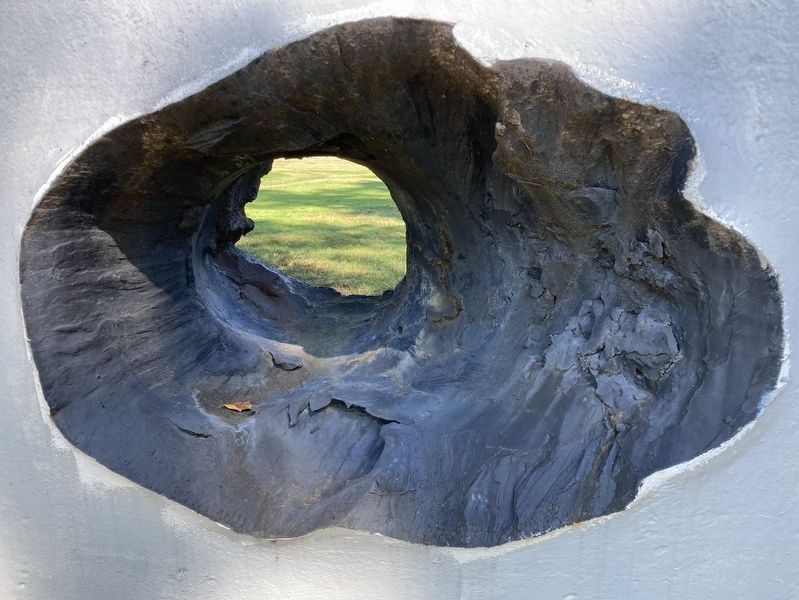
3. 19 Inch Armor Plate
Close-up of penetration showing how the steel deformed as the projectile passed through.
— Submitted November 1, 2026, by Evan Dwyer of Richmond, Virginia.
Photographed by Evan Dwyer, October 13, 2023
4. 19 Inch Armor Plate
Back of the armor plate, showing the state of the projectile that is still stuck in it.
Photographed with permission under the escort of Dahlgren Public Affairs Office personnel.
Photographed with permission under the escort of Dahlgren Public Affairs Office personnel.
Photographed by Evan Dwyer, October 13, 2023
5. Deformed 14-inch Projectile
Close-up of how the projectile looks after punching through the armor.
Photographed by Evan Dwyer, August 21, 2022
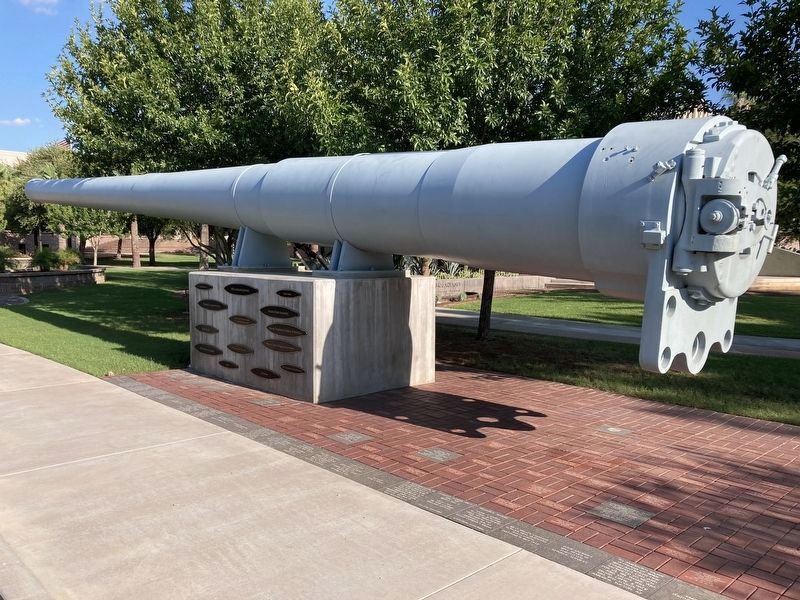
6. 14-Inch Naval Rifle
The projectiles fired into the test plate were from a rifle like this (displayed in Phoenix, Arizona - not Dahlgren, Virginia). This particular 14"/45-caliber gun tube was in use aboard USS Nevada (BB-36) during the majority of World War II. Pre-war it was on USS Arizona (BB-39) but was removed for re-lining prior to the attack on Pearl Harbor and was installed on Nevada afterwards.
Photographed by Evan Dwyer, November 9, 2018
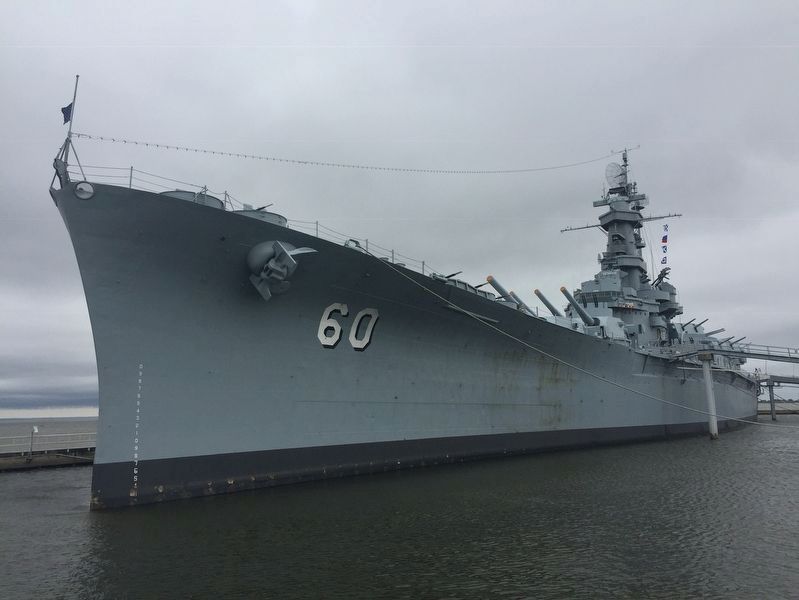
7. Battleship Alabama
At her museum berth in Mobile, Alabama. The armor used for the tests was manufactured for Alabama and was either rejected or a spare plate in case battle repairs were needed. It was not removed from the ship itself.
Credits. This page was last revised on November 1, 2026. It was originally submitted on November 1, 2026, by Evan Dwyer of Richmond, Virginia. This page has been viewed 7 times since then. Photos: 1, 2, 3, 4, 5, 6, 7. submitted on November 1, 2026, by Evan Dwyer of Richmond, Virginia.
