Liverpool in Onondaga County, New York — The American Northeast (Mid-Atlantic)
Liverpool Cemetery
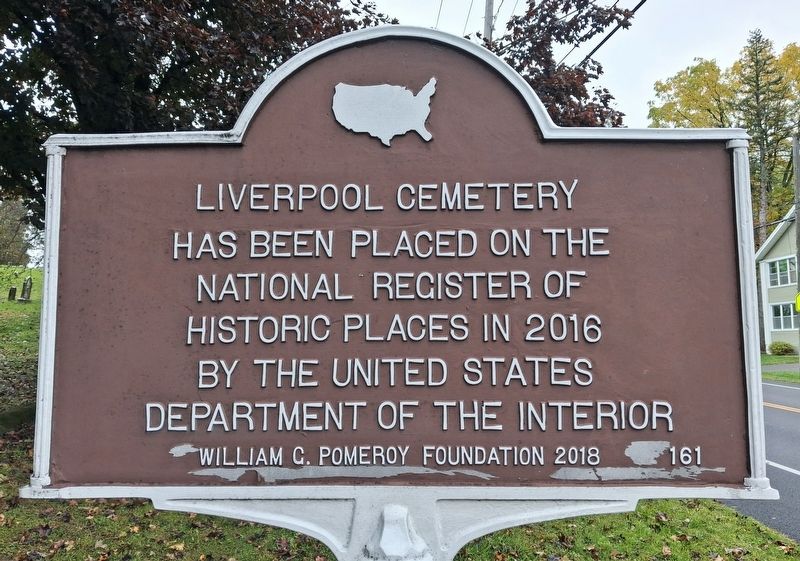
Photographed by William Fischer, Jr., October 12, 2026
1. Liverpool Cemetery Marker
has been placed on the
National Register of
Historic Places in 2016
by the United States
Department of the Interior
Erected 2018 by William G. Pomeroy Foundation. (Marker Number 161.)
Topics and series. This historical marker is listed in these topic lists: Cemeteries & Burial Sites • Settlements & Settlers. In addition, it is included in the William G. Pomeroy Foundation series list. A significant historical year for this entry is 2016.
Location. 43° 6.515′ N, 76° 12.387′ W. Marker is in Liverpool, New York, in Onondaga County. It is at the intersection of Tulip Street and 5th Street, on the left when traveling north on Tulip Street. Touch for map. Marker is at or near this postal address: 225 6th Street, Liverpool NY 13088, United States of America. Touch for directions.

Regionally, this marker is in Upstate New York, specifically in Central New York, and in the Syracuse Metropolitan Area. It is also in the American Northeast and in the Mid-Atlantic. Globally, it is in North America, on the Great Lakes, in the Western Hemisphere, in the Western World, and in the Anglosphere. Historically,
this page online
Other nearby markers. At least 8 other markers are within walking distance of this marker: Herbert W. Crawford (here, next to this marker); John A. Schmidt (a few steps from this marker); Eric Skjlbred (within shouting distance of this marker); Alexander J. Klunder (within shouting distance of this marker); Joseph A. Selinsky (within shouting distance of this marker); Harry G. Whitman (within shouting distance of this marker); Unknown Graves of Civil War Soldiers (about 300 feet away, measured in a direct line); Samuel Blackman (about 300 feet away). Touch for a list and map of all markers in Liverpool.
Regarding Liverpool Cemetery. National Register Statement of Significance excerpt:
Established in 1846, the cemetery documents the village’s desire to offer a dedicated burial location for its residents as it began to develop into a more populous community in the mid-nineteenth century. Graves were moved from the village’s earlier 1806 burial ground into the new site, now located at a more remote
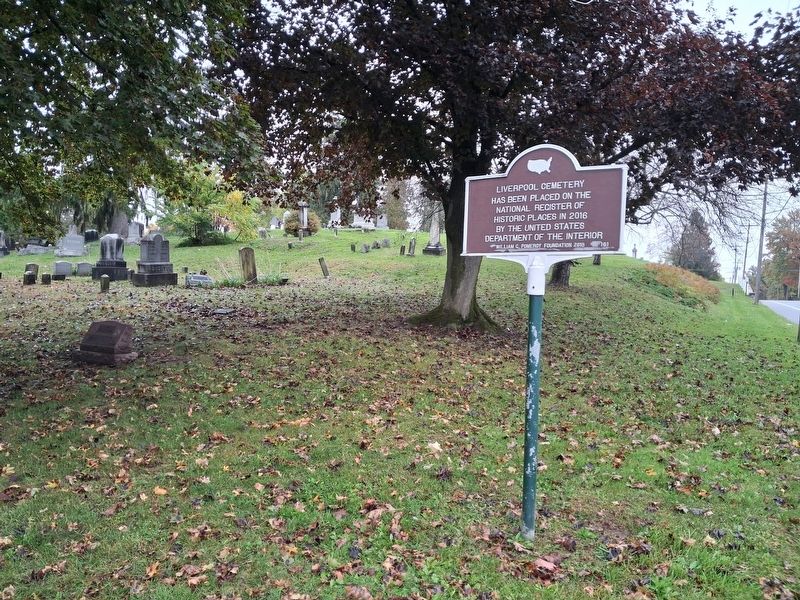
Photographed by William Fischer, Jr., October 12, 2026
2. Liverpool Cemetery and Marker
Also see . . . Liverpool NY Cemetery National Register Registration Form. (Submitted on November 3, 2026, by William Fischer, Jr. of Reynoldsburg, Ohio.)
Credits. This page was last revised on November 3, 2026. It was originally submitted on November 3, 2026, by William Fischer, Jr. of Reynoldsburg, Ohio. This page has been viewed 9 times since then. Photos: 1, 2. submitted on November 3, 2026, by William Fischer, Jr. of Reynoldsburg, Ohio.
