Echternach, Echternach, Luxembourg — Western Europe
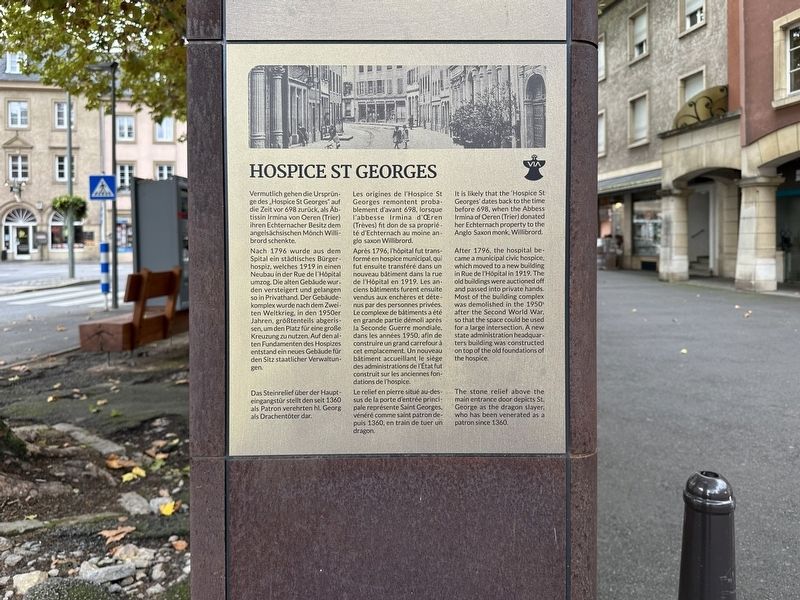
Hospice St Georges
Photographed by Andrew Ruppenstein, October 21, 2026
1. Hospice St Georges Marker

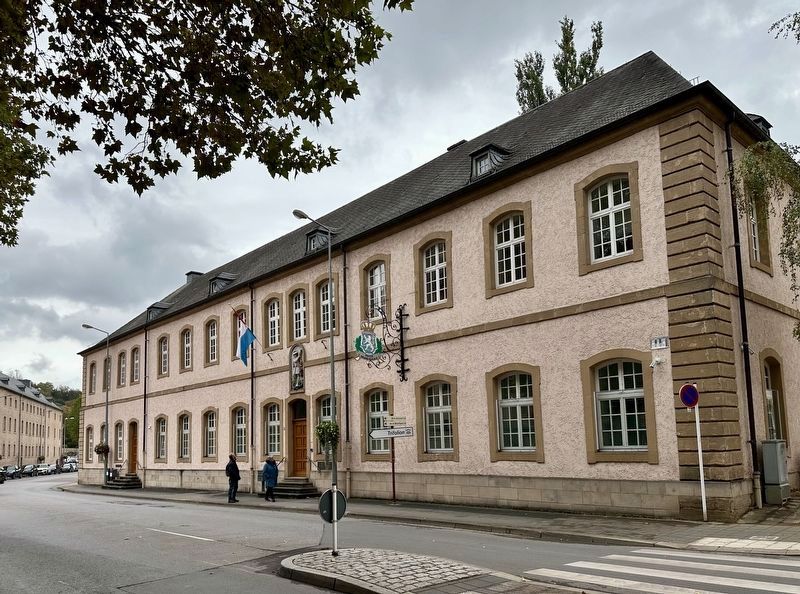
Vermutlich gehen die Ursprünge des „Hospice St. Georges“ auf die Zeit vor 698 zurück, als Äbtissin Irmina von Oeren (Trier) ihren Echternacher Besitz dem angelsächsischen Mönch Willibrord schenkte. Nach 1796 wurde aus dem Spital ein städtisches Bürgerhospiz, welches 1919 in einen Neubau in der Rue de l'Hôpital umzog. Die alten Gebäude wurden versteigert und gelangen so in Privathand. Der Gebäudekomplex wurde nach dem Zweiten Weltkrieg, in den 1950er Jahren, größtenteils abgerissen, um den Platz für eine große Kreuzung zu nutzen. Auf den alten Fundamenten des Hospizes entstand ein neues Gebäude für den Sitz staatlicher Verwaltungen.
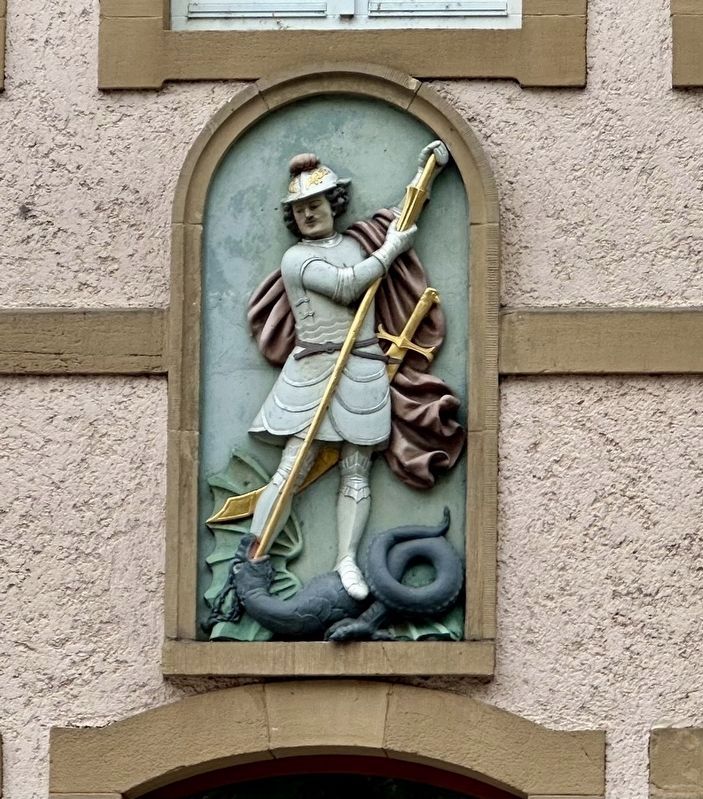
Das Steinrelief über der Haupteingangstür stellt den seit 1360 als Patron verehrten hl. Georg als Drachentöter dar.
Les origines de l'Hospice St Georges remontent probablement d'avant 698, lorsque l'abbesse Irmina d'Eren (Trèves) fit don de sa propriété d'Echternach au moine anglo saxon Willibrord. Après 1796, l'hôpital fut transformé en hospice municipal, qui fut ensuite transféré dans un nouveau bâtiment dans la rue de l'Hôpital en 1919. Les
this page online
Le relief en pierre situé au-dessus de la porte d'entrée principale représente Saint Georges, vénéré comme saint patron depuis 1360, en train de tuer un dragon.
It is likely that the 'Hospice St Georges' dates back to the time before 698, when the Abbess of Oeren (Trier) donated her Echternach property to the Anglo Saxon monk, Willibrord. After 1796, the hospital became a municipal civic hospice, which moved to a new building in Rue de l'Hôpital in 1919. The old buildings were auctioned off and passed into private hands. Most of the building complex was demolished in the 1950 after the Second World War, so that the space could be used for a large intersection. A new state administration headquarters building was constructed on
Photographed by Andrew Ruppenstein, October 21, 2026
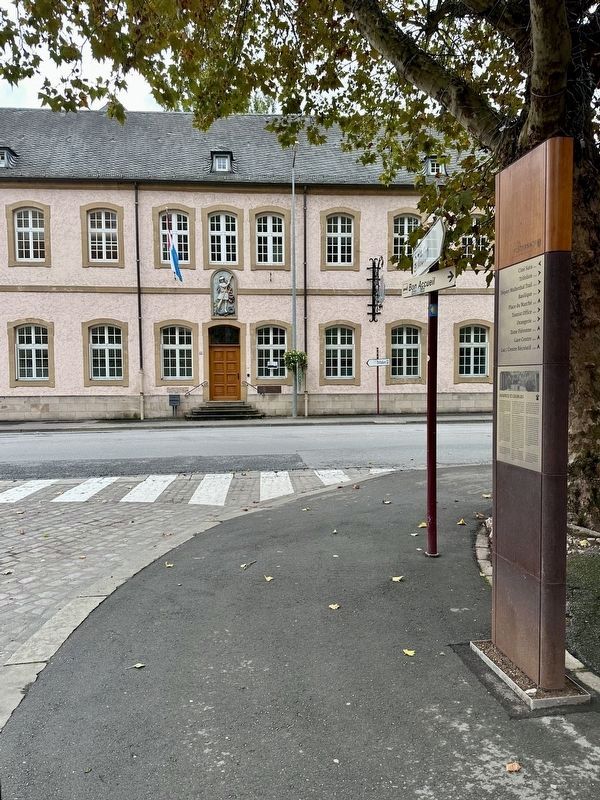
2. Hospice St Georges Marker - wide view
… with the former hospice building location visible in the background
The stone relief above the main entrance door depicts St. George as the dragon slayer, who has been venerated as a patron since 1360.
Topics. This historical marker is listed in these topic lists: Charity & Public Work • Science & Medicine. A significant historical year for this entry is 1796.
Location. 49° 48.769′ N, 6° 25.318′ E. Marker is in Echternach, Iechternach (Echternach). It is at the intersection of Rue des Escoliers and Rue du Pont, on the right when traveling east on Rue des Escoliers. Touch for map. Marker is in this post office area: Echternach, Iechternach 6436, Luxembourg. Touch for directions.

Regionally, this marker is in the Guttland and in the Mullerthal. Globally, it is in Europe, the European Union, the Benelux Low Countries, the Schengen Area, Western Europe, and the Western World. Historically, it finds itself in what was once the Roman Empire and specifically also the Holy Roman Empire.
Other nearby markers. At least 8 other markers are within walking distance of this marker: Berthold Kahn (a few steps from this marker); Herbert Kerngut (a few
Photographed by Andrew Ruppenstein, October 21, 2026
3. Former Hospice St Georges location with successor building
Photographed by Andrew Ruppenstein, October 21, 2026
4. Relief of St. George, above the entrance to the former hospice building successor
Credits. This page was last revised on November 4, 2026. It was originally submitted on November 4, 2026, by Andrew Ruppenstein of Lamorinda, California. This page has been viewed 4 times since then. Photos: 1, 2, 3, 4. submitted on November 4, 2026, by Andrew Ruppenstein of Lamorinda, California.
